

Belize: The remains of a Mayan teenager covered in crystals after being placed in an underground cave by the Mayans as a sacrifice.
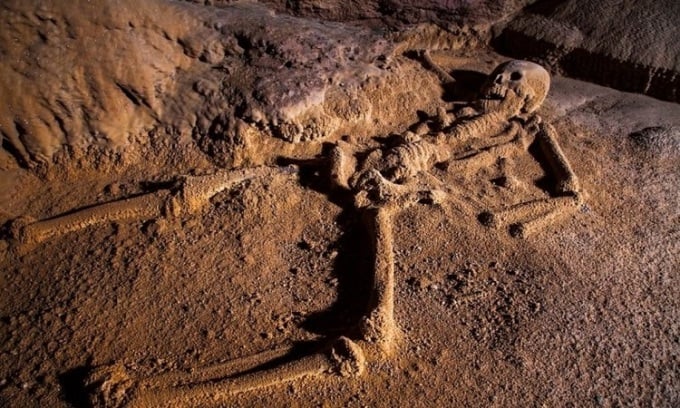
The remains of the teenager have been identified as Crystal Maiden. Photo: Amusing Planet
The Maya believed that caves, especially those stretching several kilometers underground, were gateways to hell or Xibalba, "the land of fear," where demons lived. They greatly feared hell and felt the need to appease the gods residing there by performing human sacrifices. One cave where the Maya performed this terrifying ritual is located in central Beliz, near San Ignacio, within the Tapir Mountains nature reserve.
The Actun Tunichil Muknal cave, or "ATM" for short, was first discovered in the late 1980s. The cave entrance is shaped like a sandy plain and is flooded with water. Remnants of sacrificial offerings are found right at the mouth of the cave, starting with snail shells and increasing in number as one moves deeper inside. Approximately 400 meters from the entrance is the main area containing the remains of 14 people, including the crystal-covered remains known as the Crystal Maiden.
The remains were initially believed to be those of a woman in her 20s, lying on her back with her mouth wide open and her entire skeleton covered in sparkling calcite crystals, leading researchers to name the deceased "Crystal Maiden." However, closer examination revealed the skeleton belonged to a 17-year-old teenager, sacrificed by an ancient Mayan priest more than 1,000 years ago.
The skeleton is also unusual because it is lying down and has two broken ribs. The research team believes that this person may have died in an extremely violent manner before being thrown onto the ground and lying there for at least 1,100 years. In fact, the skeleton has been there for so long that it is completely calcified.
Other skeletons lay in nooks and crannies or in open spaces, ranging from the remains of one-year-old children to adults in their 30s and 40s. The cave was filled with pottery, musical instruments, jewelry, figurines, and stingray bones. Many artifacts were also calcified on the cave floor. The Maya also carved the cave to create altars, faces, animals, or shadows.
Recent research on the ancient climate of central South America reveals that drought may have played a significant role in the collapse of this civilization. This likely explains the increased sacrificial activity in the late 9th century, before the fall of the Maya empire. Much of the artifacts discovered at Actun Tunichil Muknal remain in their original condition, making it one of the most intact caves containing Maya sacrificial remains.
An Khang (According to Amusing Planet/IFL Science )
Source link










































































Comment (0)