

Overcoming initial transitional challenges and pressures, the elected apparatus in Hai Phong is demonstrating efficient and streamlined operation, with a more responsible, proactive, and decisive approach to serving the interests of the people.
Lean operations
After reorganization, Hai Phong city has a natural area of 3,194.72 km2 and a population of 4,664,124 people; it comprises 114 commune-level administrative units, including 67 communes, 45 wards, and 2 special zones.
The merger of the two localities has opened up new development opportunities with a larger economic scale, population, and infrastructure; creating conditions to effectively utilize the potential and advantages in industry, logistics, seaports, services, agriculture, urban development, and marine economy.
Following the merger, Hai Phong places increasingly high demands on the leadership, administration, state management, and organizational capabilities of the political system in the new situation.
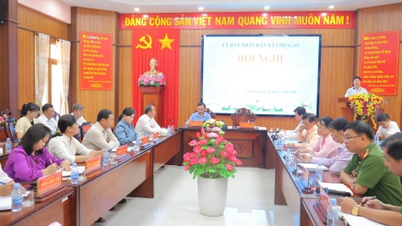
According to the Standing Vice Chairman of the Hai Phong City People's Council, Dao Trong Duc, closely following the direction of the Central Committee and the City Party Committee, the Party Committee of the City People's Council proactively coordinated with the City People's Committee and relevant agencies to comprehensively implement tasks related to consolidating the organizational structure, guiding the operation of the commune-level People's Councils, building operational regulations, reviewing coordination mechanisms, and promptly considering and deciding on issues within their authority to ensure that the implementation of the two-tiered local government model is carried out uniformly, smoothly, and in accordance with the law.
After nearly a year of operating the two-tiered local government model, the activities of the City People's Council and the People's Councils of communes, wards, and special zones have gradually stabilized, basically ensuring continuity and smooth performance in carrying out their decision-making and supervisory functions as prescribed by law.
The Standing Committee of the People's Council, the committees of the People's Council, and the representatives of the People's Council at all levels have proactively adapted to the requirements of their tasks under the new organizational structure; the quality of sessions, supervisory activities, voter outreach, and the consideration and decision-making on important local issues have gradually improved.
In particular, to concretize Resolution No. 57-NQ/TW of the Politburo on breakthroughs in the development of science, technology, innovation, and national digital transformation, the City People's Council has effectively implemented software to serve digital sessions. As one of the leading localities nationwide in implementing "paperless sessions," the port city has strongly transformed from traditional management thinking to modern governance.
Accordingly, the rate of documents digitally signed and processed entirely in a digital environment reached 90%. The rate of leaders at all levels being granted personal digital signatures reached 100%. The level of interoperability and electronic document exchange between the People's Council and Party, government, and Fatherland Front agencies reached 100%. It is estimated that approximately 90% of current session documents and reports are now in electronic form.
The process of receiving and handling voter petitions, as well as technological solutions, has been integrated through multiple modern channels. Through the voter feedback function on the electronic portal, the Office has coordinated the reception and processing of voter feedback and petitions in the digital environment...
The digitization of the entire process, from document submission and information retrieval to electronic voting, has created maximum space for debate and critical analysis of pressing issues of concern to voters. As a result, policy decisions are issued at optimal speed while ensuring quality and relevance to reality.
Hong Bang Ward is a leading locality in Hai Phong city in administrative reform and the application of information technology. This is an important foundation for the Ward People's Council to continue to develop and gradually innovate its working methods towards a modern and professional direction, meeting the requirements of local governance in the current period.
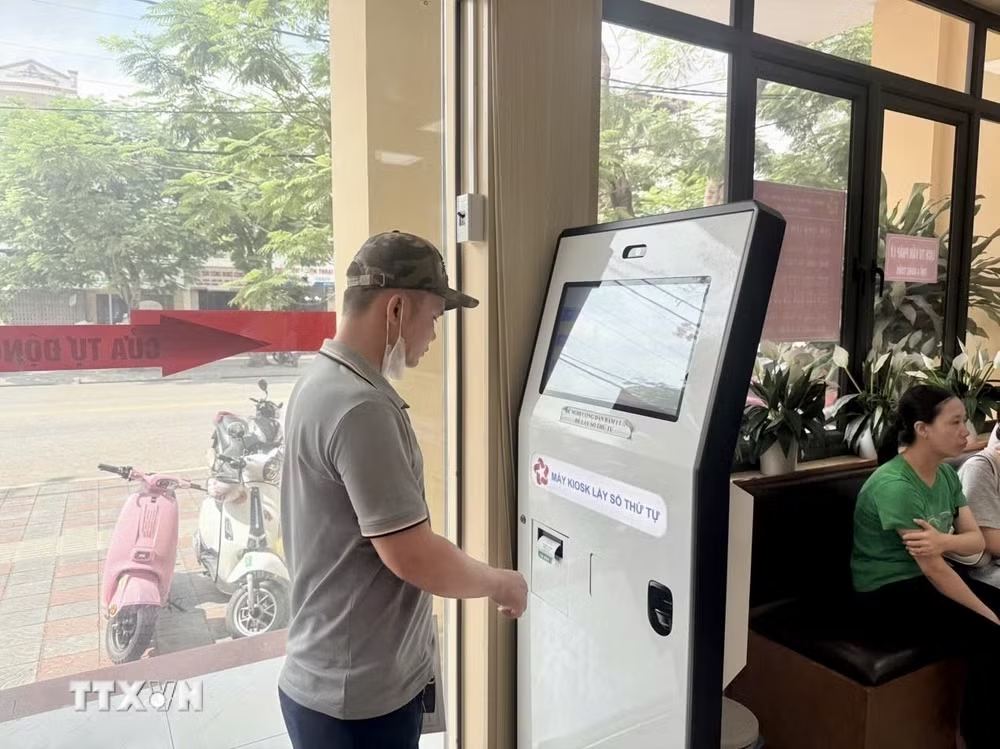
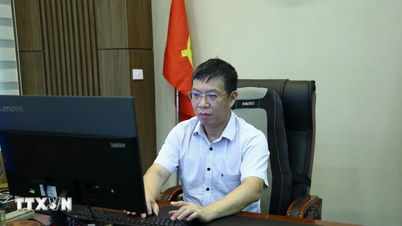
According to Nguyen Thi Phuong Thao, Vice Chairwoman of the Hong Bang Ward People's Council, immediately after implementing the two-tiered local government model from July 2025, the Standing Committee of the Hong Bang Ward People's Council directed the strengthening of information technology application in the management, operation, and organization of the People's Council's activities.
Building upon the digital transformation foundation of the former Hong Bang district, the People's Council of the ward proactively promotes the digitization of documents, utilizes document management and operational software on the network, gradually forming an electronic working method, creating a basis for building a "Digital People's Council" model, and aiming to implement "Digital Sessions" in the near future.
To date, 100% of the documents for the People's Council sessions are in electronic form and sent to delegates via digital platforms; the receipt, exchange, and processing of documents between the Standing Committee of the People's Council, the People's Council Committees, and relevant agencies are primarily carried out using document management software.
Reports, presentations, and draft resolutions are shared and updated promptly, enabling delegates to proactively study them before the session, shortening the time spent printing and distributing documents, and improving the quality of discussions and decisions.
The operational activities of the Standing Committee of the People's Council are gradually being carried out in an electronic environment, creating an important foundation for the process of building a "digital People's Council" model in the future.
The breath of life in each Resolution
In practice, the elected apparatus in Hai Phong operates efficiently, the voices of voters are conveyed more quickly, and policies are implemented more effectively and directly into daily life.
From July 1, 2025 to the present, the Hai Phong City People's Council has held 7 sessions and issued 131 resolutions (including 58 normative legal resolutions and 73 administrative resolutions); of which 26 resolutions are on finance and budget, 18 resolutions are on investment, 10 resolutions are on land, and 77 resolutions are on other fields.
At its sessions, the City People's Council promptly considered and decided on many mechanisms, policies, and solutions related to organizational structure, decentralization, delegation of authority, public investment, finance and budget, social welfare, and administrative procedure reform.
Many resolutions were issued promptly to address difficulties and obstacles arising during the implementation of the two-tiered local government model and to meet the requirements of socio-economic development.
In particular, to operate the two-tiered local government model, the City People's Council has issued many particularly important resolutions to ensure smooth operation, promote the effectiveness of decentralization, delegation of power, and authorization, making a significant contribution to the city government's leadership and management, and better serving the needs of citizens and businesses.
The quality of review by the People's Council Committees has improved; many issues are thoroughly scrutinized in terms of legal basis and authority, increasing critical analysis and policy consultation to ensure feasibility before being submitted to the People's Council for consideration and decision.
The Standing Committee of the City People's Council proactively coordinated, reviewed, and issued 298 resolutions appointing personnel to positions in the People's Councils and People's Committees of communes, wards, and special zones, and 114 resolutions appointing representatives of the former district-level People's Councils to participate in the People's Councils of new communes, wards, and special zones, ensuring that the local government apparatus operates stably, continuously, and without interruption...
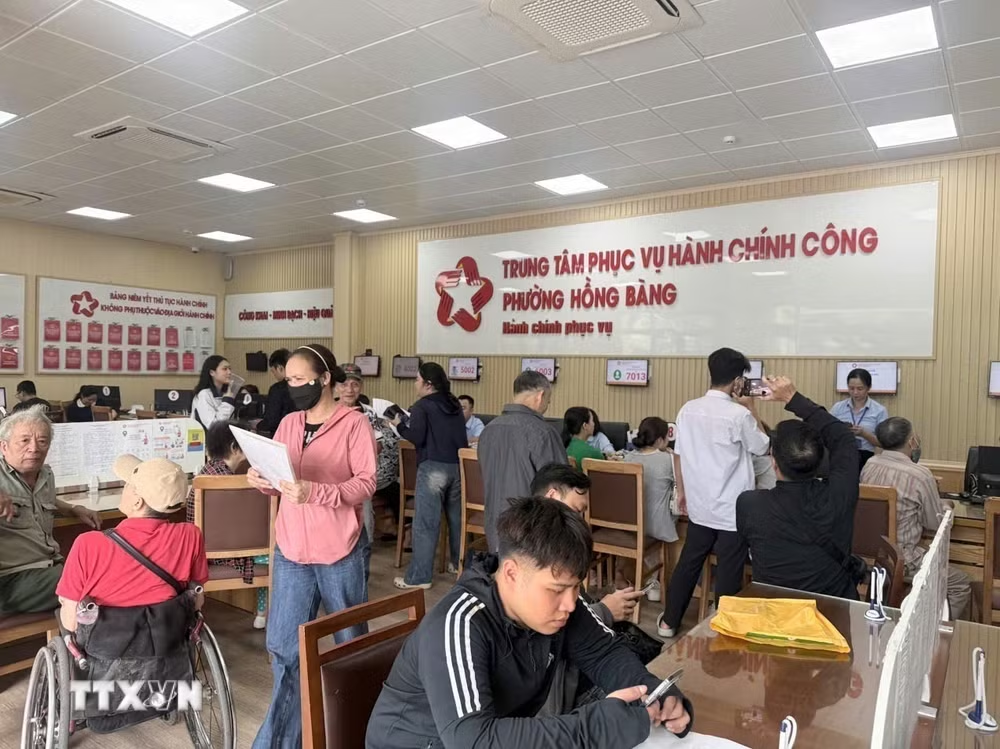
According to Le Ngoc Chau, Secretary of the Hai Phong City Party Committee and Head of the Hai Phong City National Assembly Delegation, in the context of the national reorganization, the organizational structure and personnel work of units and localities within the political system have quickly stabilized, become operational, and demonstrated effectiveness and efficiency. Socio-economic development continues to be stable at a high level; Hai Phong is the only locality nationwide to maintain double-digit GRDP growth for 11 consecutive years; national defense and security are maintained; social welfare policies are given attention; and people's trust in the political system is increasingly strengthened. This is an extremely important foundation for the city to continue entering a new phase of development, with new momentum, new determination, and new expectations.
During the 2026-2031 term, the global and domestic situations will continue to evolve rapidly, complexly, and unpredictably. However, Hai Phong also possesses fundamental advantages such as: the city's Party Committee, government, and political system are always united, stable, and effective; infrastructure is relatively well-developed; development potential and space are expanding; and the major strategic directions and thinking of the Central Government and the city have been largely established.
The city government apparatus needs to shift strongly towards action in accordance with the established motto: "Proactive implementation, leveraging momentum, achieving breakthrough growth," contributing to the realization of the goals of Resolution 45 of the Politburo on building and developing Hai Phong city until 2030, with a vision to 2045, and the directives of General Secretary and President To Lam at the working session with the Hai Phong City Party Committee on March 16, 2026, which is to build Hai Phong into a global-competitive megacity, a logistics and maritime economic center of the East Asian region, making an important contribution to the country's realization of the two 100-year strategic goals.
"To successfully achieve the set goals, the Party Committee, the government, the business community, and all sectors of the city's population need to continue to unite, with high determination, great effort, and decisive, focused actions. In particular, the Standing Committee of the People's Council, the People's Council Committees, the leaders of the City People's Committee, and the delegates of the 17th term must uphold their responsibilities and intellect, continue to innovate with a frank and open-minded spirit; and best fulfill their roles and responsibilities as elected representatives, worthy of the trust and expectations of the voters and people of the port city," City Party Secretary Le Ngoc Chau emphasized.
Source: https://www.vietnamplus.vn/hai-phong-hieu-qua-thuc-chat-tu-bo-may-dan-cu-tinh-gon-post1113016.vnp
![[Photo] Standing Committee member of the Party Central Committee Tran Cam Tu working with the Central Inspection Committee](https://vphoto.vietnam.vn/thumb/1200x675/vietnam/resource/IMAGE/2026/05/28/1779969579668_ndo_br_bnd-2495-jpg.webp)


































































Comment (0)