The central region of Vietnam is home to many unique cultural heritage sites of the Vietnamese people. Among them, the cities of Hue and Da Nang possess three exemplary UNESCO World Heritage sites: the Complex of Monuments of the Hue Imperial City – the capital of the Nguyen Dynasty for 143 years (1802-1945), Hoi An Ancient Town – a bustling international trading port dating back to the 16th century, and My Son Sanctuary – a valley dedicated to the worship of deities from various ancient Champa dynasties.
These cultural heritage sites have had a long journey from being forgotten and dilapidated to being revived and shining brightly.
To shed more light on this process, VNA reporters have produced a series of three articles on the topic: "The 'Gold Mine' of Central Vietnam Tourism : From Oblivion to Revival and Brilliance"
Lesson 1: The journey to rediscover the "glory" of cultural heritage
More than 30 years ago, the Hue Imperial Citadel Complex (Hue City), Hoi An Ancient Town, and My Son Sanctuary ( Da Nang City) were all seemingly "forgotten" sites, at risk of becoming ruins, with limited resources available for restoration, preservation, and protection.
A significant milestone in the revival of these sites was their designation as World Cultural Heritage sites by UNESCO in 1993 and 1999. Since then, these heritage sites of global significance have taken on a new appearance, experiencing a powerful resurgence.
Crossing the boundaries of ruins
The Hue Ancient Citadel Relics Conservation Center currently holds many documentary photographs of historical sites from decades ago, showing severe deterioration, desolation, and many areas becoming ruins.
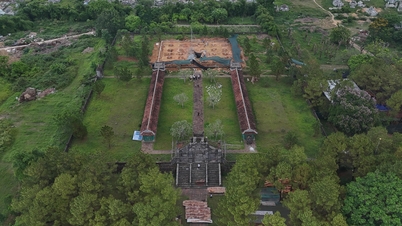
After the war, many unique architectural structures in the Forbidden City area were destroyed by bombs. Only 62 structures remain in the Imperial Citadel area compared to the original more than 130.
The citadel area now has only 97 structures, but they are also in a state of severe disrepair, with many bullet marks still deeply etched on the steles and the Nine Dynastic Urns to this day.
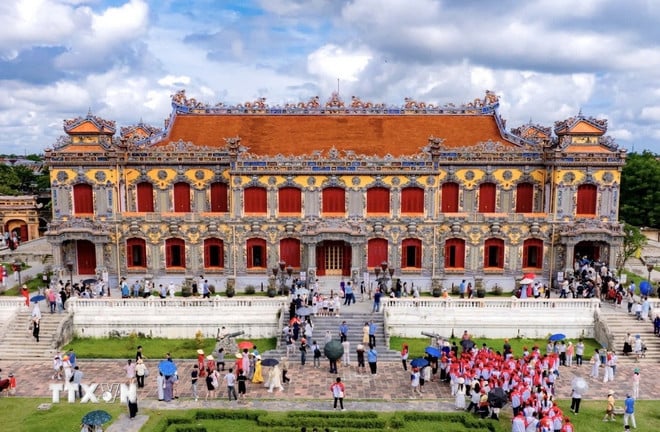
The Hue Imperial Citadel attracts a large number of visitors. (Photo: Van Dung/VNA)
In addition, the ancient capital of Hue is frequently negatively impacted by unusual weather patterns every year, including the floods of 1953, the storm of 1985, and the historic flood of 1999, which destroyed historical relics hundreds of years old.
According to Hoang Viet Trung, Director of the Hue Ancient Citadel Conservation Center, the Nguyen Dynasty – the last feudal dynasty of Vietnam – left behind a massive complex of historical relics for posterity, including citadels, palaces, tombs, and mansions.
However, the devastation of war and harsh weather have severely affected this heritage site. The Hue Imperial City was once heavily bombed, and many areas and architectural structures were wiped out.
The architectural structures remaining after the war are all degraded, damaged, and dilapidated to varying degrees, and the landscapes of the heritage sites are in a state of desolation, overgrown with vegetation. Immediately after the country's reunification, investment resources for heritage preservation were limited, leaving Hue's heritage sites facing numerous challenges and the risk of collapse.
Further upstream on the Thu Bon River (Da Nang), the My Son temple complex was formed in the late 4th century under the Bhadravarman I dynasty to worship the god Shiva and became the most important religious center of many ancient Champa dynasties for nine centuries (from the 4th to the 13th century) with its massive Hindu temple system.
However, from the 13th century onwards, when the Champa capital was moved south, My Son gradually lost its central role and was forgotten.
In the 19th century, the French discovered the temple complex, began studying the inscriptions, and organized archaeological excavations in the early 20th century.
The results of this process revealed 72 towers, temples, and other dependent structures, which French researchers divided into 13 tower complexes according to the letters A, B, C, D…N.
By 1969, the American imperialists had dropped bombs that devastated and severely damaged many temples and towers, including the 24-meter-high A1 tower, considered a masterpiece of Cham architecture in My Son.
Currently, only about 20 temples and towers remain in the entire site, and they are no longer intact. In the early 1980s, the My Son temple complex also faced a historical moment when it was on the verge of being submerged underwater when the local authorities planned a project to dam the river and build a reservoir for agricultural irrigation, but fortunately, this project was later halted.
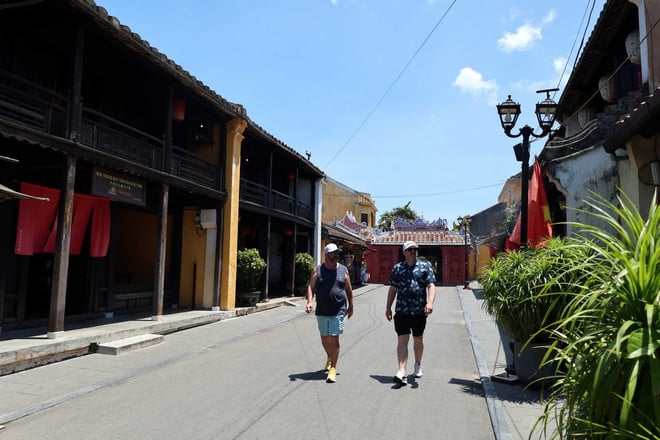
International tourists visit Hoi An Ancient Town. (Photo: Do Truong/VNA)
Heading south towards the Cua Dai estuary, the ancient town of Hoi An was formed and developed from the 16th century, and was once one of the busiest international trading ports in Southeast Asia.
From the 16th century onwards, merchants from China, Japan, the Netherlands, India, and Spain came here to trade goods. Therefore, the architectural structures and cultural values of Hoi An ancient town reflect a convergence of many Eastern and Western cultures.
After the country's liberation in 1975, the ancient town of Hoi An was preserved quite intact with more than 1,100 architectural relics, including houses, bridges, wells, markets, religious buildings such as communal houses, temples, mausoleums, shrines, assembly halls, and ancestral churches.
However, Hoi An ancient town has gone through a period of neglect, prejudice, and doubt about its value, and at one point, many religious structures faced the risk of destruction on the grounds of eradicating feudal culture.
Fortunately, at that time, thanks to the vision of the local leader, Mr. Ho Nghinh, then Secretary of the Quang Nam-Da Nang Provincial Party Committee, timely intervention prevented and preserved the ancient town of Hoi An from widespread destruction. As a result, the tangible and intangible cultural values of this town were gradually recognized and awakened, becoming a heritage of humanity in the future.
A model for heritage preservation.
Having overcome countless challenges of time and history, these three World Heritage sites have moved from a phase of "emergency rescue" to a phase of stable development, receiving international acclaim and serving as models for heritage conservation worldwide today.
Since being recognized as a World Heritage Site in 1999, many large-scale conservation programs have been implemented in Hoi An ancient town.
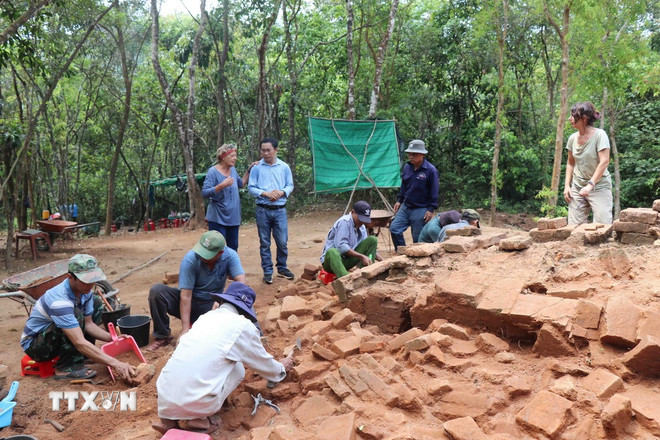
Italian and Vietnamese experts supervise the scientific dismantling and clearing process at the collapsed towers of the L group in preparation for restoration work. (Photo: Doan Huu Trung/VNA)
According to statistics, from 2008 to the present, more than 400 historical sites have been restored with a budget of approximately 150 billion VND, including funds from the state budget and contributions from the community. As a result, hundreds of ancient architectural structures have been saved from collapse, preserving their appearance for generations to come.
Da Nang city is aiming to complete 100% of the restoration work on dilapidated historical sites by 2030, and to create complete scientific documentation for all tangible and intangible cultural heritage.
By 2035, Hoi An will expand its heritage protection area, ensuring the integrity and outstanding universal value of the ancient town.
According to Pham Phu Ngoc, Deputy Director of the Hoi An World Cultural Heritage Conservation Center, most of the ancient houses in Hoi An are hundreds of years old and are privately or collectively owned.
During the implementation process, the authorities categorized the dilapidated structures requiring restoration according to the level of urgency and provided support ranging from 40% to 75% of the costs.
The Hoi An World Cultural Heritage Conservation Center is the unit responsible for developing the plan and directly implementing the restoration, ensuring it adheres to the principles of monument preservation and has received strong support from the local people.
Professor, Doctor, and architect Hoang Dao Kinh believes that the heritage city of Hoi An is being preserved intact, securely, and developing organically, opening up prospects for building Hoi An in the 21st century into a historical-ecological city with a very unique position in the system of Vietnamese cities.
According to experts, the conservation and promotion of Hue's cultural heritage has entered a stable and sustainable development phase.
The locality is currently recognized by UNESCO as a leader in the conservation and promotion of heritage values, with the potential to become a model center for conservation technology transfer in the Asia-Pacific region.
The Complex of Monuments of the Hue Imperial City was Vietnam's first World Cultural Heritage site to be recognized by UNESCO in 1993. A notable event marking a turning point in the recognition of the heritage's value and the beginning of the restoration and revival process occurred in 1981, when the then Director-General of UNESCO, Mr. Amadou Mahtar M'Bow, issued an appeal to save the cultural heritage of Hue.
Mr. Amadou Mahtar M'Bow emphasized that Hue's heritage is in a precarious state, teetering on the brink of extinction and oblivion. Only urgent rescue efforts by the Vietnamese government and the international community can save the ancient capital of Hue from this situation.
Following that appeal, a strong international campaign to support the ancient capital of Hue was launched. The outstanding and distinctive values of the Nguyen Dynasty's heritage were recognized and appreciated in accordance with their true significance. As a result, perceptions of this dynasty's heritage gradually changed in a positive direction.
Over 30 years after the Hue Imperial Citadel Complex was recognized by UNESCO as a World Cultural Heritage site, nearly 200 structures and components of structures have been restored, renovated, and enhanced in the field of preserving tangible cultural values.
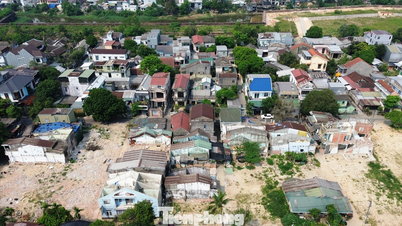
From 2019 to the present, Hue City has implemented the "Relocation of residents and land clearance project in Zone 1 of the Hue Imperial Citadel," with thousands of households being relocated to new residences, returning the land to the historical site.
In the process of the revival and elevation to World Cultural Heritage status of the ancient capital of Hue, the ancient town of Hoi An, and the My Son temple complex, the Polish architect Kazimierz Kwiatkowski (1944-1997), commonly known as Kazik, played a significant role and left his mark.
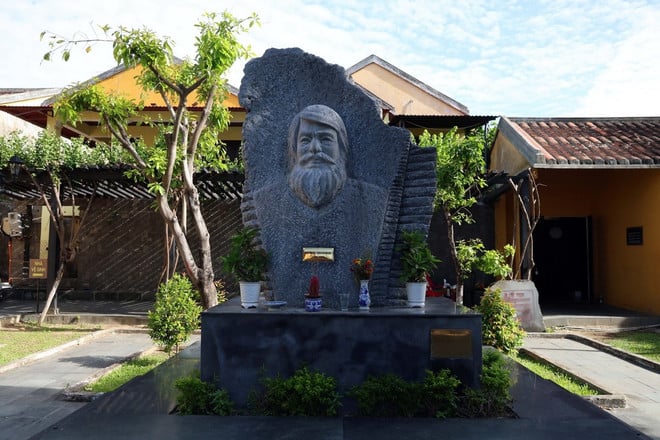
A statue of Polish architect Kazimierz Kwiatkowski (1944-1997) in Hoi An Old Town, commemorating and recognizing his contributions to Hoi An's cultural heritage. (Photo: Do Truong/VNA)
On Tran Phu Street in Hoi An's Old Town, there is a small park featuring a bust of architect Kazik, commemorating and acknowledging his immense contributions to the cultural heritage of Hoi An in particular and Vietnam in general.
Since the early 1980s, Mr. Kazik has visited Vietnam as part of a cooperation program between the two governments to assist Vietnam in researching and restoring the ancient Cham towers at My Son.
Later, Mr. Kazik came into contact with and recognized the outstanding global value of Hoi An Ancient Town and the Hue Imperial Citadel Complex. He then worked to persuade local authorities to preserve and protect the unique architectural relics there, while continuously striving to introduce and promote them to the world.
According to Nguyen Van Tho, Head of the Conservation-Museum Department (My Son World Cultural Heritage Management Board), architect Kazik and his colleagues made a significant contribution to restoring the appearance of the My Son temple complex from ruins, reinforcing the ancient towers to prevent collapse, and laying the foundation for subsequent restoration phases.
Architect Kazik strictly adheres to the school of archaeological restoration, which is to preserve the original monument and its original components intact, without altering or falsifying the monument. He primarily uses technical reinforcement methods to maintain the current state, only restoring parts if there is a scientific basis, and does not advocate for complete restoration or mixing the original with newly introduced reinforcements.
Between 1997 and 2022, research, conservation, and restoration of the My Son relics achieved many new successes thanks to cooperation programs between Vietnam and Italy and India in the restoration of the G, H, K, and A tower groups.
Currently, India is continuing to support the restoration of towers E and F during the period 2025-2030.
Source: https://www.vietnamplus.vn/hanh-trinh-tim-lai-hao-quang-cua-di-san-van-hoa-post1062044.vnp




![[Photo] General Secretary and President To Lam and the President of the Philippines hold talks.](https://vphoto.vietnam.vn/thumb/1200x675/vietnam/resource/IMAGE/2026/06/01/1780283481955_vna-potal-tong-bi-thu-chu-tich-nuoc-to-lam-va-tong-thong-philippines-hoi-dam-8797519-1429-jpg.webp)






























































Comment (0)