

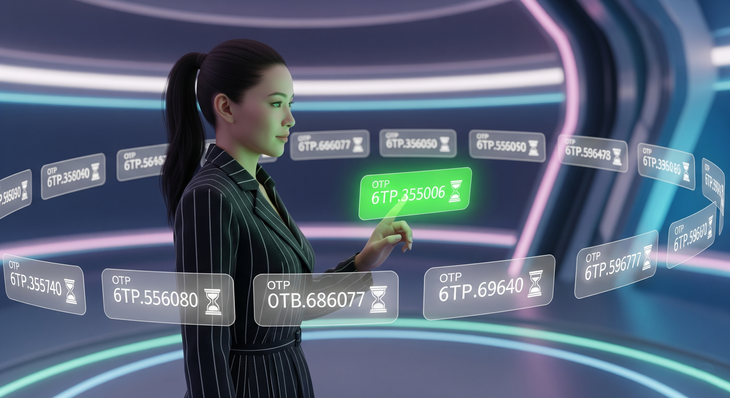
Each OTP code is unique at any given time and cannot be duplicated.
One-time passwords (OTPs) are a familiar element in today's digital world, from banking transactions to social media account security. Few people know that this fleeting sequence of numbers is generated using a complex encryption mechanism, combining real-time processing, private keys, and standardized algorithms.
Understanding how OTP works gives users greater peace of mind and provides insight into one of the most popular security methods today.
The 'OTP Wall'
OTP stands for One Time Password, meaning a password that can only be used once. This code usually consists of 6 digits, is randomly generated, and appears in operations such as bank transfers, social media logins, or account verification.
What makes OTP special is its extremely short validity period, only 30 to 60 seconds. After that time, the code expires and must be regenerated if not used. This minimizes the risk of being exploited by malicious actors or reusing old codes.
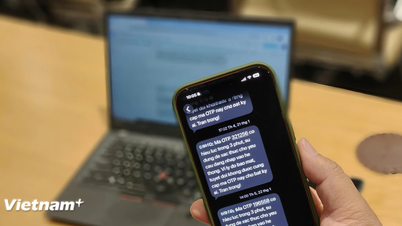
Many banks in Vietnam now use OTP (One-Time Password) to verify online transactions. Users receive a code sent to their phone and must enter it correctly within a given timeframe. Similarly, platforms like Google and Facebook also use OTP for two-factor authentication to protect accounts.
Despite its simple and fleeting appearance, OTP is one of the most effective security measures available today. The brevity of this code is not accidental, but is controlled by a tightly controlled code generation system, based on specific timing and encryption principles.
One code, one use: Where did it come from?
Most current OTP codes are generated using the TOTP mechanism, which stands for Time-Based One-Time Password. This is a type of code based on real-time clocking, usually lasting only about 30 seconds before being replaced by a new code.
Besides TOTP, there is another mechanism called HOTP, which uses a counter instead of time. However, HOTP is less common because the code does not automatically expire after a fixed period.
To generate each OTP code, the system requires two elements: a fixed secret key assigned to each account and the current time according to the system clock. Every 30 seconds, the time is divided into equal segments and combined with the secret key to generate a new code. Therefore, no matter where you are using the authentication application, as long as the time on your device matches the server time, the OTP code will be correct.
Each 30-second interval is considered a "time window." When the time moves to the next window, a new code is generated. The old code is not deleted, but it automatically becomes invalid because it no longer matches the current time. This mechanism means that each OTP code can only be used at that specific moment and cannot be reused after a few tens of seconds.
The code generation process follows the international standard RFC 6238, using the HMAC SHA1 algorithm for encryption. Although only 6 digits are generated, the system is complex enough to make guessing correct nearly impossible. Each user has a unique key, and the code generation times are different, so the probability of a duplicate code is almost zero.
Interestingly, applications like Google Authenticator or Microsoft Authenticator can generate OTP codes without an internet connection or cellular signal. After receiving the initial private key, the application only needs to synchronize with the correct time to function independently. This increases flexibility while still ensuring security during the authentication process.
Risks associated with OTP codes and how to protect yourself.
OTP is an effective layer of protection, but it's not absolutely secure. In many recent scams, criminals didn't need sophisticated attacks; they simply tricked victims into providing their OTP codes.
Fake calls impersonating bank employees, fraudulent text messages with fake login links, or fake prize notifications are all aimed at obtaining OTP codes within their validity period.
Some malware can even silently read messages containing OTPs if the user has granted permission to an unknown application. This is why more and more services are switching to using apps to generate their own codes, instead of sending them via text message. This method makes the codes less dependent on the mobile network and more difficult to intercept.
To protect your account, users should absolutely never share their OTP with anyone. If you receive an unusual call, message, or link requesting a code, stop and check carefully. Using two-factor authentication with apps like Google Authenticator or Microsoft Authenticator is also a significant way to enhance security.
Source: https://tuoitre.vn/he-lo-bi-mat-ma-otp-20250704115450312.htm

![[Photo] General Secretary and President To Lam works with the Party Committee of the Ministry of Health on the work of Vietnamese traditional medicine.](https://vphoto.vietnam.vn/thumb/1200x675/vietnam/resource/IMAGE/2026/05/20/1779294323718_a1-bnd-2978-3319-jpg.webp)

![[Image] "Journey of Hope" promotes the organ and tissue donation movement in Vietnam.](https://vphoto.vietnam.vn/thumb/1200x675/vietnam/resource/IMAGE/2026/05/20/1779294400833_1-8910-jpg.webp)



































































































Comment (0)