

.jpg)
From "repair" to personalized development support
Associate Professor Vo Van Minh, Rector of the University of Education - Da Nang University, believes that ASD is not an individual's "fault" but rather a form of differentiated development within the diverse spectrum of human beings.
“ASD students are not outside the world . They are a part of the world, it's just that their way of perceiving and interacting is different from ours,” Associate Professor Vo Van Minh stated.
From this perspective, attempting to "normalize" autistic children at all costs can put additional pressure on both the children and their families. According to Associate Professor Vo Van Minh, each autistic child is an independent individual, and there is no "general formula" for intervention.
Therefore, rigid intervention models are unlikely to be effective and may even stifle children's inherent strengths. Instead of imposing common standards, it is necessary to build a suitable environment for children to develop in their own way.
We can't force children to become a version of ourselves, but we can learn how to enter their world. "Understanding who your child is" is more important than finding the best method.
Assoc. Prof. Dr. Vo Van Minh
According to experts, the current trend is shifting from a "fix-up" model to a "personalized development support" model, focusing on leveraging strengths and creating conditions for children to adapt to their living environment. As awareness changes, support activities will also be more effectively directed.
.jpg)
From a psychological perspective, Associate Professor Dr. Nguyen Thi Hang Phuong, Department of Educational Psychology, University of Pedagogy - Da Nang University, believes that the mental state of parents directly influences the development of children.
"If parents are stressed, anxious, or exhausted, those emotions will quickly transfer to their children," shared Associate Professor Dr. Nguyen Thi Hang Phuong.
According to her, supporting parents, from childcare skills to mental health care, should be considered an integral part of intervention programs. This is also a trend being adopted by many countries as they shift the focus from "child therapy" to "supporting the entire family ecosystem."
In reality, many parents face psychological shock upon receiving a diagnosis, leading to anxiety, financial pressure, and disruptions in family life.
Associate Professor Vo Van Minh argues that parents also need support as independent entities, not just as "caregivers." "If parents are exhausted, all intervention efforts will be affected," he said.
Given this reality, building parent support networks, skills training programs, and community connections are considered necessary steps to enhance the effectiveness of long-term support.
Family - a crucial factor in supporting children with autism.
Experts agree that the family plays a crucial role in supporting children with autism.
Dr. Lam Tu Trung, Vice President of the Vietnam Association of Psychotherapy, emphasized the "irreplaceable" role of parents. According to him, intervention time at specialized facilities each day is only about 45 minutes to an hour, while the majority of a child's remaining time is spent at home.
"For the remaining time, who will do it? It's the family. If parents don't understand and don't continue providing support at home, then all efforts will almost be in vain," Dr. Trung said.
Therefore, the family should not only be a place of care but also a "natural therapeutic environment," where children practice communication, behavioral, and emotional skills in their daily lives. The perseverance and love of parents are considered crucial factors in the effectiveness of interventions.
In addition, Dr. Lam Tu Trung also emphasized the importance of guiding siblings to participate in caregiving, ensuring fairness and understanding.
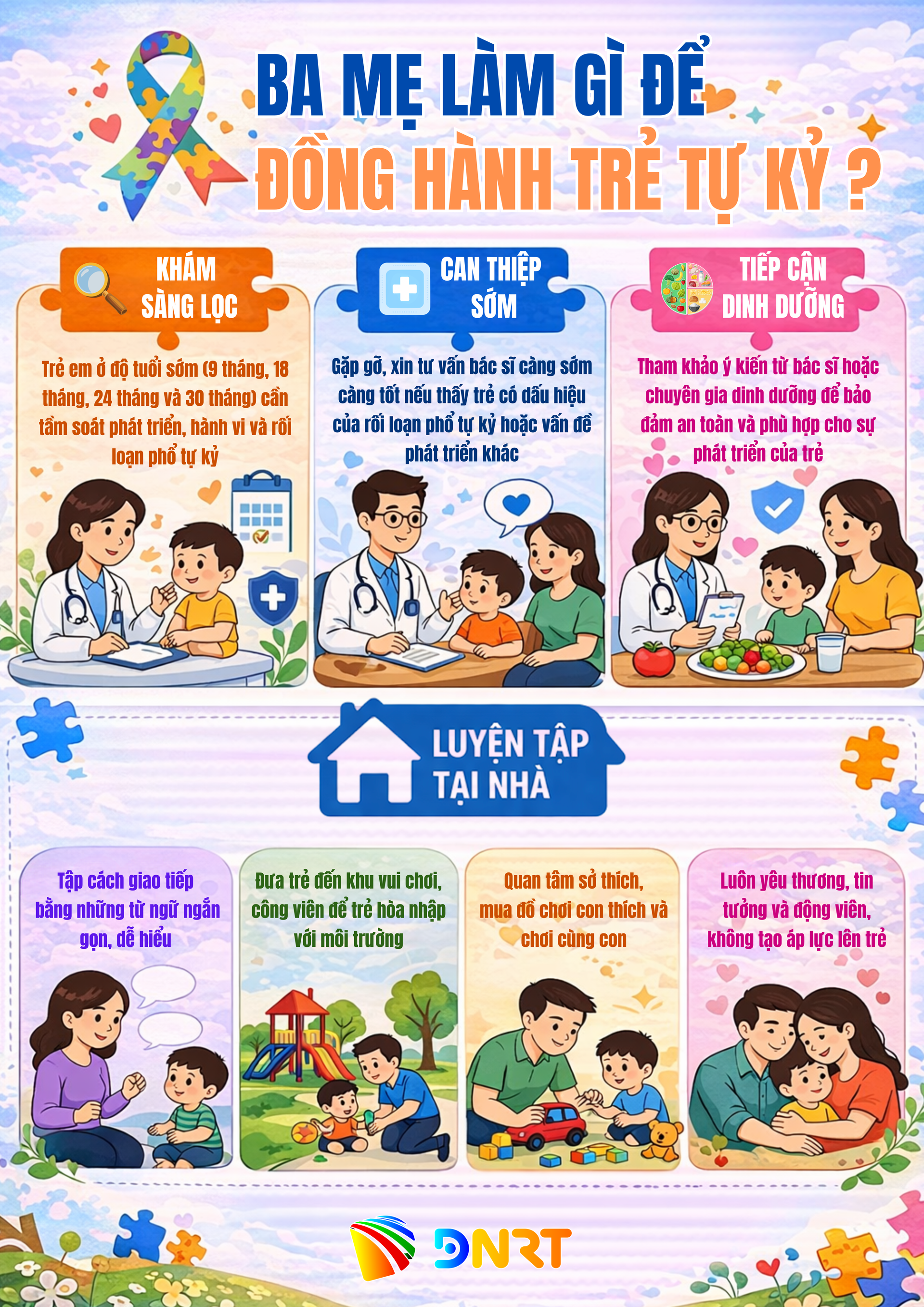
Sharing the same view, Associate Professor Dr. Le My Dung, Head of the Department of Educational Psychology and Social Work, University of Education - Da Nang University, believes that the family is the "first and most important link" in the ecosystem supporting children with ASD.
"Parents are the closest people to their children and understand them best. When equipped with the right knowledge and skills, they can become the best teachers for their children," Associate Professor Dr. Le My Dung stated.
According to experts, for the journey of children with ASD to be effective in the long term, coordination between family, school, and society is necessary. In this, the family plays a central role, while educational institutions and professional organizations play a supporting and guiding role.
1 in 100 children have ASD.
ASD is a neurodevelopmental disorder that affects communication, language, and the ability to establish social relationships.
According to the World Health Organization (WHO), on average, 1 in 100 children is diagnosed with ASD.
In Vietnam, there are no complete statistics. According to the General Statistics Office (2019), there are approximately 6.2 million people with disabilities aged 2 years and older nationwide, of which an estimated 1 million are people with ASD.
Studies show that the number of children with ASD is on the rise, accounting for approximately 30% of children with learning disabilities.


Source: https://baodanang.vn/hieu-dung-de-dong-hanh-tre-tu-ky-3331274.html
![[Photo] General Secretary and President To Lam and the President of the Philippines hold talks.](https://vphoto.vietnam.vn/thumb/1200x675/vietnam/resource/IMAGE/2026/06/01/1780286997787_anh-man-hinh-2026-06-01-luc-11-09-43.png)
![[Photo] Reception to welcome General Secretary and President To Lam and his wife on their State visit to the Philippines](https://vphoto.vietnam.vn/thumb/1200x675/vietnam/resource/IMAGE/2026/06/01/1780295488620_vna-potal-chieu-dai-chao-mung-tong-bi-thu-chu-tich-nuoc-to-lam-va-phu-nhan-tham-cap-nha-nuoc-toi-philippines-8798060-7855-jpg.webp)
































































Comment (0)