

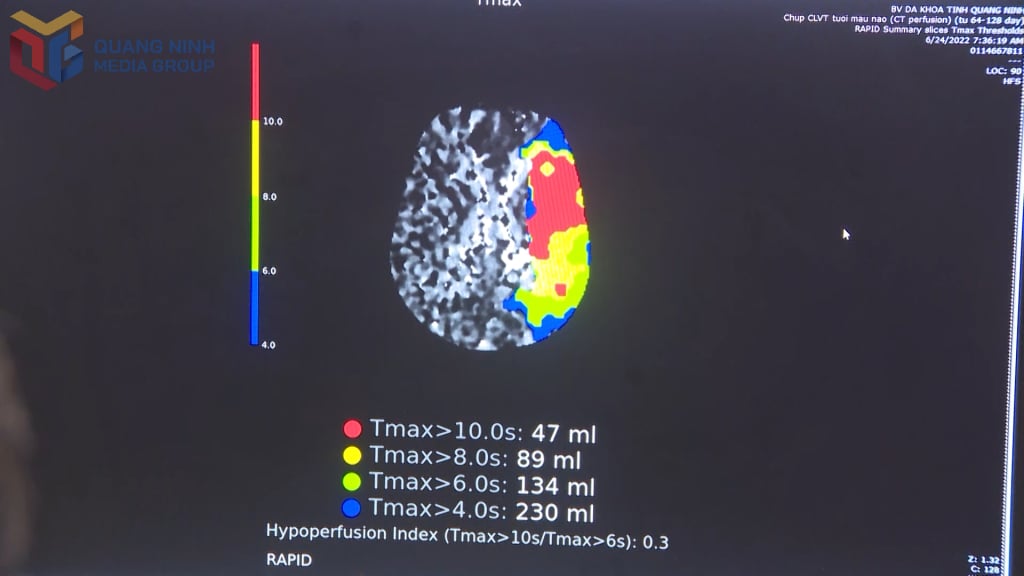
Rapid is an artificial intelligence software developed by Stanford University (USA), currently widely used in many countries with advanced healthcare systems. This software can analyze brain images from CT or MRI scans in a very short time, from just 30 seconds to 2 minutes, and provide accurate analysis of the location of lesions, the volume of necrotic brain tissue, and areas at risk of damage in the following hours.
At Quang Ninh Provincial General Hospital, the application of Rapid has yielded significant results in the emergency care and treatment of stroke. Dr. Ngo Quang Chuc, Head of the Diagnostic Imaging Department, stated: "Using Rapid software, we can not only identify the location of the lesion and affected blood vessels, but also accurately quantify the core of the lesion. This helps the medical team make treatment decisions much faster and more accurately."
Notably, the Rapid software application has extended the "intervention window" for stroke patients to 24 hours, instead of just the first 6 hours as before. As a result, many patients, even those admitted late, have a better chance of survival and minimizing severe long-term consequences.
According to statistics, the Provincial General Hospital receives 250-300 cases of stroke each year, with the majority of patients arriving after the "golden hour." Before Rapid, for late-arriving cases, doctors could only provide medical treatment and could not perform thrombectomy. However, thanks to this AI software, the opportunity for effective treatment for patients has been significantly expanded.
The Director of the Provincial General Hospital, Dr. Nguyen Ba Viet, shared: "Since the introduction of Rapid, even for cases admitted within the first 6 hours, we can accurately assess the feasibility of intervention and have saved many lives that were previously impossible."
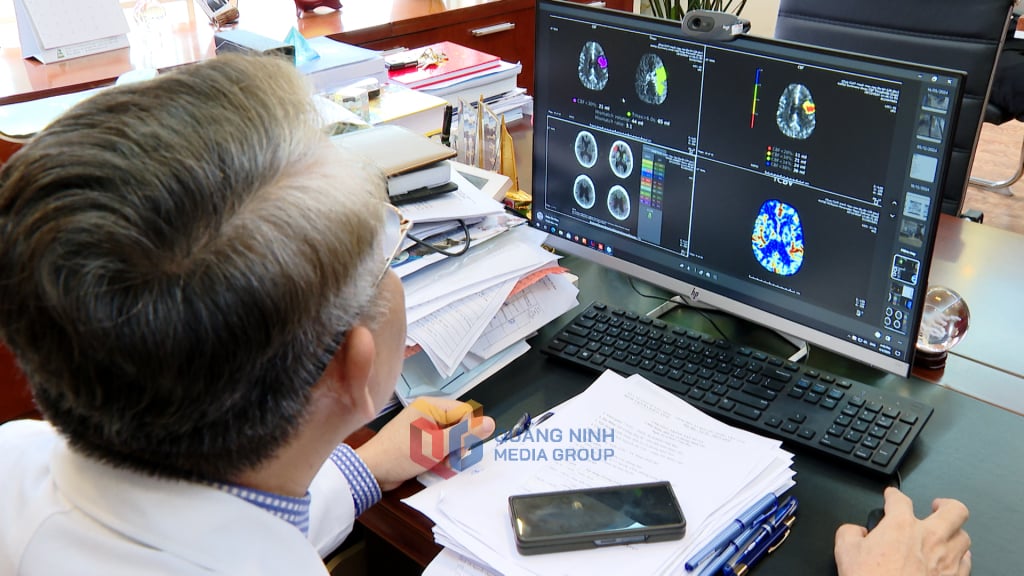
Beyond its fast and accurate analysis capabilities, Rapid software can also send results directly to doctors' accounts within the treatment team via smart devices, optimizing decision-making time, especially in emergency cases.
The application of artificial intelligence in healthcare, particularly Rapid technology, is contributing to bringing Quang Ninh's healthcare sector closer to the modern trend of digital transformation. This is also clear evidence of the implementation of important directions outlined in Resolution 57 of the Politburo on the development of science, technology, and innovation in the context of the fourth industrial revolution.
In the coming period, the Provincial General Hospital will continue to promote research and application of high technology and digital technology in its professional work. This is not only an inevitable trend but also an important driving force to improve the quality of medical examination and treatment, contributing to better protection and care of people's health.
Source: https://baoquangninh.vn/quang-ninh-hieu-qua-tu-ung-dung-tri-tue-nhan-tao-trong-dieu-tri-dot-quy-3353816.html


![[Photo] Prime Minister Pham Minh Chinh attends the Conference on the Implementation of Tasks for 2026 of the Industry and Trade Sector](/_next/image?url=https%3A%2F%2Fvphoto.vietnam.vn%2Fthumb%2F1200x675%2Fvietnam%2Fresource%2FIMAGE%2F2025%2F12%2F19%2F1766159500458_ndo_br_shared31-jpg.webp&w=3840&q=75)



























































































Comment (0)