

For the Vietnamese, the snake, present in the treasure trove of folk culture, is creatively and vividly portrayed with various variations. These range from a system of names – similar to general names based on the snake's survival characteristics and appearance, such as cobra, tiger snake, rat snake, green snake, rattlesnake, etc. – to names reflecting local customs or dialects like "chằn tinh" (monster), "giao long" (dragon), "thuồng luồng" (a mythical serpent), "mãng xà" (a type of serpent), "ông giải" (a type of snake), and even "con rồng" (dragon),... Furthermore, the methods of worship and veneration through religious practices in sacred spaces in different localities provide the basis for the imagery that inspires creative verbal art (fairy tales, folk songs, proverbs, idioms) and folk visual arts across generations.
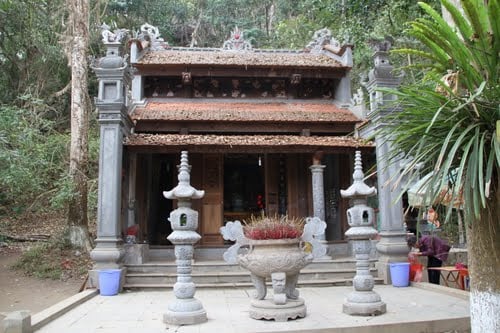
The temple dedicated to the snake god is located in Cam Luong commune, Cam Thuy district, Thanh Hoa province .
1. The image of the snake in folk art and language.
For the Vietnamese people, perhaps the earliest manifestation and expression of the snake in their subconscious is through the Giao Long (dragon) variant in the legend of Lac Long Quan and Au Co, a story recreating the origins of the Vietnamese nation and the legend of Saint Giong slaying the Giao Long to save his mother during the Hung Kings era, demonstrating the filial piety of a son always devoted to his people and country. Entering the world of fairy tales, snakes also appear in many variations, such as pythons or ogres.
Through generations, Vietnamese people have passed down the famous legend of Thạch Sanh, which features the haunting image of a serpent demon that had practiced its magic for many years, constantly harming people and forcing villagers to sacrifice a human life to it annually. Ultimately, it was defeated by the kind and courageous hero Thạch Sanh. The collection of Vietnamese folk tales (by Nguyễn Đổng Chi) includes more than a dozen stories mentioning the image of snakes in various forms such as dragons, serpents, serpent demons, and snake spirits. Some stories portray snakes as benevolent creatures that help villagers, earning their praise and worship, while others directly portray snakes as evil creatures that harm innocent people, causing them to be shunned and hated.
Besides the presence of snakes with various roles and name variations in the treasury of legends and fairy tales, we can also clearly identify the image of the snake as received and reflected in the treasury of Vietnamese proverbs, idioms, folk songs, and children's rhymes.
Behind every proverb, idiom, or folk song lies the multifaceted image of the snake in the various aspects and corners of people's lives, from different contexts, through metaphorical or direct expressions revealing different emotions and attitudes. Therefore, even in contemporary society, people still recite and use familiar proverbs and idioms as explanations or reflections on people, life, and the world.
These are familiar examples of proverbs and idioms: "A Buddha's mouth but a snake's heart" (A hypocrite who speaks kindly but harbors malicious intent to harm others); "A tiger's mouth and a venomous snake" (Referring to a dangerous and treacherous place where anyone who goes will be dismembered and their body torn apart, unable to return alive); "Adding legs to a snake" (Referring to unnecessary, superfluous, and counterproductive actions); "A tiger carrying away a snake and biting" (If not one misfortune, then another)...
And in the world of folk songs, nursery rhymes, and chants, the snake is always cited or borrowed as an image to illustrate the thoughts, feelings, and attitudes of people in relation to their ecological, humanistic, and socio-cultural environments. This could be the cheerful, innocent singing of laborers during their breaks in the fields: "When will March come, when frogs bite the snake's neck and drag it out into the field?"; "Dragons and snakes ascend to the clouds, there's a Nuc Nac tree, and a glorious house!"
It is also possible that the image of the snake was borrowed to express attitudes towards social relationships, awareness of the disparity between rich and poor, thereby conveying a subtle yet profound and meaningful warning: "Hardship is in the tavern and the hut; Aunt and Uncle don't ask why; Wealth is far away in Laos; Tigers carry snakes and bite, seek refuge quickly."
But often, the image of the snake is borrowed to spark songs expressing affection, subtle resentment, gentle yet profound and culturally rich sentiments, even in the context of a village festival: "The cobra lies on the rehmannia root; The heavenly horse eats the celestial grass; I blame my deceitful and deceitful lover; He cast me down to the underworld and abandoned me!"
Or in a heartfelt, simple yet heartwarming confession of faithful love: "We are like two intertwined snakes; let the water flow as it may, we will support each other!...".
And so, in the world of folk art, through the system of legends, fairy tales, folk songs, proverbs, idioms... it is easy to identify the image of the snake with its diverse variations, sometimes associated with evil, cunning, deceit (venomous venom, living in darkness), difficult to befriend; but there are also times when the snake is considered a helpful friend in times of material or emotional hardship, especially for those at the bottom of society.
Because of the characteristics of snakes that make them difficult for humans to befriend, through life experiences, the human subconscious has developed a fear of snakes, a desire to befriend them, a hope that snakes will not harm humans, and has even deified snakes, bringing them into sacred spaces in temples and considering them as supportive deities in the cultural and spiritual life of the community across generations.
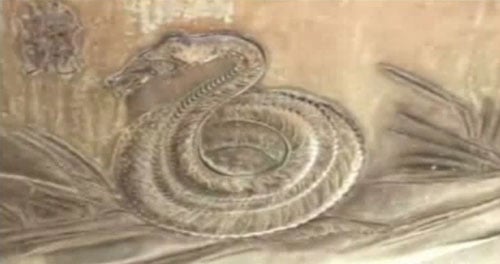
Image of a serpent on the Nine Dynastic Urns of the Nguyen Dynasty. Archival photo.
2. The image of the snake in religious practices
Since the dawn of humanity, the worship of snakes has existed and persisted in many ancient civilizations. Following this humanistic belief, the worship of snakes has been a primitive belief of the Vietnamese people, signifying the worship of their ancestors and the water deity. As a people with agricultural origins in rice-farming civilization, their livelihoods depended on a delta region crisscrossed by numerous rivers connecting rural areas. This provided a favorable environment for snakes to thrive and interact with human life.
Possessing both positive attributes (contributing to cuisine, medicinal remedies) and negative attributes (venom that kills humans and animals), snakes have been idealized and deified, becoming a mystical, supernatural force capable of helping humans preserve their lineage, bringing favorable weather and bountiful harvests, while at times becoming a destructive force that brings floods and death. Therefore, people both hunted snakes for culinary purposes, medicinal uses, and as omens of good fortune; and at the same time, feared and revered them as deities, bringing them into temples for worship, offering incense year-round with the hope of praying for good fortune, peace, and prosperity for generations to come.
Therefore, numerous snake temples, with their status and responsibility of worshipping water deities, have sprung up along the Red River, Cau River, Duong River, Thai Binh River, and seemingly almost all the large and small rivers of the Northern Delta, especially those rivers prone to flooding and dike breaches annually. They then spread upstream along the rivers and tributaries of the northwestern midland and mountainous regions, and downstream into the South Central and Southern regions, as part of the nation-building and religious practices of the various ethnic groups within this multi-ethnic nation.
In the sacred spaces of temples, shrines, and palaces, whether dedicated to historical or supernatural figures, directly worshipping snake gods or other mythical deities, there is always the presence of symbolic "snake figures" guarding prominent positions outside the main hall or in the mysterious inner chambers.
Or, if not explicitly depicted in the sacred spaces of temples, the serpent is rumored to be associated with the circumstances of pregnancy and childbirth of mothers, who gave birth to children under particularly strange and unusual circumstances, becoming a harbinger of the appearance of heroic and divine figures with great achievements contributing to the nation's founding or defense (the legends of the Truong Hong and Truong Hat temples along the Cau, Thuong, and Duong rivers; the legend of the Linh Lang temple under the Ly dynasty; the legend of the Phung family temple on the Luc Dau river; the legend of the Linh Lang - Long Vuong temple in Ha Tinh, etc.).
And so, the snake entered the folk consciousness as the lord of desire and reproduction, becoming a powerful deity, bearing various names, from Giao Long to Thuong Luong or Ong Giai, always associated with the origins of maternal motifs, imprinted in specific circumstances to give birth to extraordinary talents for the homeland and the country.
Against the backdrop of the presence of snake figures or images in sacred spaces in rural villages, people have revered and honored snakes, elevating them to the status of guardian deities residing in temples, wielding authority and power over an entire village or group of villages. From this, the image of the snake has been embellished, transforming it into a crested serpent deity with extraordinary strength and authority over the community, assisting villagers and even kings in defeating enemies and overcoming calamities. The snake is often bestowed with high-ranking titles, such as Supreme or Middle-ranking deities, a common sight in tens of thousands of Vietnamese villages.
Also stemming from worldviews and philosophies of life that include the presence of imagery – the image of the serpent deity – in the Vietnamese community, the practice of worshipping goddesses and then mother goddesses (most notably the worship of the Three/Four Realms Mother Goddesses) has been associated with the presence of snake imagery in temples, shrines, and pagodas in thousands of Vietnamese villages.
In almost all sacred spaces dedicated to the Mother Goddess, whether it's the shrine of Saint Mother Lieu Hanh or other Mother Goddesses, shrines to the Emperors, the female deities, the young female deities, the officials, etc., one always sees the presence of a pair of divine snakes intertwined on the crossbeam of the shrine (sometimes a pair of green snakes, sometimes a pair of white or yellow snakes), their heads facing the main deity as if in reverence and also as if ready to unleash immense mystical energy powerful enough to protect and assist the devotees.
The very presence of the snake imagery contributes to the sacralization of the role of the main deities in the temple, the Holy Mothers, elevating them to a position of supreme power, winning the faith of devotees and all beings in general – those who gather in the sacred space before the altar of the Holy Mothers with the aim of praying for wealth, prosperity, peace, protection from all calamities and illnesses, and seeking energy for creativity and success in life, both now and in the long term.
REFERENCES
1. Nguyen Dong Chi (1976), Treasury of Vietnamese Folk Tales, Social Sciences Publishing House.
2. Tran Lam Bien - Trinh Sinh (2011), The world of symbols in the cultural heritage of Thang Long - Hanoi; Hanoi Publishing House.
3. Jean Chevalier & Alain Gheerbrant (1997), Dictionary of World Cultural Symbols, Da Nang Publishing House, Nguyen Du School of Creative Writing.
4. Dang Van Lung (1991), Three Holy Mothers, National Culture Publishing House.
5. Nguyen Ngoc Mai (2013), The historical and valuable spirit possession ritual, Culture Publishing House.
6. Ngo Duc Thinh (ed. 2002), Mother Goddess Religion in Vietnam, Culture and Information Publishing House.
7. Legends of the Gods of Hanoi (1994) Culture and Information Publishing House.
8. Prof. Dr. Cao Ngoc Lan, PhD Candidate Cao Vu Minh (2013), Understanding the spiritual culture of the Vietnamese people; Labor Publishing House.
Prof. Dr. Bui Quang Thanh
Vietnam National Institute of Culture and Arts
Source: https://baophutho.vn/hinh-tuong-con-ran-trong-van-hoa-viet-227051.htm

![[Photo] General Secretary and President To Lam meets with National Assembly delegates from ethnic minorities.](https://vphoto.vietnam.vn/thumb/1200x675/vietnam/resource/IMAGE/2026/04/20/1776696701056_a1-bnd-8331-3342-jpg.webp)
![[Image] National Assembly discusses the implementation of the socio-economic development plan.](https://vphoto.vietnam.vn/thumb/1200x675/vietnam/resource/IMAGE/2026/04/20/1776696707422_ndo_br_img-20260420-185419-jpg.webp)




























































Comment (0)