

 On an area of over 3,000 square meters of low-yield rice land, Ms. Xa Thi Sang's family has switched to growing pumpkins for their shoots, which brings in 3 to 5 times more value than growing rice.
Effectiveness from practice
Not only Ms. Sang's family, but in Mo Da hamlet, Kim Boi commune, many households have escaped the predicament of struggling to produce crops by converting water-scarce rice fields to vegetable cultivation. These plots, which once yielded low productivity, have now become areas for commercial production, providing stable income and contributing to improving the lives of many families.
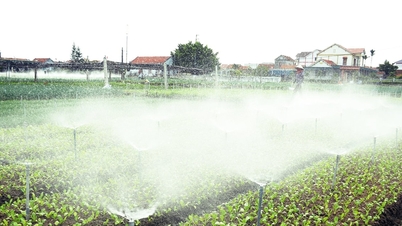
Similarly, the model of converting inefficient rice fields to growing Black Grapes in Thanh Son commune has made a significant impact. Thanks to the application of automatic irrigation systems, plastic mulching, and advanced care procedures, the grapevines grow well and yield stable productivity. Some households even combine this with experiential tourism , allowing visitors to tour and pick grapes on-site, thereby increasing income per unit of cultivated land.
In Phong Chau ward and Phung Nguyen commune, the conversion of rice land to the cultivation of safe vegetables and cash crops has become the main direction. Many areas that previously only produced one or two rice crops with low efficiency have now been planned as vegetable growing zones according to VietGAP standards, linked with cooperatives and businesses that guarantee product purchase. Income per hectare has increased many times compared to traditional rice cultivation, while also creating regular jobs for local laborers.

Many households in Mo Da hamlet, Kim Boi commune, have boldly converted their low-yield rice fields to cultivate cash crops, bringing in higher incomes.
According to Mr. Nguyen Van Quan, Deputy Director of the Department of Agriculture and Environment, the restructuring of crop and livestock production on rice land is no longer just a guiding policy but has become an essential need. For many years, rice production in low-lying areas, high-lying fields lacking water, or far from irrigation systems has increasingly revealed its limitations. Input costs are rising, economic efficiency is low, while the demands for agricultural product quality and adaptation to climate change are becoming increasingly high.
From essential needs to the right direction
Based on this reality, the Provincial People's Committee recently issued a plan for restructuring crop and livestock production on rice-growing land in the province in 2026 to direct relevant departments and localities to implement the restructuring of crop and livestock production on rice land in a systematic and phased manner. According to the plan, in 2026, the entire province is expected to convert 1,383.3 hectares of rice land to suitable production methods. Of this, 867.9 hectares will be converted to annual crops; 349.6 hectares to perennial crops; and 165.8 hectares to a rice-based aquaculture model.
The conversion was implemented in 35 communes and wards, ensuring compliance with land use planning, preserving the ability to revert to rice cultivation when necessary, and not impacting food security. Notably, the conversion process was not spread thinly but closely followed the natural conditions and advantages of each region. Localities with large conversion areas, such as Lac Son, Yen Tri, Muong Thang, Muong Vang, and Phong Chau, are all areas with large areas of low-yield rice cultivation, where mechanization is difficult or irrigation water sources are not readily available. Instead of maintaining low-yield rice production, people were encouraged to switch to crops with higher economic value.

Residents of Khang Chóng hamlet, Yên Thủy commune, have switched from rice cultivation to pumpkin farming, yielding high returns.
In addition, another effective transformation is the planting of perennial fruit trees on rice paddy land, according to a list approved by the Provincial People's Committee. Trees such as pomelo, orange, banana, longan, and jackfruit are selected to suit the soil conditions of each region. Typical examples include the pomelo growing areas of Đoan Hùng and Tân Lạc; the orange growing area of Cao Phong; and other specialty products of the province, which are organized for commercial production, applying VietGAP and GlobalGAP standards, establishing planting area codes and brands, contributing to the formation of a sustainable agricultural value chain.

Thanks to the conversion of rice paddies to the cultivation of specialty pomelos, many households in Chi Dam commune have more stable incomes.
Alongside the restructuring of crop patterns, many localities have effectively implemented the model of rice cultivation combined with aquaculture. In low-lying areas or those with readily available water sources, the model of rice cultivation combined with fish farming helps utilize the water surface of rice paddies, increasing income and reducing production risks. Some places even combine this with raising snails and bees for honey production on converted land, aiming towards the development of ecological agriculture . Despite achieving many positive results, the transformation process still faces numerous difficulties such as long-standing rice production practices, limitations in capital, technology, and consumer markets.
In light of this situation, the province has determined to continue strengthening the role of specialized agencies in providing technical guidance, supporting seed production, promoting linkages between farmers, cooperatives, and businesses, and accelerating the application of science and technology. According to Mr. Nguyen Van Quan, Deputy Director of the Provincial Department of Agriculture and Environment, the restructuring of crop and livestock production on rice land is not about abandoning rice cultivation, but rather a flexible approach to improve land use efficiency, increase production value, and boost people's income.
It can be said that, with practical models in restructuring crop and livestock production on rice land that have proven effective, Phu Tho is gradually affirming the right direction in agricultural restructuring, towards sustainable development and adaptation to climate change.
Manh Hung
Source: https://baophutho.vn/hieu-qua-tu-chuyen-doi-co-cau-cay-trong-tren-dat-lua-245407.htm














































































Comment (0)