

Researchers have discovered large amounts of water trapped within the sediments and rocks of a lost volcanic plateau, now lying deep within the Earth's crust.
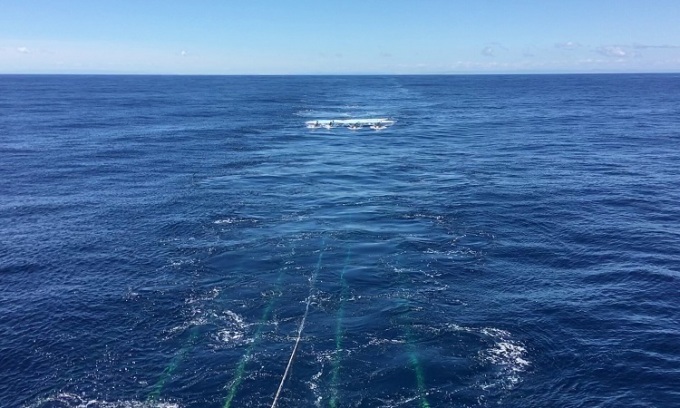
Geological imaging equipment is dragged behind a research vessel during a survey of the Hikurangi Subduction Zone off New Zealand. Photo: Adrien Arnulf
Revealed through 3D seismic imagery, an ancient reservoir lies 3.2 kilometers beneath the ocean floor off the coast of New Zealand, where it may have dampened the effects of a major earthquake fault opposite the North Island, Phys.org reported on October 8.
Faults often generate slow-moving earthquakes, known as slow-slip events. These can release harmless tectonic pressure over days and weeks. Scientists want to know why they occur more frequently in some faults than others. Many slow-slip earthquakes are thought to be related to buried water. However, previously, there was no direct geological evidence to suggest such a large water reservoir existed at a fault in New Zealand.
"We haven't been able to observe deep enough to know exactly what the impact is on the fault, but we can see that the amount of water accumulating here is much higher than usual," said lead researcher Andrew Gase, a postdoctoral researcher at the University of Texas Geophysical Institute (UTIG).
The research, published in the journal Science Advances, is based on seismic surveys and ocean drilling conducted by the research team at UTIG. Gase, now a postdoctoral researcher at Western Washington University, called for deeper drilling to find the bottom of the lake so researchers can determine if it influences pressure around the fault. This is crucial information for a more accurate understanding of large earthquakes.
The location where researchers found the lake is within a vast volcanic region formed when a lava column the size of the United States rose to the Earth's surface in the Pacific Ocean 125 million years ago. This event was one of the largest volcanic eruptions on Earth and caused tremors for millions of years. Gase used seismic scans to build 3D images of the ancient volcanic plateau. Through this, he saw that the sediment, largely thick around the buried volcano, was buried. Gase's colleagues at UTIG conducted experiments with samples of volcanic rock cores and found that water accounted for nearly half of its volume.
Gase speculates that the shallow sea where the eruption occurred eroded part of the volcano into porous rock that stored water, acting as an aquifer. Over time, the rock and debris transformed into clay, accumulating even more water. This new finding is significant because researchers believe that underground water pressure may have been a key factor in creating the conditions for releasing tectonic pressure through slow-slip earthquakes. This always happens when water-rich sediments are buried along faults, trapping water underground. However, the New Zealand fault contains very little of this typical oceanic sediment. Instead, the research team suggests that the ancient volcano and rocks transformed into clay carried large volumes of water as they were swallowed by the fault.
An Khang (According to Phys.org )
Source link

![[Image] Close-up view of the interchange connecting the two expressways and Long Thanh Airport.](https://vphoto.vietnam.vn/thumb/1200x675/vietnam/resource/IMAGE/2026/05/25/1779703378210_ndo_br_z7863716673926-224453a31600126cce10622af6290afd-4549-jpg.webp)


![[Image] Hanoi's urban life under the challenge of a "scorching hot" environment](https://vphoto.vietnam.vn/thumb/1200x675/vietnam/resource/IMAGE/2026/05/25/1779706979265_nang-nong-t5-2026-minh-duy-7-4636-jpg.webp)
























































































Comment (0)