

From January to March of the lunar calendar each year, visitors to Ninh Binh not only get to immerse themselves in the stunning natural scenery and the sacred atmosphere of traditional festivals, but also get to admire the familiar characteristic sight of the kapok flower blooming season.
This flower is not only a sign of the changing seasons but also a vibrant touch against the backdrop of the ancient heritage of the former imperial capital, attracting numerous tourists to visit and admire it.
A blazing "torch" in the heart of the heritage site.
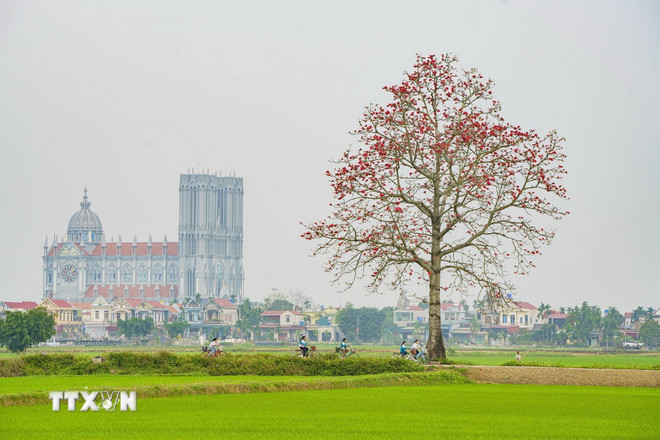
The kapok tree, also known as the cotton tree or kapok flower, usually blooms profusely in the third lunar month each year, signaling the transition from spring to summer. Kapok trees often grow along riverbanks, beside village roads, or scattered around temples and pagodas, creating a nostalgic scene reminiscent of peaceful rural areas.
In Ninh Binh, the vibrant kapok trees stand out against the lush green mountains and clear blue waters, further enhancing the mystical beauty of this land.
Nestled against a rocky mountain, Bich Dong Pagoda in Nam Hoa Lu ward, Ninh Binh province, is not only famous for its ancient architecture but also stands out for the beauty of its centuries-old kapok trees blooming brilliantly.
Located just to the left of the entrance gate to Bich Dong Pagoda, the kapok tree is a highlight, further enhancing the ancient, serene, and mysterious atmosphere of the pagoda amidst the vast, verdant mountains.
Under the kapok tree, the elders of the area often stop to rest after temple ceremonies. For them, the kapok tree is not just a flower, but an "old friend" who has accompanied them through the years.
Ms. Nguyen Thi Thuy, from Nam Hoa Lu ward, Ninh Binh province, shared that the kapok tree in front of Bich Dong pagoda was planted by her maternal grandfather. To date, the tree is over 100 years old.
Every time she went to the temple, stepping across the small stone bridge and seeing the thick, five-petaled kapok flowers scattered on the ground, she felt a sense of peace. The deep, rich red of the kapok flowers at Bich Dong was not harsh, but rather perfectly suited to the mossy roofs of the temple and the solemnity of the cave.
Her childhood was filled with hardship; when the kapok flowers fell, the children would pick them up to play pretend. Now, in her twilight years, standing under the tree's canopy, listening to the chirping of starlings pecking at the nectar, she feels happy that the tree is still there, healthy and resilient, blooming despite the sun, rain, storms, and wind.
The kapok tree stands like a silent guardian, watching over the temple gate, reminding descendants of the resilience and simple roots of their rural homeland.
When she is old and frail and can no longer go to the temple, Mrs. Thuy hopes that the kapok tree will continue to bloom brightly every March so that people from afar can still see the peaceful essence of this ancient capital.
Popular "virtual photo spots" for young people.
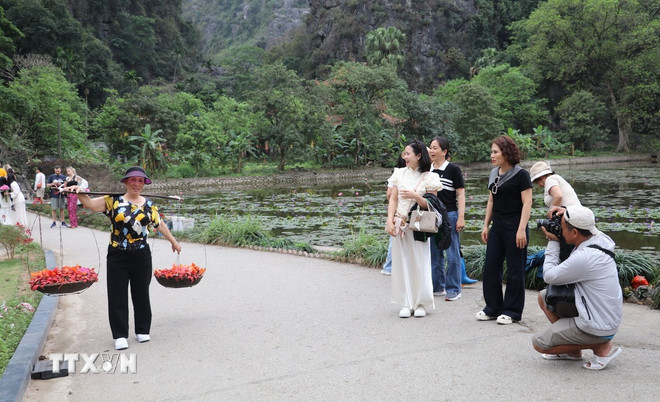
In Ninh Binh, the kapok tree is not just a roadside tree but has become an integral part of the heritage landscape. Many famous kapok trees attract young people and tourists alike every March, such as the kapok tree in Yen Mo commune; the kapok trees scattered along the dike and limestone mountain ranges at Van Long lagoon, Gia Van commune; and the kapok tree at Tam Chuc pagoda...
Photographer Nguyen Van Duc, from Hoa Lu ward, Ninh Binh province, said that in March in Ninh Binh, his camera bag always has an empty memory card because the red color of the kapok flowers here has a very unique appeal.
The kapok flower of Ninh Binh is a beautiful blend of the stillness of stone and the heat of fire. The red color of this flower is very sensitive to light; if the sun is too strong, the red color easily "burns," losing all the details of its thick, luscious petals.
What he liked most were the early mornings when the mist still lingered over the Ngo Dong River, or the late afternoons when the sunlight streamed through the gray limestone cliffs; at those times, the kapok tree appeared like a blazing torch in the tranquil space.
The most challenging part is capturing the moment a kapok flower falls, because unlike the delicate blossoms of the sưa or sấu trees, kapok flowers fall straight down decisively like an arrow. If you're lucky, you might be able to photograph the flower spinning in mid-air before hitting the turquoise waters of Tam Cốc or the moss-covered stone steps of Bích Động Pagoda.
These days, to get beautiful check-in photos with the kapok flowers, many young people have to go early in the morning or wait until late afternoon because early morning or sunset is when the light is most beautiful to capture the vibrant red color of the kapok flowers against the sky.
Dinh Phuong Dung, a tourist from Hanoi, shared that to get "thousands of likes" on check-in photos, young people should choose classic, gentle outfits, or traditional ao dai (Vietnamese long dress) that suit the spiritual and nostalgic atmosphere.
Clothing should ideally be white, cream, or neutral tones to stand out against the vibrant red flowers and ancient mossy background.
Since kapok trees are usually very tall, position your camera low and shoot upwards to capture the entire canopy of vibrant red blossoms intertwined with the sky. The photographer should pose walking slowly or standing under the roof of an ancient temple to add depth to the image.
The kapok flower season in Ninh Binh usually passes very quickly, lasting only a few short weeks in March. Whether you're checking in under a centuries-old tree or quietly watching the petals fall on the water's surface, the experience of the kapok flower season in Ninh Binh will surely leave an unforgettable impression on every visitor.
Source: https://www.vietnamplus.vn/hoa-gao-thang-ba-thap-lua-giua-non-nuoc-co-do-ninh-binh-post1100673.vnp
































































































Comment (0)