

On the occasion of Vietnam's Book and Reading Culture Week, a reporter from SGGP newspaper had a conversation with artist Tran Dai Thang, Director of Dong A Culture Joint Stock Company, and author of this publication.
* REPORTER: Recently, you surprised many people with the release of your book, "My Story - It's All From Books." From an artist to someone who makes books for people, and now an author. What's interesting about this journey, sir?
* Artist TRAN DAI THANG: My purpose in life is to find joy every day; if I can't find one joy, I move on to another, to make life less boring. Writing a book wasn't my main goal, so I didn't prepare anything beforehand. I only allowed myself a few months to write, and when it was finished, I went to find joy in other work. However, I didn't think writing a book would be so much fun. If I had known it would be this enjoyable, I would have written it a long time ago!
* How did you feel about your first experience as an author?
* It was very hard work, but it also helped me understand the work of writers more thoroughly. I've had three jobs: artist, publisher, and economist . Each job brought its own unique emotions, but writing books brought incredibly intense emotions. It left me with no peace for a single moment during that time. Every time I thought of a good word or a valuable detail, I had to add it immediately, regardless of the time.
Fortunately, we now have all sorts of technological tools to help us quickly edit manuscripts, no matter where we are. Because of this, I appreciate even more the efforts of our ancestors, who wrote by hand with great difficulty, and who faced immense challenges when needing to add or revise. I feel that if it weren't for the present day, I certainly wouldn't have been able to write this book. Furthermore, I received a great deal of encouragement and inspiration from writer Ho Anh Thai.
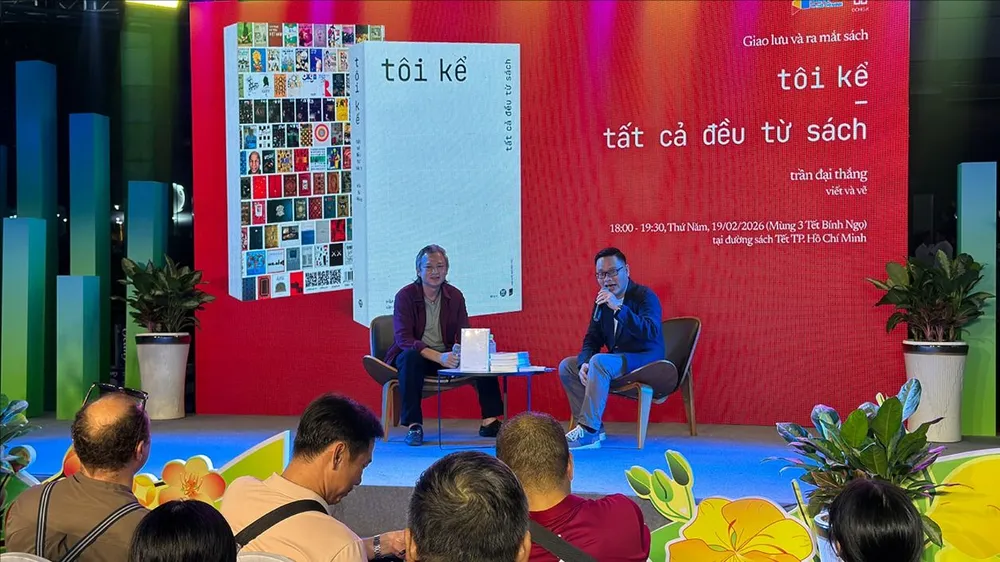
* In "My Story - It's All From Books ," you mentioned once-famous names in the publishing industry, such as "Dai-Cu-Hoa-Son" and "Hieu-Tan-Tri-Phuoc" in Ho Chi Minh City, or "Nhat Bach, Nhi Quy, Tam Mien, Tu Huyen" in Hanoi . Currently, many publishing companies are emerging, but those four prominent groups are no longer around. What happened?
* To understand this issue, one must know the history of the domestic publishing industry. The reality is that publishing was easier in the past than it is now. Back then, the publishing landscape was fertile but untapped; whoever pioneered a piece of it claimed that space to work in, and no one else interfered.
Therefore, each individual in that quartet became renowned for their respective fields of writing, to the point that today, when people mention a particular genre of books, they immediately think of the specific individuals who achieved success in that genre. But things are very different now; every genre and field has its creators, there is no specific division, and no one monopolizes it.
In that context, book publishing has also undergone fundamental changes. In the past, exceptional talent wasn't always necessary; at certain points in history, those with keen insight were the winners. Now, there are many talented people; to succeed, one must be extremely skilled, sometimes even exceptional.
* With over 20 years of experience in the publishing industry and numerous participations in major international book fairs, what is your assessment of the current state of Vietnamese publishing?
Currently, Vietnam buys the copyrights and even translates simultaneously any attractive book titles released in other countries. However, that's just the tip of the iceberg; the depth of development lags behind other countries. For example, many countries have specific strategies to create truly valuable book series, while we still focus only on producing bestselling books.
Furthermore, while other countries highly value books made with artistic merit, in our country they are considered luxury items. I feel this is an unfair perception of artistic books in our country. People may celebrate a work of art, but they consider books made as works of art unnecessary, believing that books only need to be read and not beautified, and that beautifying them is a waste. In reality, I believe that beautiful books have a positive impact and greatly stimulate reading culture.
* The Cá Chép Bookstore on Võ Văn Tần Street (Ho Chi Minh City), a brainchild that he poured so much heart and soul into, has just had to cease operations. Is this a sign of the decline of the traditional bookstore model today?
* People's consumer habits are changing very rapidly, primarily focusing on online shopping. This is not unique to Vietnam; it's happening worldwide. Independent and private bookstores have significantly declined. Those that remain must find alternative ways to survive; they can no longer operate the same way as before.
For us, even though the Cá Chép bookstore has closed, Đông A will still maintain this location and continue to pursue other models related to books. However, my colleagues and I are still considering the specifics. It could be a book cafe, a place to hold seminars and workshops about books…
Furthermore, I have completed the "Books to Every Home" project and am finalizing the procedures for licensing by the Publishing Department. If approved, I will dedicate one year to implementing this project. At that time, the Cá Chép Bookstore will no longer be a local bookstore but will "travel" to provinces and cities via large book trucks. I will bring books to introduce and sell in all provinces and cities of Vietnam, especially in remote areas.
"Producing a book involves many steps and costs. If all copies are sold, the profit is about 20% of the cover price. If they don't sell, we have to clear inventory and reduce prices, which almost certainly results in a loss. That's why, even though many new book companies emerge each year, the number is still very small compared to other industries. Even so, for many people, choosing to work in the book industry isn't primarily for the sake of books themselves; they mainly feel that the competition is less intense and easier to navigate," shared artist Tran Dai Thang, Director of Dong A Culture Joint Stock Company.
Source: https://www.sggp.org.vn/hoa-si-tran-dai-thang-lam-sach-bay-gio-phai-cuc-ky-gioi-post851875.html


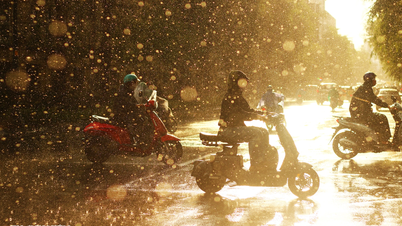
![[Image] Hanoi's urban life under the challenge of a "scorching hot" environment](https://vphoto.vietnam.vn/thumb/1200x675/vietnam/resource/IMAGE/2026/05/25/1779706979265_nang-nong-t5-2026-minh-duy-7-4636-jpg.webp)
![[Image] Close-up view of the interchange connecting the two expressways and Long Thanh Airport.](https://vphoto.vietnam.vn/thumb/1200x675/vietnam/resource/IMAGE/2026/05/25/1779703378210_ndo_br_z7863716673926-224453a31600126cce10622af6290afd-4549-jpg.webp)









































































Comment (0)