Commemorating President Ho Chi Minh 's birthday reminds every cadre and Party member to strive even harder to study and follow Ho Chi Minh's ideology, ethics, and style. This is not something too grand, distant, or difficult to achieve. Learning from and following Uncle Ho means transforming his simplest lessons into a guiding principle for self-reflection and self-correction, cultivating revolutionary ethics, and realizing the ideal of serving the Fatherland and the people.
Learn from Uncle Ho through the simple and familiar things.
Uncle Ho's simplicity was not only reflected in his rubber sandals, cloth-covered hat, or faded khaki clothes, but also in his words, actions, writings, and lifestyle, dedicating his entire mind to the affairs of the nation and its people, as he advised: "To win the people's love and affection, we must do our utmost to do what benefits them and avoid what harms them."
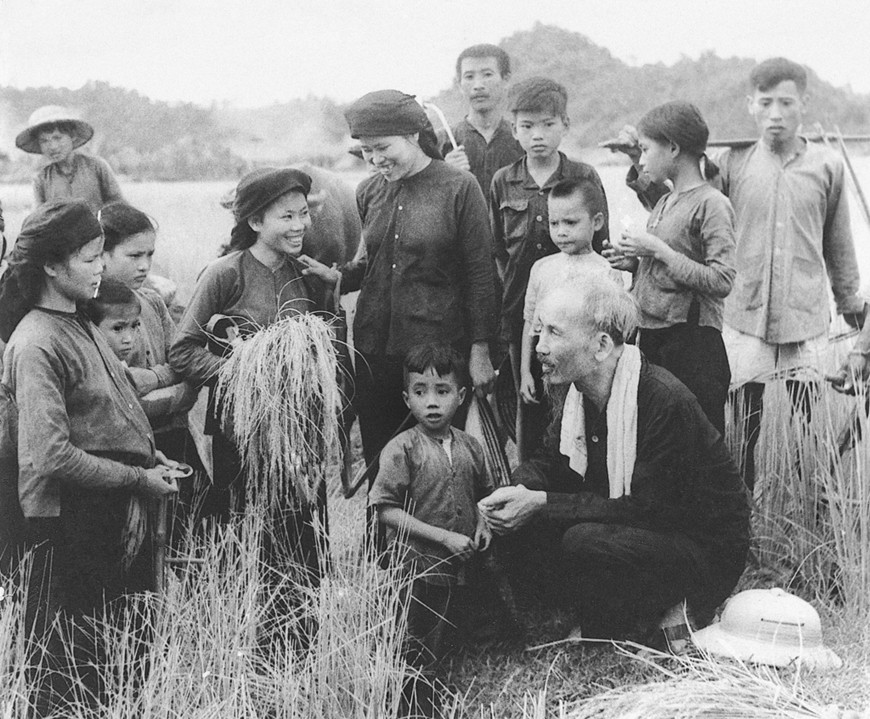

President Ho Chi Minh visits Hung Son Cooperative in Dai Tu district, Thai Nguyen province during the harvest season (1954). Photo: hochiminh.vn
Every official and Party member needs to examine themselves, asking if they are being drawn into a pragmatic, ostentatious, formalistic, wasteful, extravagant lifestyle, or one characterized by individualism. To be close to the people, one must live a simple life, integrate into the lives of the people, and listen to and understand their thoughts and aspirations.
In the article "Uncle Ho Still Marches with Us" on the occasion of the 135th anniversary of President Ho Chi Minh's birth, General Secretary To Lam affirmed that President Ho Chi Minh was a harmonious unity of thought, morality, and a simple, pure, humble, yet extremely noble lifestyle. His shining example of "diligence, thrift, integrity, righteousness, and selfless dedication" is a standard for all generations.
President Ho Chi Minh always considered himself "the loyal servant of the people," which is the root of his revolutionary virtues and ethics. In his Last Will and Testament, dated May 10, 1969, he instructed: "Finally, I leave my boundless love to the entire people, the entire Party, the entire army, and to the young people and children." He reminded: "The Party needs to have a very good plan to develop the economy and culture, in order to continuously improve the lives of the people."
To be worthy of being servants of the people, he instructed that officials must reflect on their attitude of listening attentively, acting humbly, and showing respect and politeness when interacting with the people, whether they are workers, farmers, artisans, or intellectuals.
Humility, listening, and learning are in stark contrast to arrogance, authoritarianism, a bureaucratic attitude, and indifference to the grievances of the people, whether they are workers, farmers, soldiers, students, or intellectuals. The "revolutionary bureaucratic" mindset, the arrogance, authoritarianism, despotism, lack of democracy, and alienation from the masses are completely alien to the ethics and style of Ho Chi Minh.
Entering a new era, an era of national progress and prosperity, the mindset of administrative command-based management must be replaced by a mindset of service, listening, mobilization, persuasion, and creation. When the people need us, officials must be present; when the people face difficulties, officials must address them. Officials must learn to listen sincerely from the hearts of the people with humility, learning, and a willingness to improve themselves through genuine listening, in the spirit of "the people are the foundation," "with the people, we have everything," and "the people can propel the boat forward, and the people can also overturn it."
Honesty, discipline, opposition to extravagance, and the ability to listen.
President Ho Chi Minh taught: "A nation that knows how to be thrifty, honest, and upright is a nation that is rich in material wealth and strong in spirit." Reflecting on Regulation 144 dated May 9, 2024, of the Politburo on the Revolutionary Ethics Standards for Cadres and Party Members in the New Era, every cadre must examine themselves to see if they have truly been selfless and impartial, and whether they have shown deference, avoidance, or a desire for harmony in the face of the wrongdoings of comrades and colleagues.
Party members must resolutely fight against their own individualism and that of their comrades; they must be humble, open-minded, simple, exemplary, self-correcting, and uphold discipline, order, and unity within the Party. This is the revolutionary model, the morality and style of Ho Chi Minh.
Self-reflection and self-correction are only truly meaningful when the ultimate result is the strengthening of the Party organization; the continuous improvement of socio-economic development and people's living standards; the country's prestige and high standing in the international arena; and the absolute trust of the people in the Party and socialism.
Every cadre and Party member is a role model, a pioneer in excellently fulfilling assigned tasks, daring to think, daring to act, and daring to take responsibility for the common good of the people and the country.
"Self-reflection and self-correction," following the moral example and style of Ho Chi Minh, is a continuous process of striving, training, and self-cultivation without end. When each cadre and Party member knows how to maintain self-control, set an example, self-reflect and correct, remain simple and humble, and are concerned about the difficulties of the people and the collective, that is when revolutionary morality is most genuinely enhanced, forming a solid foundation for our Party to remain strong, our nation to endure forever, and the ideals of socialism to increasingly bear fruit.
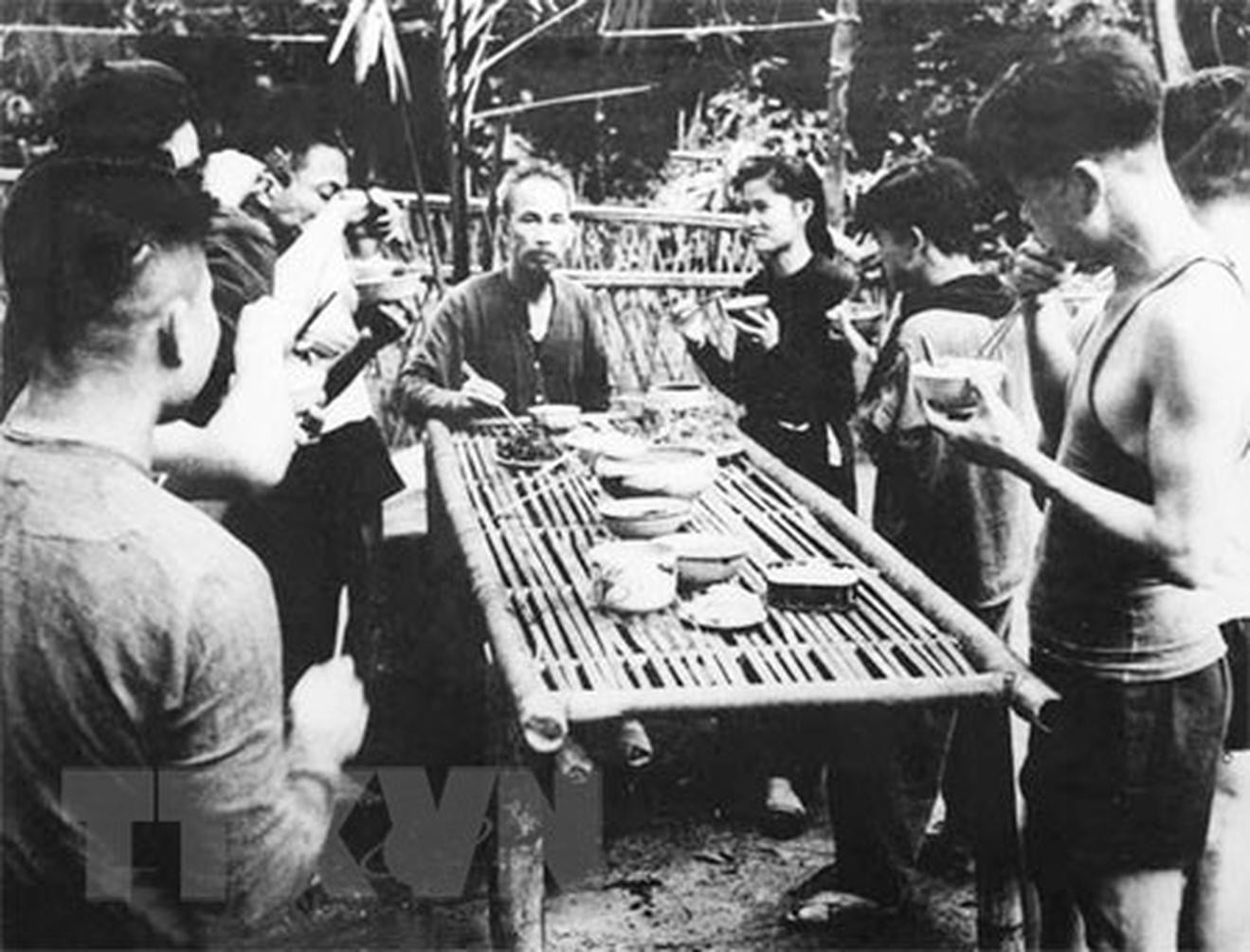
President Ho Chi Minh during a meal with compatriots and soldiers in the Viet Bac war zone. Photo: Archival material/VNA.
Learning from Uncle Ho is not about striving to achieve extraordinary things, but rather a persistent journey of self-cultivation starting from the smallest things. Uncle Ho once taught: "Every person has both good and evil within them. We must know how to make the good in each person blossom like spring flowers and the bad gradually disappear."
Cultivating revolutionary ethics is like washing your face every day.
Uncle Ho's simplicity also extended to his thinking, his style of thought, his writing, his words, and his daily actions. Let's look back at how we spend and enjoy ourselves. Do we ever shop just to "show off" on social media? Do we ever waste food, water, or precious time on pointless pleasures? Let's cherish the smallest things. When material needs decrease, our minds will be lighter and more focused on core values within.
In work and life, do we ever develop a sense of arrogance and self-importance, disregarding the opinions of others? When receiving feedback, do we become offended or are we willing to listen? Learn to listen more than you speak. When successful, share the credit with the team. When failing, have the courage to take responsibility for your mistakes before blaming external circumstances. Arrogance leads us to the brink of disaster. Humility is the best way for us to learn and continuously improve.
Despite being the President of the country, the supreme leader, a national liberation hero, and a world cultural figure, Uncle Ho always considered himself "a loyal servant of the people".
Whether it was a matter of national importance or simply picking up trash bags and tending to a garden, Uncle Ho always did it with the utmost care and concentration. Are we working in a "perfunctory" manner, taking credit for others' work and just getting things done? Let's cultivate discipline and meticulousness. Every task we undertake, no matter how small—like composing an email or tidying our desk—should be done with kindness and self-respect. Professionalism stems from carefulness, thoroughness, and a dedicated, wholehearted attitude towards our work.
Uncle Ho likened cultivating revolutionary ethics to washing one's face daily; it must be done every day, diligently and meticulously, otherwise the face will remain dirty. To improve each day, before closing the day, ask yourself: What good things did I do today? Where did I go wrong? Don't make excuses for your mistakes. Be brave enough to admit to yourself: Today I wasn't good in this area; if I didn't complete the task, I will make up for it tomorrow; if I misspoke or broke a promise, I must do it tomorrow and sincerely apologize.
The 14th National Congress of the Communist Party of Vietnam marked the beginning of a new era of national development, demonstrating the unwavering resolve, determination, and spirit of national unity towards the goal of building a peaceful, independent, democratic, prosperous, civilized, and happy Vietnam, steadily advancing towards socialism – the path chosen by our Party, our people, and President Ho Chi Minh.
Studying and following Ho Chi Minh's ethics and style not only demonstrates the immense love and respect the entire nation has for him, but it also represents the Lac Hong culture, the enduring strength of the nation, and a mandate for life today.
On the occasion of the 136th anniversary of the birth of the great President Ho Chi Minh, we study and follow Ho Chi Minh's ethics and style, starting from the simplest things. This does not make us petty or insignificant; on the contrary, it strengthens our character and purifies our souls.
Studying consistently, studying diligently, and as President Ho Chi Minh advised, learning a little each day, correcting a little, so that each day we become better, is how we build and enrich our lives with more value, happiness, and fulfillment, contributing to bringing the Resolution of the 14th Party Congress into life.
Source: https://vietnamnet.vn/hoc-bac-can-tu-soi-tu-sua-minh-2514026.html







































































Comment (0)