

Global temperatures have soared in recent years as the world continues to burn planet-warming fossil fuels such as coal, oil, and natural gas. Alarmingly, that trend shows no sign of slowing down.
In its annual climate update report, the WMO stated that between 2023 and 2027, there is a 66% chance that the planet's temperature will rise above 1.5 degrees Celsius above pre-industrial levels for at least one year within the next five-year period. Furthermore, there is a 98% chance that at least one year within the next five years—and the entire five-year period—will record record temperatures for the planet.
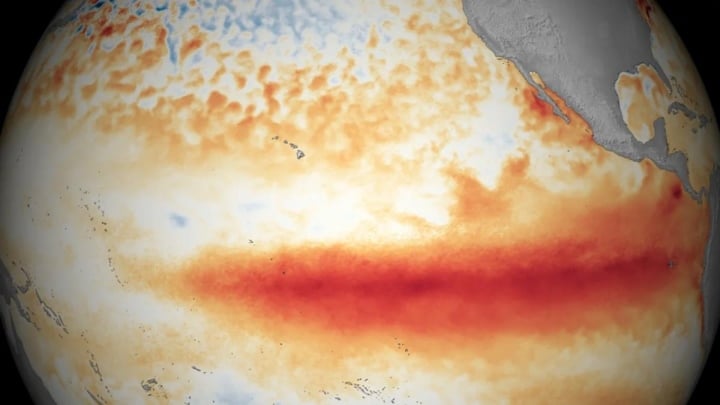
Ocean temperatures in the tropical Pacific warmed due to a strong El Niño phenomenon in January 2016. (Image: NOAA)
According to the WMO, a violation of the 1.5°C threshold stipulated in the Paris Climate Agreement may only be temporary, but it would be the clearest signal yet of how rapidly climate change is accelerating – speeding up sea level rise, more extreme weather, and the degradation of vital ecosystems.
Countries committed in the Paris Climate Agreement to limit global warming to below 2 degrees Celsius – ideally 1.5 degrees Celsius – above pre-industrial levels. Scientists consider 1.5 degrees Celsius a critical tipping point; exceeding that level could significantly increase the risk of severe flooding, droughts, wildfires, and global food shortages.
“This report does not mean we will permanently exceed the 1.5°C limit set in the Paris Agreement, which refers to long-term warming over many years. However, the WMO is sounding the alarm that we will be temporarily violating the 1.5°C limit with increasing frequency,” said WMO Secretary-General Petteri Taalas.
Petteri Taalas added: “The warming El Niño phenomenon is expected to develop in the coming months, and this, combined with human-induced climate change, could push global temperatures to unprecedented levels. This will have far-reaching impacts on human health, food security, water management, and the environment. We need to be prepared.”
The hottest year on record so far is 2016, following a very strong El Niño event. El Niño tends to increase temperatures in the following year as it develops, which could make 2024 the hottest year on record.
The world has seen warming of about 1.2 degrees Celsius as humans continue to burn fossil fuels and cause pollution that warms the planet. Although Earth has experienced three years of cooling due to the La Nina phenomenon, temperatures have subsequently soared to dangerous levels.
The report states that the risk of temporarily exceeding the 1.5°C mark has steadily increased since 2015, when the WMO placed the risk of violating this threshold at nearly zero.
The WMO predicts that the average annual global near-surface temperature between 2023 and 2027 will be 1.1°C to 1.8°C higher than the average of the 1850s and 1900s – a period before the dramatic increase in pollution and planet warming caused by the burning of fossil fuels.
Leon Hermanson, a Met Office scientist and lead author of the report, commented: "Global average temperatures are projected to continue rising, moving us further and further away from the climate we are familiar with."
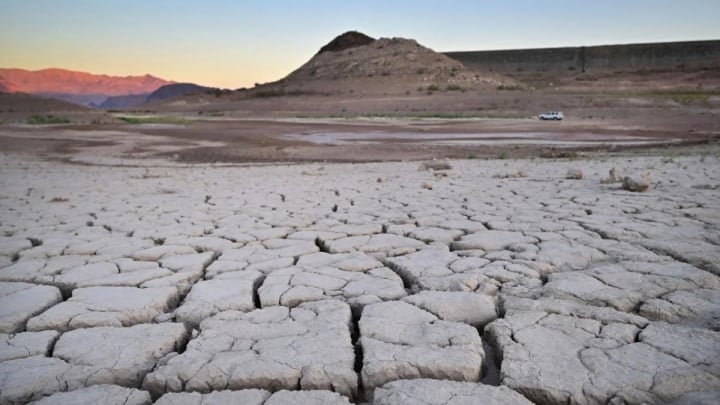
Climate change is causing serious consequences. (Photo: AFP/Getty)
Why is a 1.5°C increase important?
Scientists have long warned that the world needs to keep global temperatures from rising above 1.5 degrees Celsius to avoid catastrophic and potentially irreversible changes.
Warming above this level would increase the risk of triggering major tipping points, including the destruction of coral reefs, the melting of polar ice sheets, which would raise sea levels and devastate coastal communities.
In the United States alone, 13 million people could be forced to relocate due to rising sea levels by the end of this century. For many low-lying Pacific island nations, warming above 1.5 degrees Celsius poses a threat to their survival.
Rising temperatures also increase the frequency and intensity of extreme weather events, including droughts, storms, wildfires, and heatwaves. This year alone, a series of temperature records have been broken around the world. In March, parts of Argentina struggled with temperatures up to 10 degrees Celsius above normal. High temperature records were also broken across much of Asia in April, while record high temperatures scorched locations in the Pacific Northwest in May.
According to NASA, limiting global warming to below 1.5 degrees Celsius could reduce the exposure of approximately 420 million people to extreme heat waves.
Opportunities to act are dwindling.
With every small fraction of 1.5 degrees Celsius of global warming, the impacts worsen. But that also means that any action we take to mitigate even a small amount of warming will be beneficial. Scientists believe that, as the window of opportunity for action narrows, humanity still has time to reduce global warming by abandoning fossil fuels like oil, coal, and natural gas in favor of clean energy.
"This report [the WMO report] should be a rallying cry to strengthen global efforts to address the climate crisis," shared Doug Parr, chief scientist at Greenpeace UK.
Many have also called for adaptation measures to prepare for the emerging climate impacts, such as building coastal walls to protect communities from rising sea levels.
World leaders are expected to convene at the United Nations' COP28 climate summit in Dubai later this year. There, they will conduct a “global inventory”—an assessment of progress toward the goals agreed upon in the Paris Climate Agreement. Certainly, there is still a long way to go to achieve the targets of keeping global warming within 1.5 degrees Celsius, by cutting planet-warming pollution by more than 40% by 2030.
Hung Cuong (VOV.VN)
Beneficial
Emotion
Creative
Unique
Wrath
Source






















































![[VIMC's 40-day rapid rollout] VOSA accelerates the deployment of a comprehensive logistics solution for HODA.](https://vphoto.vietnam.vn/thumb/402x226/vietnam/resource/IMAGE/2025/12/23/1766473634002_vosa-23-12-25-2_upscayl_2x_remacri.jpeg)












![[Photo] Closing Ceremony of the 15th Conference of the Central Committee of the 13th Party Congress](https://vphoto.vietnam.vn/thumb/402x226/vietnam/resource/IMAGE/2025/12/23/1766462841764_a1-bnd-3731-1647-jpg.webp)
































Comment (0)