

 |
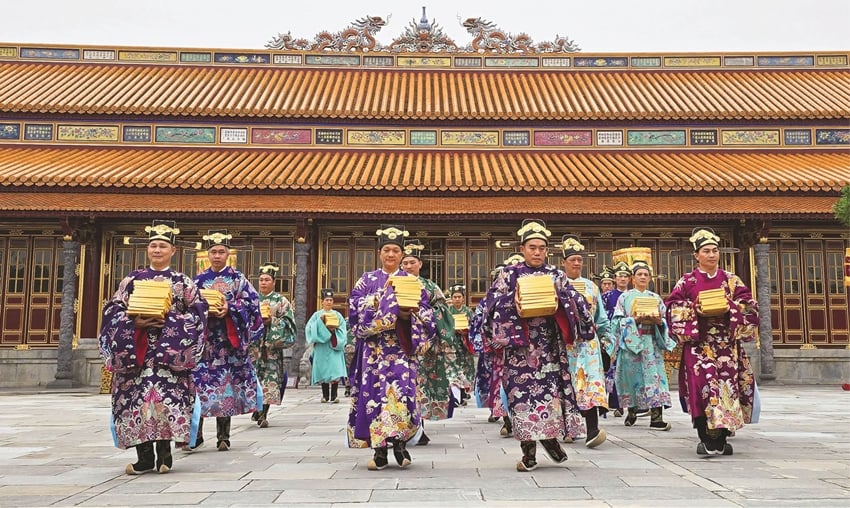
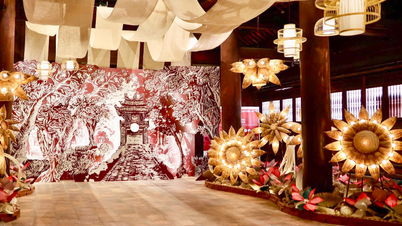
| Artists recreated this special New Year's festival, which dates back to the Nguyen Dynasty. |
Amidst the eager anticipation of visitors, the Hue Imperial Citadel Relics Conservation Center (BTDTCĐ) will reenact the Lunar New Year's Day ceremony in a theatrical format on the first day of 2025. The program is presented as a continuation of the humanistic values and optimistic spirit of welcoming the new year from our ancestors.
During the Nguyen Dynasty (1802-1945), the Lunar New Year was a royal ceremony, held on the first day of the Lunar New Year with a grand court ceremony at the Thai Hoa Palace and a regular court ceremony at the Can Chanh Palace. First, the grand court ceremonies took place in the courtyard and inside the Thai Hoa Palace. The Emperor's procession traveled from the Can Chanh Palace to the Dai Cung Mon Gate and then to the Thai Hoa Palace to personally preside over the ceremony.
During the ceremony, officials present petitions wishing the king a prosperous new year. The king will bestow his favors, granting monetary rewards and a banquet to the officials attending the ceremony. Two ceremonial cannons placed outside the Thai Hoa Palace will be fired to welcome the new year. At this time, the king will retreat to the Can Chanh Palace to continue the New Year's rituals. There, the royal brothers, young princes, and other dignitaries will bow in greeting to the king. This will be followed by the king's announcement of the banquet and spring rewards…
To better serve tourists, the ceremony was held at Thai Hoa Palace, with the participation of hundreds of actors and artists from the Hue Royal Court Traditional Arts Theatre.
Van Hai, a tourist from Hanoi, shared that although he had researched these rituals beforehand, witnessing them firsthand at the place where they took place allowed him to fully appreciate the solemnity and significance of these ancient court ceremonies. "It was truly an unforgettable experience," Van Hai said.
Not only adults, but many young people also showed special interest in this reenactment program. Minh Anh, a tourist from Ho Chi Minh City, expressed: “These rituals not only help us understand history better but also awaken our responsibility to preserve national culture. This is a way to remind the younger generation of the profound meaning of returning to our roots.”
According to Nguyen Phuoc Hai Trung, Deputy Director of the Hue Center for Conservation of Cultural Heritage, the Lunar New Year ceremony, with its grand court rituals, is presented in a theatrical format to promote the tangible and intangible heritage of the Nguyen Dynasty. The Center has researched and recreated the New Year's court ceremony based on documents from the Dai Nam Thuc Luc and the Kham Dinh Dai Nam Hoi Dien Su Le… The ceremony also partly showcases the traditional beauty associated with the ancient royal New Year celebrations.
Although the Lunar New Year celebration cannot be recreated in its original form due to objective reasons, through narrative elements, visitors can still understand the rituals and "feel" the humanistic values hidden in messages such as the king's pronouncements: "Since I succeeded to the throne, I have received the mandate of Heaven; following the virtues of my late father, I have devoted myself wholeheartedly to the important affairs of governance and focused on the important matters of agriculture. I have established the regulations for the Ban Soc festival and the Tich Dien ceremony. Yet, last year, there were continuous storms and floods, and even the threat of disease. I have comforted the provinces and cities affected by natural disasters and floods, and have provided relief by opening granaries to alleviate hunger... Autumn passes, winter ends, and the old year ends. Spring arrives, and Tet comes, illuminating the entire land..."
Besides the Grand Ceremony of the Lunar New Year, the Hue Center for Conservation of Traditional Culture has recently recreated many other rituals in theatrical form, depicting ancient ceremonies and practices, such as: the Ceremony of Distributing the New Calendar, the Ceremony of Honoring Doctors of Philosophy; the annual reenactment of the Ceremony of Erecting the New Year Pole - Raising the New Year Banner (signaling the arrival of Tet), the Ceremony of Lowering the New Year Pole (marking the end of the Tet holiday and the beginning of a new working year) and the Ceremony of Opening the Seal to wish a happy new year… Notably, the Ceremony of Honoring Doctors of Philosophy made a deep impression when it was recreated in the 2024 Road to Olympia Finals at Ngo Mon Gate - becoming a symbol of the tradition of studiousness.
At the same time, many major ceremonies were successfully organized, such as the Xa Tac and Nam Giao rituals, the Altar of the Departed Souls; the Hue Nam Palace festival, the ceremony of gratitude to Lord Nguyen Phuc Khoat... "Recreating court rituals is not only a way to honor cultural values but also meets the requirements of preserving Nha Nhac - an intangible cultural heritage of humanity, in its original performance space," Mr. Trung said. Each festival is not only associated with tangible heritage but also contributes to enriching Hue's unique tourism products, while opening up opportunities for the world to access Vietnamese cultural heritage through a modern lens, to cherish and preserve the heritage of our ancestors.
Source: https://huengaynay.vn/van-hoa-nghe-thuat/hoi-sinh-nghi-le-cung-dinh-149868.html


![[Photo] Opening Ceremony of the National People's Council Conference on the Implementation of Directions and Tasks for the 2026-2031 Term](https://vphoto.vietnam.vn/thumb/1200x675/vietnam/resource/IMAGE/2026/05/28/1779939257690_ndo_br_bnd-1991-jpg.webp)
![[Image] Checking the security conditions at the exam site, ready for the 10th grade exam.](https://vphoto.vietnam.vn/thumb/1200x675/vietnam/resource/IMAGE/2026/05/28/1779943458889_z7872507660648-d764421a26e8cd7b61d70d142a48a685-jpg.webp)











































Comment (0)