PRESERVING THE FUNDAMENTAL ELEMENTS
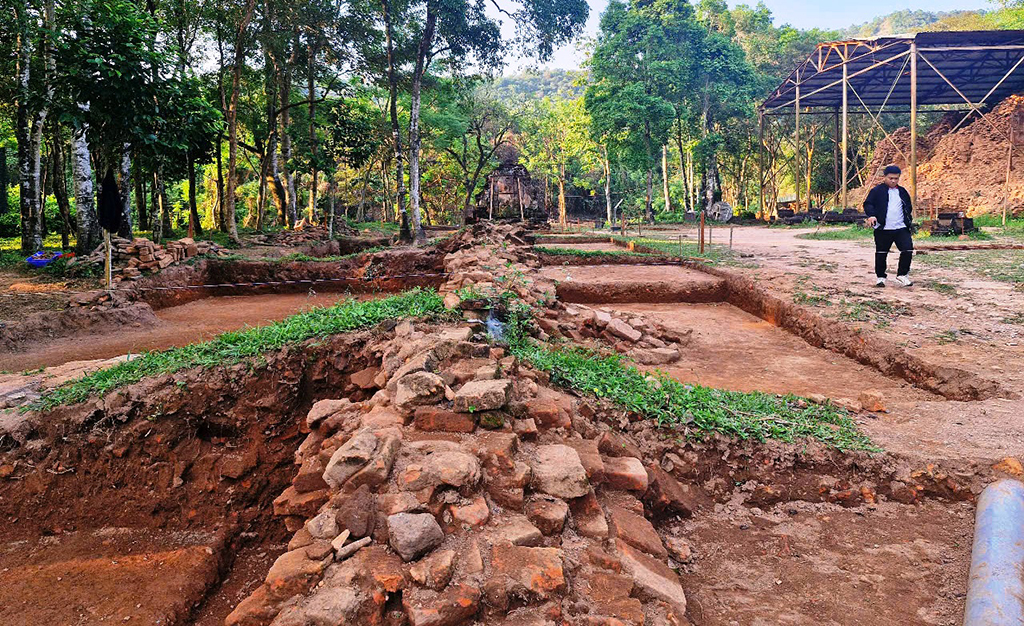
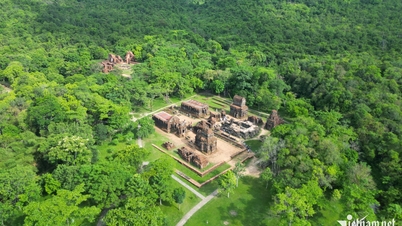
In late March, under the guidance of Indian experts, more than 20 skilled workers were clearing vegetation and scientifically dissecting the overall area of groups F and E at the My Son World Heritage Site (Duy Xuyen District, Quang Nam Province). Drawing on experience from previous restoration efforts, the team of workers collaborated seamlessly with the Indian experts. After nearly a month of work, the preparation phase was nearing completion.
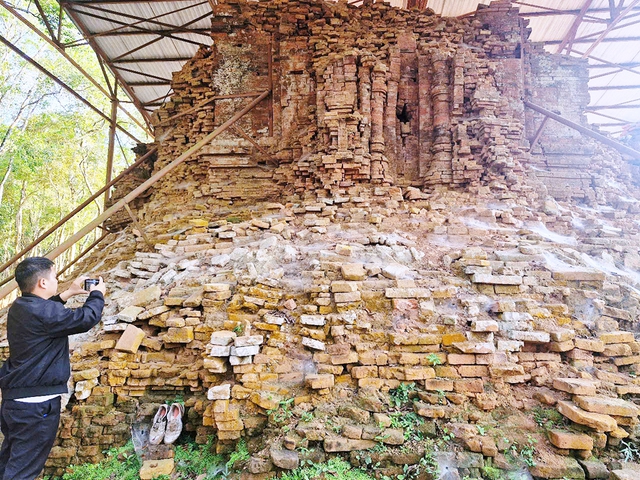
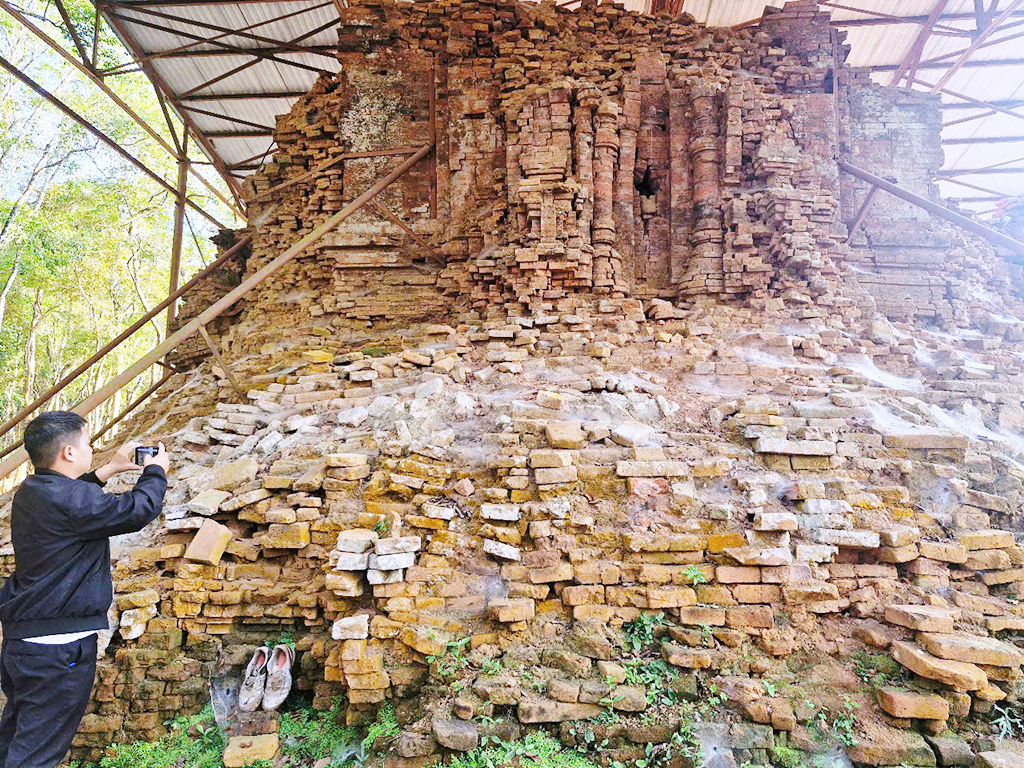
The F1 tower is in serious disrepair. PHOTO: MANH CUONG
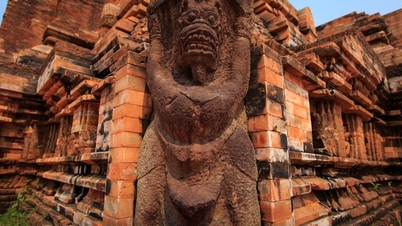
The My Son Cultural Heritage Management Board stated that the F and E tower groups are located close together. The F group comprises three structures: F1, F2, and F3. While tower F3 has completely collapsed and disappeared due to bombing during the war (its location is now only known through a map), the remaining two structures, F1 and F2, are also in serious disrepair. The collapsed gate tower F2 has left only a 3.2-meter-high section of wall leaning south at approximately 3 degrees, with numerous deep cracks. The northern section of wall remains several meters high, and both sections are being supported by iron bars.
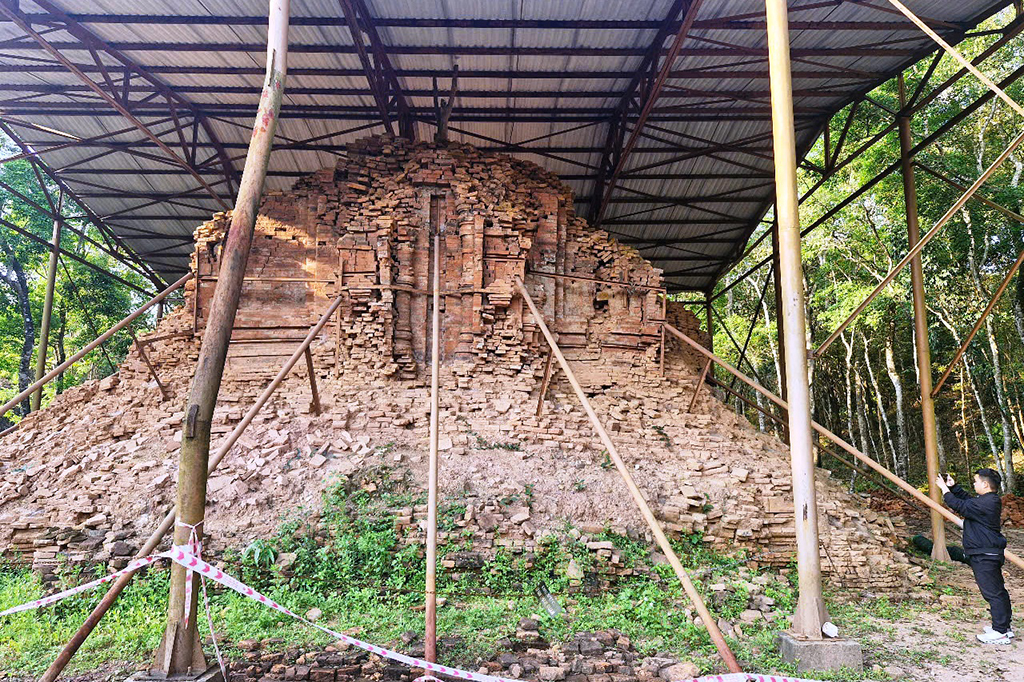
Most concerning is tower F1, an archaeological site excavated in 2003, which shows no signs of restoration and is currently covered. The walls are cracked, the bricks are faded and show signs of being reclaimed; sections of the walls are at high risk of collapsing at any time if not restored soon. Significantly, the F tower group is one of the earliest Shiva-worship architectural complexes, dating from the 7th-8th to the 10th-11th centuries, and is important evidence of the development of architecture and sculptural art in the My Son temple complex in particular and Champa in general.
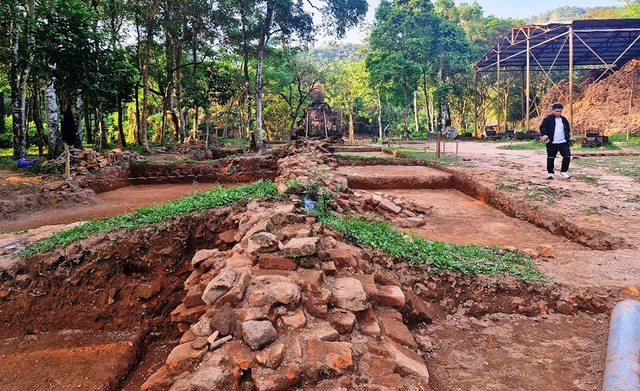
Workers have been clearing and cleaning the area around towers F and E.
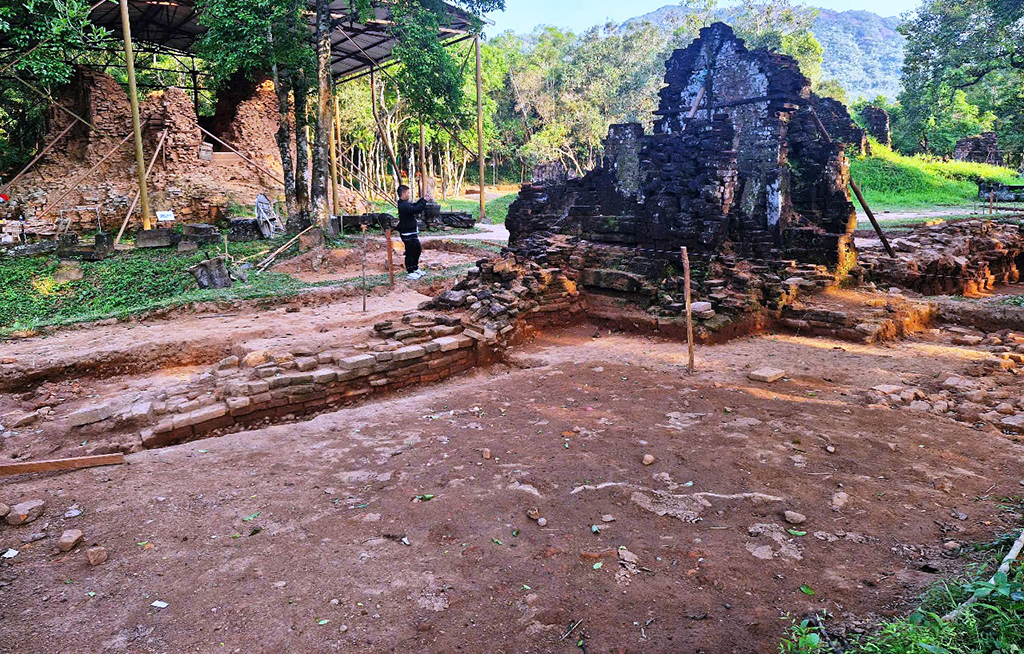
The E tower group comprises eight architectural structures (E1, E2, E3, E4, E5, E6, E7, E8). E1 is the main tower of the E area, dating back to the 8th century, and is the earliest surviving relic. Except for tower E7, which has been restored (2011-2013), most of the structures in the E tower group are severely dilapidated and damaged, now remaining as ruins…
Speaking to a reporter from Thanh Nien newspaper , Mr. Nguyen Cong Khiet, Director of the My Son Cultural Heritage Management Board, said that the project to preserve the F and E tower groups will officially start in May and last until 2029. According to the plan, the project includes components for the preservation and restoration of groups F and E; a drainage system and pathways around groups F and E, with a total value of 4.852 million USD from non-refundable aid from the Indian Government . The restoration process will mainly focus on reinforcing and preserving the original elements in a solid manner, ensuring authenticity.
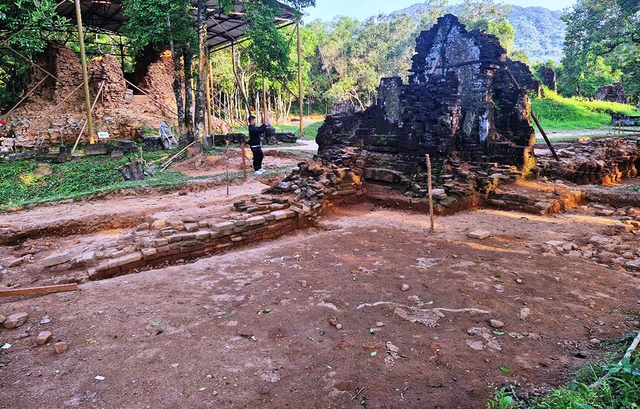
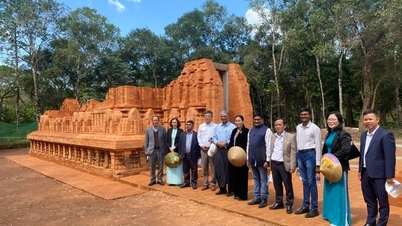
The successful implementation of the conservation project for tower groups F and E will make a significant contribution to the revitalization of the entire My Son historical site. PHOTO: MANH CUONG
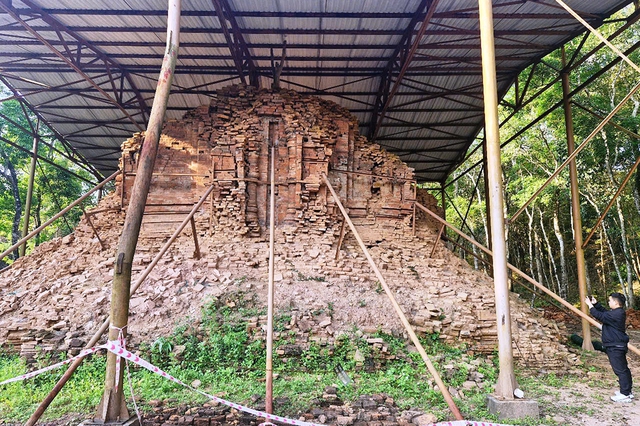
In 2003, Tower F1 was excavated, but at that time it was only covered with a corrugated iron roof. PHOTO: MANH CUONG
CONTRIBUTING TO THE REVIVAL OF THE ENTIRE HISTORICAL SITE
According to Mr. Nguyen Cong Khiet, the F tower complex has a long history and is considered by Indian experts to be one of the largest tower complexes in the entire My Son sanctuary. However, due to war damage, many towers are now just ruins. "Tower F1 is the main temple complex, playing the most important role. In 2003, Tower F1 was excavated, but at that time there was no restoration solution, only a corrugated iron roof to protect it from the weather. If it is not restored soon, Tower F1 is at risk of landslides during upcoming storms," Mr. Khiet said.
Mr. Khiet affirmed that the successful implementation of the conservation project for tower groups F and E will significantly contribute to the "revival" of the entire My Son historical site, as these are the last remaining damaged temple groups in My Son. In particular, visitors to My Son will have the opportunity to directly witness the process of experts reviving one of humanity's most precious spiritual architectural works. "If tower groups F and E are restored, it will maximize the value of the heritage, restoring the long-standing historical value of the tower groups. Along with that, the tourism space will be expanded, offering more experiences and attracting more tourists on their journey to explore My Son. Therefore, the restoration project for these tower groups is urgent," Mr. Khiet asserted.
Mr. Shri Azmira Bhima, Director of the Archaeological Survey of India, expects that the conservation and restoration of towers F and E will contribute to overcoming the damage and deterioration; restoring and perfecting the architectural space of the My Son Sanctuary - a unique world cultural heritage site. In particular, this will contribute to improving the management and professional capacity of staff, creating conditions for building and forming a skilled workforce for monument conservation. The clear effectiveness of the projects is the stability of the temple structures within the My Son sanctuary.
The My Son restoration project began in 2014, aiming to revive the ancient architectural complex. From 2017 to 2022, the Indian government funded 55 billion VND to restore the K, H, and A towers, returning them to their original appearance as when they were discovered by the French. This project has been highly praised by domestic and international experts and tourists. The restoration process collected 734 artifacts of various kinds, including the discovery of the largest monolithic Linga-Yoni altar in Vietnam at tower A10. In 2022, this altar was recognized as a National Treasure. In 2024, My Son also announced the discovery of an underground "sacred road" at the K tower area. Archaeological researchers believe this mysterious road dates back to the 12th century (corresponding to the age of tower K). This is the main road, the "sacred road," the royal road leading into the My Son sanctuary.
Source: https://thanhnien.vn/hoi-sinh-nhung-thap-co-hoang-phe-cuoi-cung-o-my-son-185250407210706151.htm


![[Photo] General Secretary and President To Lam presides over a meeting with the Central Organizing Committee.](https://vphoto.vietnam.vn/thumb/1200x675/vietnam/resource/IMAGE/2026/06/03/1780482764658_a1-bnd-4741-3342-jpg.webp)
![[Photo] First session of the 14th Congress of the Vietnam Trade Union](https://vphoto.vietnam.vn/thumb/1200x675/vietnam/resource/IMAGE/2026/06/03/1780465947883_ndo_br_img-3852-jpg.webp)
![[Photo] Secretary of the National Assembly Party Committee, Chairman of the National Assembly presides over the meeting of the Standing Committee and Executive Committee of the National Assembly Party Committee.](https://vphoto.vietnam.vn/thumb/1200x675/vietnam/resource/IMAGE/2026/06/03/1780480353201_ndo_br_bnd-2585-jpg.webp)
























![[Video] Sunset at Lap An Lagoon – Where the sun sets over the fishing nets](https://vphoto.vietnam.vn/thumb/1200x675/vietnam/resource/IMAGE/2026/05/31/1780192137701_beach-landscape-sea-water-nature-grass-745871-pxhere-com.jpeg)
















Comment (0)