

Once one of the busiest trading ports in the Southern region of Vietnam in the early 17th century, Nuoc Man not only marks a golden age of international trade but is also considered the birthplace of the Vietnamese Quốc ngữ script.
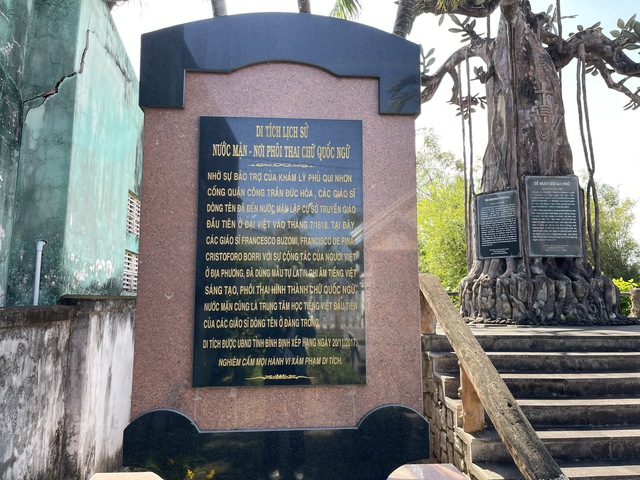
Gia Lai province plans to restore the Nuoc Man historical site – the birthplace of the Vietnamese Quốc ngữ script.
PHOTO: DUC NHAT
According to Dr. Dinh Ba Hoa, former Director of the Binh Dinh Museum, in the early 17th century, Nuoc Man emerged as a major commercial center of Dang Trong (Southern Vietnam) alongside Hai Pho (Hoi An). Located beside Thi Nai Lagoon, it was once a bustling stopover for Japanese, Chinese, and Western merchants.
In 1618, when the missionary Cristoforo Borri arrived in Nuoc Man, he described the place as a large "city." The local governor also had a comfortable house built there for the missionaries.
The prosperity and openness of the Nước Mặn trading port created favorable conditions for Jesuit missionaries such as Francesco Buzomi, Francisco de Pina, Cristoforo Borri, and Antonio de Fontes to reside, evangelize, and build the first church in this area. It was during their learning of Vietnamese and communication with the local people that these missionaries and their Vietnamese collaborators began experimenting with transcribing Vietnamese using the Latin alphabet.
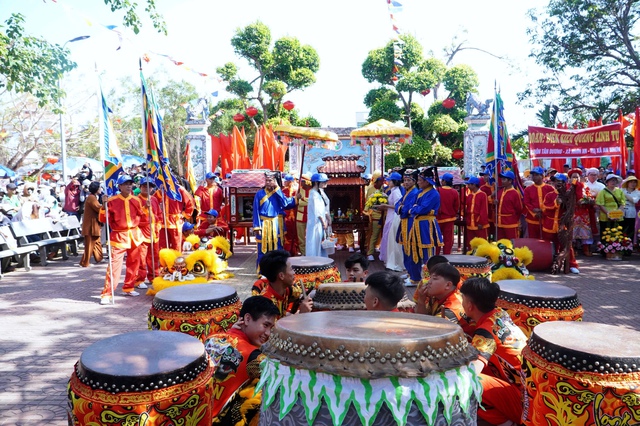
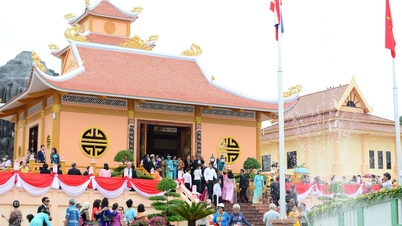
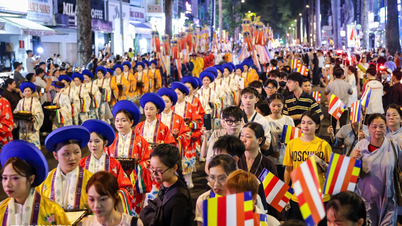
The Ba Pagoda Festival - Nuoc Man Port preserves the memory of a once prosperous and thriving trading port.
PHOTO: DUC NHAT
Those rudimentary characters formed the first foundation for the formation and development of the Vietnamese Quốc ngữ script. Therefore, Nước Mặn is considered by many researchers to be one of the first cradles of the Quốc ngữ script in Vietnam.
However, according to Dr. Hoa, after its heyday, the Nuoc Man trading port gradually declined in the late 18th and early 19th centuries when the estuary became silted up, making waterway trade routes less convenient. The silt from the Con River also couldn't drain into the sea, causing sedimentation, the river branches dried up, saltwater couldn't reach the market, and boats couldn't access the port. From a bustling port city, Nuoc Man gradually faded into oblivion amidst the fields bordering the Thi Nai lagoon.
Nevertheless, many historical relics still remain here, such as the Quan Thanh Temple, the Ba Pagoda, and the Chinese families who once contributed to the prosperous appearance of the ancient port town. These cultural values are gradually being restored through the annual Ba Pagoda - Nuoc Man Port Festival and the preservation of historical sites.
According to the Gia Lai Provincial People's Committee, this is not only a relic of exceptionally important historical, cultural, and linguistic value, but also a milestone of profound significance in the process of national cultural development, contributing to the formation of a unified language tool, creating a foundation for the dissemination of knowledge, the development of journalism, education , literature, and social life in Vietnam through many historical periods.
Therefore, investment in, preservation, and promotion of the value of historical sites need to be studied systematically and in depth, commensurate with the typical value of the birthplace of the Vietnamese Quốc ngữ script. From there, it can gradually be developed into a unique cultural, historical, and tourist destination with value in traditional education, scientific research, and promoting the image of the locality.

The banyan tree with 16 branches at the Nước Mặn Port City historical site - the birthplace of the Vietnamese Quốc ngữ script.
PHOTO: DUC NHAT
Recently, the People's Committee of Gia Lai province agreed on the principle of implementing a project to restore, preserve, and promote the historical value of Nuoc Man - the birthplace of the Vietnamese Quốc ngữ script. According to the plan, the historical site will be connected with Ba Nuoc Man Pagoda and other nearby cultural and religious structures to form a unique cultural, historical, and tourism complex of the locality.
The investment aims not only to preserve the original values of the ancient trading port but also to develop Nuoc Man into a destination for tourism, research, and traditional education. Through this, it contributes to reviving pride in the journey of the formation of the Vietnamese national script.
Source: https://thanhnien.vn/hoi-sinh-vung-dat-phoi-thai-chu-quoc-ngu-185260519225316297.htm






















































































Comment (0)