

The scent of the village is easily recognizable but hard to forget.
Amidst the hustle and bustle of life, the small village of Dong Khe, Hoang Giang commune ( Thanh Hoa province), still "slows down" in its own unique way. There, as the year draws to a close, the atmosphere softens in the lingering smoke mingled with the sweet fragrance of incense.
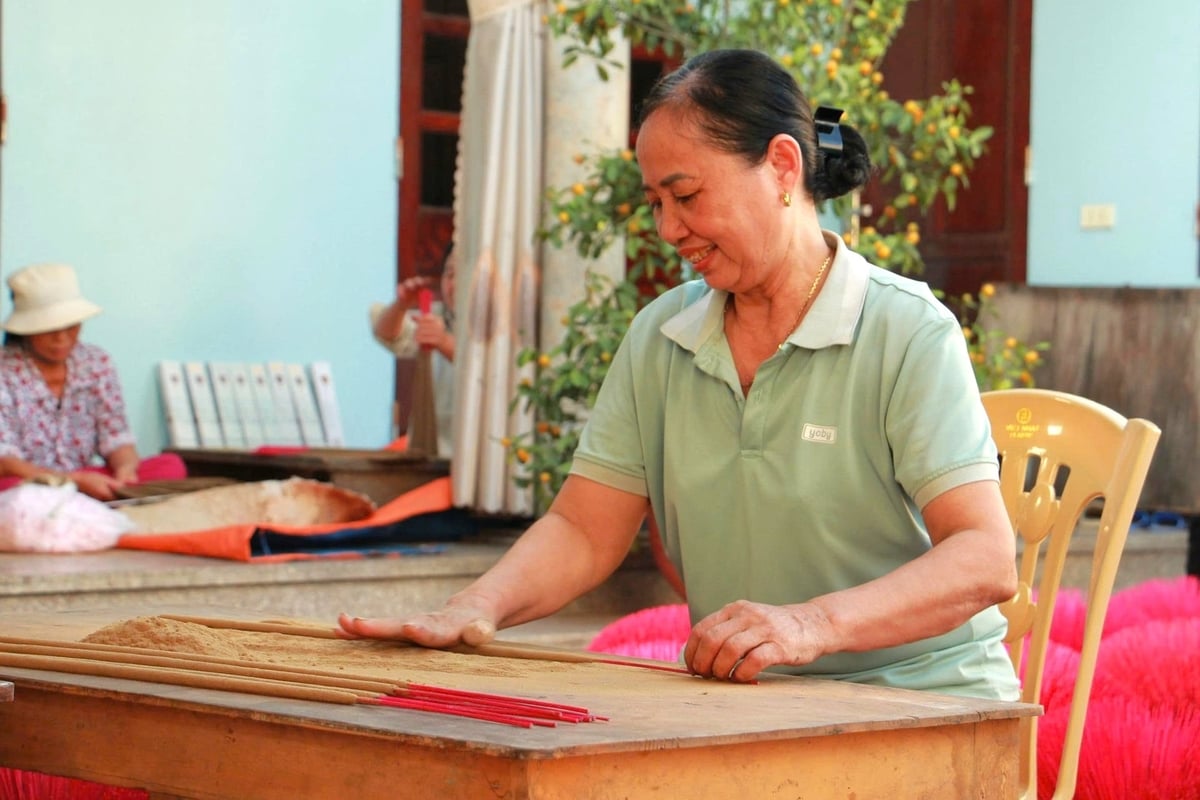
Ms. Doan Thi Tien stated that, despite many ups and downs, Dong Khe incense has retained its unique "character," characterized by its easily recognizable and unforgettable aroma and entirely natural ingredients. Photo: Trung Quan.
According to the elders in the village, the incense-making craft in Dong Khe dates back to the 18th century. At that time, a villager followed a merchant to the Kinh Bac region to learn the art of incense making and then brought it back to teach. From just a few initial households, the craft gradually spread throughout the village, becoming a livelihood for many generations.
Despite enduring the vicissitudes of history and facing the harsh changes of the market economy , Dong Khe incense village has survived like a smoldering flame that has never been extinguished.
What makes Dong Khe incense so special is its unique "quality," derived from entirely natural ingredients and its easily recognizable, unforgettable aroma. The villagers say that just by smelling it, you know it's the incense of their hometown.
For visitors from afar, arriving at the village during the end of the year is like stepping into a different world. The small road leading into the village is adorned with a "new look." On both sides of the path, rows of bright red incense sticks are lined up, drying in the sun. In the courtyard of each house, men hunch over machines splitting incense sticks, while women sit in rows, their hands nimbly rolling each stick through a smooth, thick layer of resin. Despite the charcoal powder staining their hands black, the women still manage to create perfectly round and smooth incense sticks.
“From mid-October in the lunar calendar, every household speeds up to prepare incense supplies for the Lunar New Year and New Year festivals. Unfortunately, the weather turns cold and humid during this period, so we have to take advantage of every ray of sunshine to dry the incense. If we are careless, just one sudden rain shower and all our hard work is wasted,” said Mrs. Doan Thi Tien while rolling incense sticks.
Mrs. Tien is one of the few remaining people in the village who still make incense by hand. Now 65 years old, her hands are calloused from years of hard work, her fingernails darkened by charcoal powder, but her movements remain skillful and precise. Each incense stick she makes seems to carry the love of her craft and the wishes for peace and prosperity accumulated through generations.

In the days leading up to Tet (Lunar New Year), artisanal incense makers in Dong Khe work day and night, speeding up preparations to meet customer orders. Photo: Trung Quan.
According to Ms. Tien, to create an authentic Dong Khe incense stick, the craftsman must go through more than a dozen steps, and no step can be done carelessly. The incense sticks are made from carefully selected mature bamboo, reed, or cane; they are split into small pieces, evenly whittled, then dyed red at the base and dried.
The "soul" of the incense stick lies in the mixture of resin and incense powder. The resin is mixed with charcoal powder made from peanut, sesame, or dried banana leaves to create the right consistency. Then, the incense stick is rolled through the resin, and then coated with a layer of herbal powder, a type of herb that creates a gentle base fragrance, ensuring the incense burns evenly and the ash curls beautifully. After completing all the steps, the incense is dried in the sun. The sun and wind not only help the incense dry but also preserve its original color and aroma.
Nowadays, some stages, such as splitting bamboo sticks, are assisted by machinery, reducing the labor involved. However, most households in Dong Khe remain loyal to the manual method of rolling incense sticks. "Making it with a machine is faster, but rolling it by hand is the only way to truly infuse the incense with emotion, to feel the familiar scent of home, and to feel that we are genuinely preserving the craft of our ancestors," shared Ms. Doan Thi Tien.
With its unique production method, Dong Khe incense is highly sought after in the market. The incense burns evenly, produces light smoke, contains no added chemicals, and the ash curls beautifully, symbolizing completeness and good fortune. Bundles of vibrant red incense are carried by traders to all corners of the country, from Thanh Hoa and Nghe An to Gia Lai and Ho Chi Minh City… gracing the ancestral altars of every family during the Lunar New Year.
Currently, the two main products that make up the Dong Khe brand are incense sticks and incense rods. Incense sticks cost around 35,000-40,000 VND per bundle; incense rods range from 55,000-95,000 VND per 10 sticks (prices may vary depending on the time of year). The selling price is generally not high, but it is enough to provide villagers with extra income during the Lunar New Year season.
A desire to preserve the craft.
During the Tet holiday season, the entire village of Dong Khe is bustling from early morning until late afternoon. Some are rolling incense sticks, others are drying them in the sun, and still others are bundling the finished products. The gentle fragrance wafts through the air, blending with the cheerful calls of people, creating a feeling that Tet is drawing very near.

The two main products that make up the Dong Khe brand are incense sticks and incense rods. Photo: Thanh Tung.
Bundles of finished incense sticks are carefully packaged and stacked on the porch, waiting to be shipped to provinces throughout the country. These are not just simple offerings for worship, but also represent the heartfelt devotion, faith, and prayers for a peaceful new year that the incense makers send through each wisp of smoke.
"There's only one big harvest each year. If we make a lot, we'll have some money for Tet (Lunar New Year). We have to stop in the spring because of the humid weather, and the incense sticks don't dry properly," shared Mr. Doan Van Mau, who has been involved in the traditional handcrafted incense making profession for nearly 40 years.
However, amidst the lingering aroma of incense smoke, the villagers of Dong Khe still harbor a constant worry: if they cannot attract a younger generation to continue their ancestors' craft, will the incense-making tradition, which is over 300 years old, survive in the village?
According to Mr. Doan Van Mau, in the past, children in the village grew up knowing how to make incense sticks, but now most of them have gone to school, worked far away, or switched to other professions, and very few are still interested in the traditional incense-making craft. If you go deep into the small alleys of Dong Khe today, it's not difficult to notice that most of the incense makers are elderly. The presence of young people in the village following the craft is becoming increasingly rare.
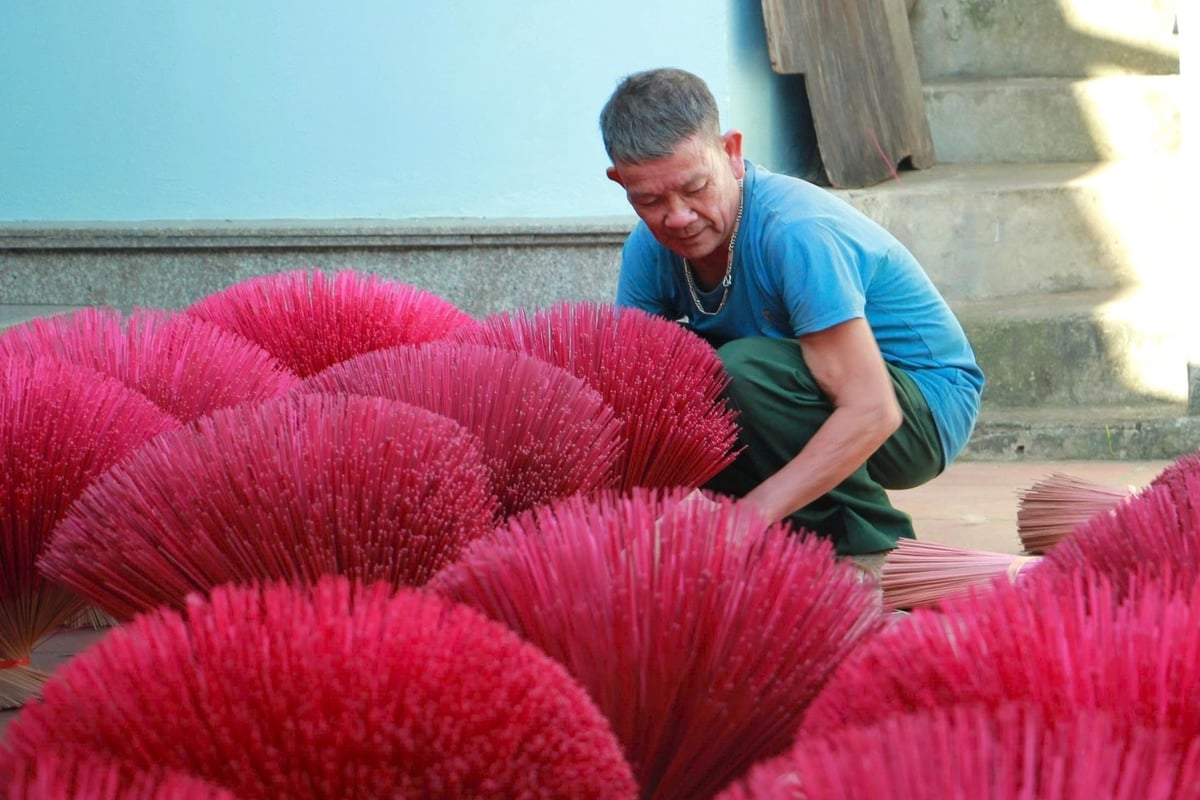
According to Mr. Doan Van Mau, the people of Dong Khe village have always been concerned about how to preserve the traditional incense-making craft. Photo: Trung Quan.
Perhaps it's because incense making is inherently risky. Just a sudden rain shower can ruin dozens of incense sticks drying in the sun. Natural ingredients are becoming increasingly scarce and expensive, while the market is being overwhelmed by cheap, industrially produced incense…
"Despite facing many difficulties, for each person in Dong Khe village, incense making is not just a livelihood but also a memory and a cultural tradition during every family reunion season. Preserving this traditional craft means preserving the soul of our homeland for ourselves and for future generations," Mr. Mau confided.
Source: https://nongsanviet.nongnghiepmoitruong.vn/huong-dong-khe-thom-tu-ky-uc-thom-sang-xuan-nay-d794457.html



















![The Quintessence of Northern Vietnam's Villages: [Part 2] The Famous Cassava Noodles of Kunming](https://vphoto.vietnam.vn/thumb/402x226/vietnam/resource/IMAGE/2026/05/28/1779937455892_3929-3144-mien-dong-15-nongnghiep-023138.jpeg)
![The Essence of the Village: [Part 1] Wine on the mountain, tea in the clouds - Bang Phuc](https://vphoto.vietnam.vn/thumb/402x226/vietnam/resource/IMAGE/2026/05/27/1779841729178_3821-1jpg-nongnghiep-103814.jpeg)

















































Comment (0)