

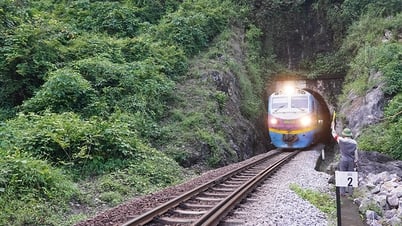
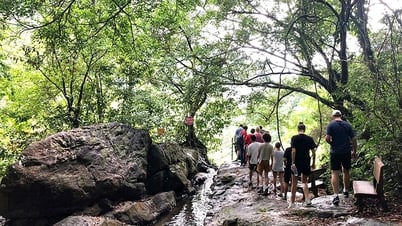
(QBĐT) - At Km466+861 on the North-South railway line, between Lac Son and Le Son sections, after climbing 140 steps, visitors will reach the scenic Chan Linh Cave, famous in ancient historical accounts of Quang Binh province.
Geological processes and transformations have created many caves within the mountains of Le Son village, now Van Hoa commune (Tuyen Hoa district), such as Mu Chan Cave and Oong Cave, but the most prominent is Chan Linh Cave.
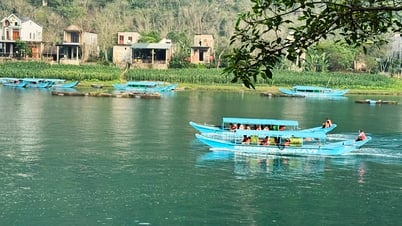
Chan Linh Cave is a famous scenic spot located west of the village, nestled within a limestone mountain called Len Dut Chan, extending all the way to the Gianh River. It marks the boundary between Kinh Chau hamlet, Chau Hoa commune, and Le Son village. The cave, approximately 100 meters high, possesses a mystical beauty intertwined with numerous legends and mythical tales, making it a particularly attractive destination for poets and scholars visiting Le Son in the past.
 |
The cave door was not locked.
Guests are reluctant to leave" (2)
The book Dai Nam Nhat Thong Chi records quite detailed the legend of Den Dut Chan, where Chan Linh cave was formed: “ It is said that in the past there was a fairy Chan Linh who often lived in the cave. There was also a monk who was skilled in magic. One day, the monk used a sword to cut the side of the mountain, and then cut the foot of the mountain. The fairy ran away to Phuc Lam ward, the monk followed her, and then both of them turned into rocks on the mountain.... On this mountain slope there is a place where the rock looks like it has been cut, it is said that this is the mark of the monk's sword; at the foot of the mountain there is a hollow place, it is said that this is the mark of the monk cutting the foot of the mountain. To the west of this mountain, there is a rocky cliff opening up on both sides, in the middle there is the Chan Linh fairy temple, whenever we pray for rain we are often blessed ” (3) .
Legend has it that, since ancient times, Chan Linh has boasted over 3,000 beautiful landscapes. Fairies would often descend to the river to bathe, then enter the caves to admire the scenery and rest, where chess boards were provided for entertainment. Among these fairies was a princess, daughter of the Jade Emperor, who was so captivated by the beauty of Chan Linh that she requested to descend to the mortal world upon returning to Heaven. The Jade Emperor agreed and appointed his daughter as the mistress of Chan Linh Cave, overseeing its beauty. This legend was adapted into a poem titled "Chan Linh Cave Literary Practice" by Mr. Hang, a folk poet from Le Son village, written in 1902 and transcribed by the late teacher Luong Duy Tam.
"...Returning to the celestial realm to pay homage to God,
The scenery of Chân Linh is extraordinary.
Throughout the land, the scenery was clearly depicted.
The decree was issued by the Jade Emperor, bestowed with the title.
The Lord was appointed as the Master of the True Spirit Cave.
"To replace the power of wind and rain, to save the people."
The poem "Chân Linh Cave's Literary Practice" also records the event where the owner of Chân Linh Cave appeared in a dream to King Thiệu Trị, advising him to temporarily stop crossing the river to avoid strong waves and winds during his northern tour in 1842. After returning to the capital, King Thiệu Trị issued a royal decree to express his gratitude and appointed the owner of Chân Linh Cave as the deity of Quảng Trạch Prefecture, bestowing gold, silk, and brocade upon him, and entrusting Lệ Sơn village with the annual rituals during the spring festival.
"When the golden palanquin makes its northern procession of the cross"
To repay the divine favor, I offer a peach of jade.
Although it was the Han Emperor's dream,
It was also the Queen Mother who appeared and disappeared...
And once again, they gifted me a few rose bushes.
The money from the dragon cloud amounted to millions of gold and silver coins.
Imperial decree announcing the spring festival.
Bao Gong manifested his benevolent grace and bestowed his kindness upon us…”.
With legends about the Broken Foot Rock and the Fairy Chan Linh, and the poetic inspiration of many poets and writers who have created verses about the beauty of this paradise-like place, the already vibrant and romantic landscape of Chan Linh Cave has become even more captivating. From the O Chau Can Luc to the Dai Nam Nhat Thong Chi and Dong Khanh Dia Du Chi, all describe Chan Linh Cave but do not mention the detail of its entrance being filled in. Therefore, to this day, the exact time when Chan Linh Cave was filled in remains undetermined. The filling in of the cave entrance is a regrettable loss not only for Le Son village in particular but for Quang Binh province in general. Because, according to descriptions in ancient historical texts, the scenery and stalactites inside Chan Linh Cave were as dazzling and magnificent as Phong Nha Cave in Bo Trach district.
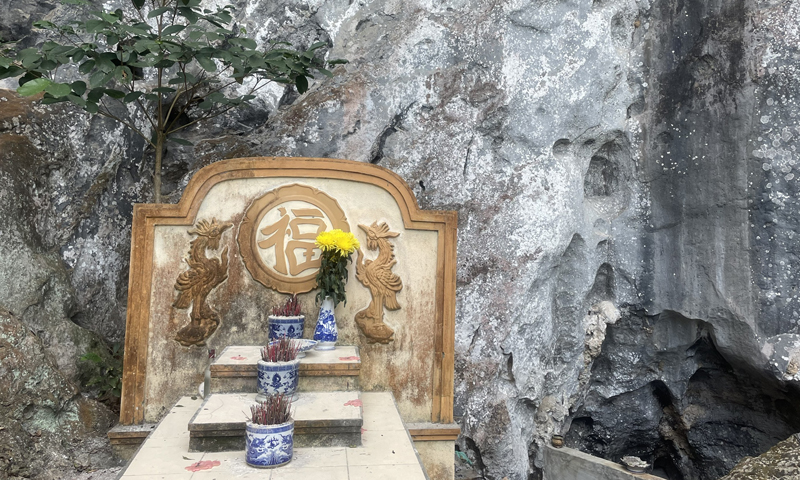
According to tradition, during drought years, village officials and functionaries would prepare offerings to the fairy goddess at the temple. After the ceremony, the villagers would kill a dog, cut off its head, and row a boat to the middle of the Gianh River, in front of the Chan Linh cave, throwing it into the river. They believed that the cave entrance would be defiled by the dog's blood, and the gods would send rain to wash away the impurities. Thanks to this, the fields would be spared from drought. From ancient times to the present day, Le Son village has maintained the custom of sending village elders and dignitaries to the temple at the entrance of the Chan Linh cave to offer sacrifices, praying for protection, favorable weather, and flourishing crops.
According to Mr. Tran Xuan Que (85 years old, residing in Le Loi village, Van Hoa commune), the entrance to Chan Linh cave was already blocked. During the war against the US, the area around Len Dut Chan was heavily bombed by enemy aircraft aiming to collapse the tunnel entrance of the North-South railway line, causing rocks from the mountaintop to fall and further solidify the cave entrance. In 2010, the People's Committee of Van Hoa commune built an access road and restored the altar right in front of the cave entrance. The blocked cave entrance, located to the right of the altar when viewed from the Gianh River, has been sealed with concrete.
Geological processes, coupled with human impact, have sealed off the entrance to Chan Linh Cave. Its shimmering, mystical beauty, imbued with legend, continues to be hidden within the pages of ancient history. The opportunity to conquer and unveil the mysteries of Chan Linh Cave awaits cave exploration experts.
Nhat Linh
(1), (2). Duong Van An, O Chau Can Luc , Asian Culture Publishing House, Saigon, 1961, pp. 14, 15.
(3). National History Institute of the Nguyen Dynasty, Dai Nam Nhat Thong Chi, Labor Publishing House, East-West Language and Culture Center, Hanoi, Volume II, 2012, pp. 519-520.
Source

























































































Comment (0)