

According to the International Institute for Strategic Studies' 2023 annual assessment, the Iranian armed forces are one of the largest in the Middle East, with at least 580,000 active-duty personnel and approximately 200,000 trained reservists.
Currently, experts believe that Iran's arsenal of cruise and ballistic missiles has the capability and range to reach any target throughout the Middle East. According to the US Office of the Director of National Intelligence, Iran possesses the largest number of ballistic missiles in the region.
Most notably among these is the country's first domestically produced hypersonic ballistic missile, the Fattah. Not only is it a symbol of Iran's military might, but this weapon also poses a serious challenge to Israel's advanced missile defense systems, which were once considered impenetrable.
Unstoppable
The Fattah-1, unveiled in 2023, was Iran's first hypersonic missile and was named by the country's then-Supreme Leader, Ayatollah Ali Khamenei. Just a year later, the country introduced the Fattah-1 with significant improvements.
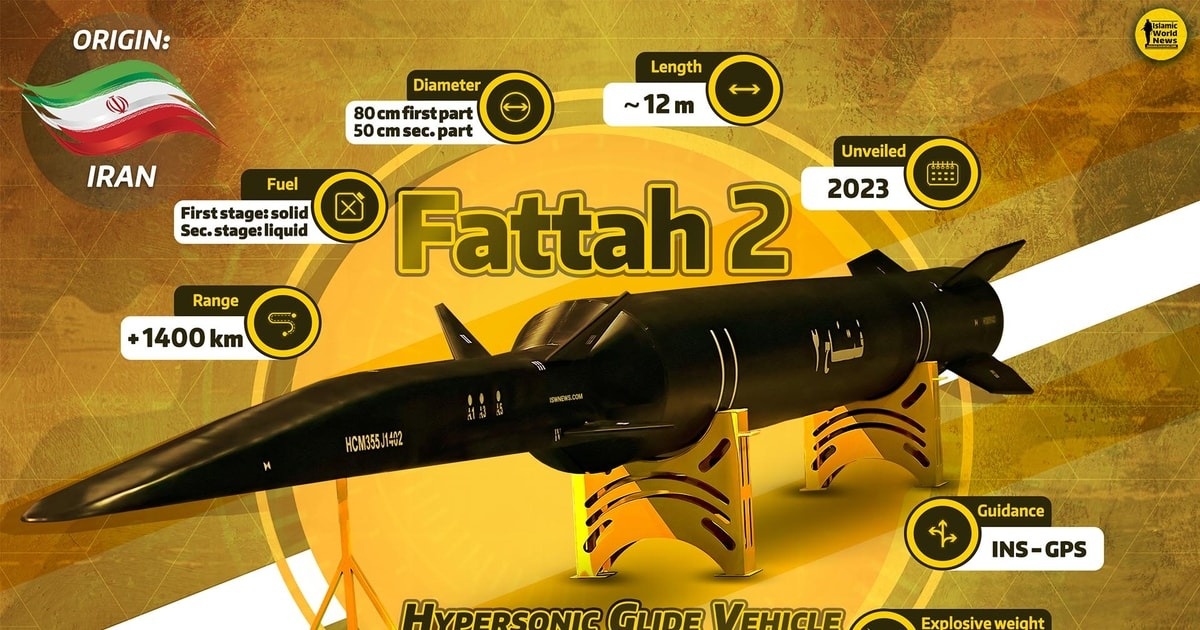 |
Technical specifications of the Fattah-2 hypersonic missile. Photo: ISW News |
Unlike the first-generation Fattah, the Fattah-2 uses a hypersonic glide vehicle instead of a conventional re-entry warhead. This allows the missile to maneuver both horizontally and vertically in the final phase, approach the target from an unpredictable direction, and maintain very high speeds in the atmosphere.
According to Iranian sources, Fattah-2 is capable of traveling at Mach 15 – equivalent to approximately 18,522 km/h and 15 times the speed of sound.
More specifically, the Fattah-2's hypersonic glide vehicle (HGV) technology allows the missile to change direction in a short time during descent to avoid interception. At this speed, the Fattah-2 significantly reduces the reaction time of any naval defense system.
Furthermore, it can travel enormous distances in just a few minutes. This makes early detection the most crucial condition for Fattah-2's target vessels.
Unlike standard ballistic missiles, the Fattah-2, with its HGV technology, delivers its warhead in a highly unpredictable manner. This weapon has a range of approximately 1,500 km, allowing it to strike multiple targets in the area.
The HGV helped Fattah-2 separate from the booster rocket and travel through the atmosphere at a lower altitude. It did not follow a predictable parabolic trajectory. This complicates standard tracking methods, which rely heavily on pre-programmed trajectories.
The main advantage of the Fattah-2 is its ability to change flight direction mid-air while gliding at altitudes of 12-30 km. It can be controlled both vertically and horizontally, approaching targets from unexpected directions.
This type of flight maneuvering within the atmosphere allows weapons to avoid radar detection for longer periods. By the time the ship's sensors lock onto the target, the possibility of interception is virtually closed. This forces defense networks to constantly recalculate the flight path.
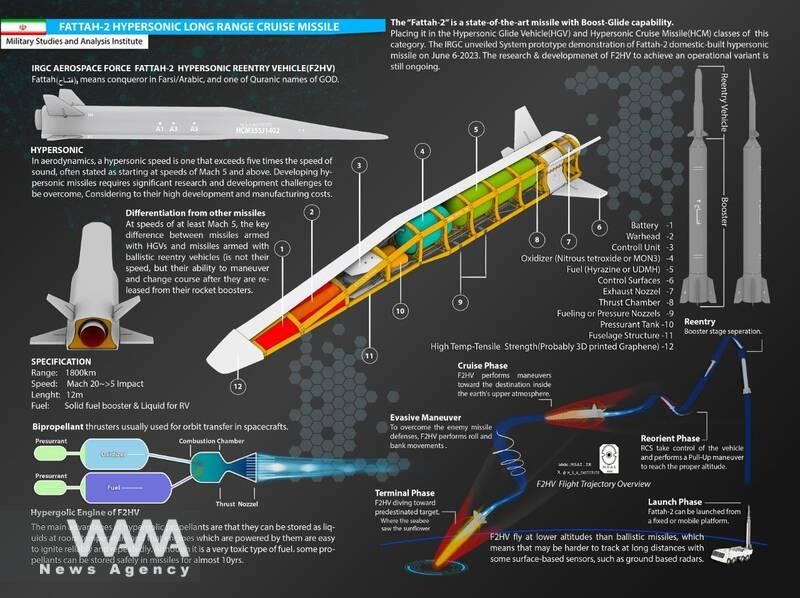 |
The Fattah-2 possesses the ability to change its flight direction mid-air while gliding at altitudes of 12-30 km. It can be maneuvered both vertically and horizontally, approaching targets from unexpected angles. Photo: WANA News Agency. |
Yuval Baseski, Vice President of Rafael — Israel's leading manufacturer of missile defense systems — acknowledges that current systems are designed to target objects moving along predictable trajectories.
To intercept a missile reaching Mach 15 like the Fattah-2, the defense system would need to react at approximately 30 times the speed of sound. Baseski asserts that current technology does not meet that requirement.
Challenges for US aircraft carriers
The US carrier strike group USS Abraham Lincoln is currently protected by Arleigh Burke-class destroyers equipped with the Aegis combat system.
This system is capable of tracking and processing over 100 targets simultaneously and can perform calculations to prioritize the most urgent threats.
To detect threats like the Fattah-2, modern U.S. destroyers use the SPY-6 radar system. These systems have multiple arrays providing continuous, 360-degree situational awareness with no blind spots.
The SPY-6 is significantly more sensitive than older generation radars, allowing it to detect smaller, faster objects at greater distances. It simultaneously tracks ballistic missiles, cruise missiles, and hypersonic missiles while eliminating electronic interference.
The primary interceptor missile in this defense system is the SM-6, designed to destroy targets in the terminal phase of their trajectory.
However, the biggest problem is that the SM-6 only flies at Mach 4. Intercepting an object moving more than three times faster, like the Fattah-2, is a challenge that almost exceeds the limits of physics.
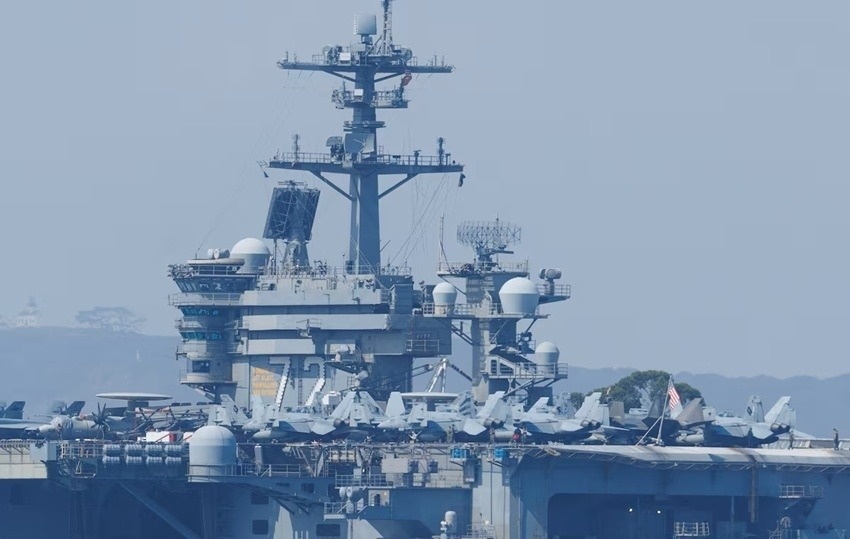 |
Military experts believe the USS Abraham Lincoln's defense system is almost incapable of stopping Fattah-2. Photo: Reuters. |
However, the problem wasn't just speed. Because the Fattah-2 flew at a low altitude, the curvature of the Earth obscured it from warship radar until the missile was very close. By the time the Aegis system detected the target, the reaction time was only seconds.
This has prompted Israel to research and develop a specialized "zone" defense system to counter hypersonic missiles like the Fattah-2. However, experts believe that this process could take decades and cost billions of dollars.
Even if the U.S. could intercept a single Fattah-2 missile under ideal conditions, that wouldn't be a realistic combat scenario.
Each missile carries a 200 kg warhead. If multiple missiles are launched simultaneously, in combination with drones and cruise missiles, the number of SM-6s on each destroyer will quickly be depleted.
Therefore, it is not the speed of individual missiles, but rather the combined, large-scale attack tactics that pose the most serious threat to carrier strike groups, according to military analysts.
Source: https://znews.vn/iran-van-con-ten-lua-khong-the-danh-chan-post1634225.html
![[Photo] Opening Ceremony of the National People's Council Conference on the Implementation of Directions and Tasks for the 2026-2031 Term](https://vphoto.vietnam.vn/thumb/1200x675/vietnam/resource/IMAGE/2026/05/28/1779939257690_ndo_br_bnd-1991-jpg.webp)





























































































Comment (0)