

From songs and folk melodies
Perhaps, for the people of Minh Hoa, no one is unfamiliar with humming a few characteristic songs and melodies of their homeland. These simple, unpretentious songs and melodies are not only lullabies from childhood, but are also closely linked to the lives, work, and production of the people here, such as: call-and-response singing, ritual singing, folk singing, and fishing chants…
According to Mr. Dinh Xuan Dinh, former Chairman of the Vietnam Cultural Heritage Association of Minh Hoa district (formerly), the "Ho Thuoc Ca" (Fish Poisoning Chant) is a form of folk music reflecting the social labor practices of the people of Minh Hoa. The chant originated from the collective practice of poisoning fish by grinding or crushing the roots of the "teng" plant, then preparing it into a poison to be thrown into streams and creeks to catch fish. The "Ho Thuoc Ca" has a flexible and urgent rhythm, following the rhythm of the pestle grinding the poison. The lyrics are variations of six-eight syllable verses, with smooth and refined verses stemming from love between couples or from labor and production.
When performed, the 2/4 rhythm creates a harmonious and unified resonance, resulting in high efficiency in collective work. In the past, the fish-hunting chant was also used in social gatherings with friends, and in chants between hosts and guests.
Today, folk songs are performed at festivals and celebrations such as weddings and even while lulling children to sleep, especially during the Mid-March Festival in Minh Hoa. The singing and drumming are still performed as they were during labor. Whenever the folk song begins, the distinctive drumming "Hoi len la hoi len" blends with the clapping of the crowd, making the celebration even more lively.
 |
| Many traditional sports and folk games are maintained and organized at the annual Minh Hoa Culture-Sports-Tourism Week and the Mid-March Festival - Photo: VM |
In Minh Hoa, the "sac bua" singing tradition is a form of folk art and cultural activity that has been preserved, developed, and creatively adapted by the local people. According to Mr. Dinh Xuan Dinh, to this day, "sac bua" singing is still performed in many forms, such as: singing around alleys, gates, drums, firecrackers, singing in the courtyard, proclaiming names, and offering blessings…
The opening lines of the folk songs often begin with: "Poetry, yes, yes/Respectfully yielding to both sides" and end with: "Le, le is le/Ho le is le" or "Ho happy is ho happy". What is special about Minh Hoa folk singing is that it differs from folk singing in other localities in that a singing group usually consists of 5-7 people, led by a respected leader. The group consists only of men wearing long robes and turbans; there are no women, because the people believe that blessings from men will bring good fortune, prosperity, and strength to the household in the new year.
Many potentials
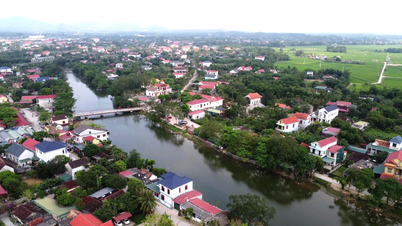
The land of the former Minh Hoa district possesses a diverse and rich collection of tangible and intangible cultural heritage, abundant in form, valuable in content, and vividly manifested through legends, rituals, festivals, customs, and traditions of the community.
To date, the locality has 3 national intangible cultural heritage sites, including: the "Hát sắc bùa" (a type of folk singing) of Minh Hóa district and Đồng Hới city; the folk performing arts and folk knowledge of "Hò thuốc cá" (a type of folk performing arts and folk knowledge) of Minh Hóa district; and the "Rằm tháng Ba" Festival of Minh Hóa district (a type of traditional festival). This land still preserves and contains the imprint of ancient Vietnamese civilization, integrating many layers of culture, with many archaeological sites, such as the caves: Yên Lạc, Xóm Thón, Trăn, Xóm Thâm…
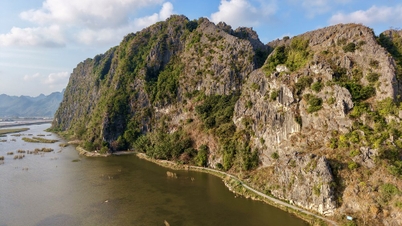
Along with that are historical relics associated with the formation, development, construction, and protection of the Fatherland, such as: the resistance base of King Ham Nghi; relics and historical sites along the Truong Son - Ho Chi Minh Trail such as: the Command Headquarters of the 559th Command, Cha Quang Hill, Heaven's Gate, Mu Gia Pass, Da Deo Pass, Rinh Tunnel, Khe Ve, Kim Bang Temple, But Waterfall, Nguyen Viet Xuan Battlefield, Cha Lo International Border Gate and many majestic natural landscapes: Tu Lan Cave, Ruc Mon Cave, Mo Waterfall, Yen Phu Lake…
According to Mai Xuan Thanh, Deputy Director of the Department of Culture, Sports and Tourism, these cultural and historical heritage sites are not only "red addresses" for educating the younger generation about patriotism and love for their homeland, but also attractive destinations for tourists to visit and experience. All of these heritage values are resources and advantages for localities to develop various types and products of tourism, such as cultural and historical tourism, ecotourism, and experiential tourism.
Therefore, a close and systematic connection between tangible and intangible cultural heritage is essential, not only for preserving and promoting heritage values, but also to serve the socio-economic development of localities within the unified geographical and historical context of the local communities.
DCH
Source: https://baoquangtri.vn/van-hoa/202604/ket-noi-khong-gian-di-san-0e72533/
![[Photo] General Secretary and President To Lam presides over a working session with the Central Policy and Strategy Committee on the development of the materials industry.](https://vphoto.vietnam.vn/thumb/1200x675/vietnam/resource/IMAGE/2026/05/21/1779359935432_a3-bnd-3129-1412-jpg.webp)

![[Photo] National Assembly Chairman Tran Thanh Man working with the Standing Committee of the Law and Justice Committee](https://vphoto.vietnam.vn/thumb/1200x675/vietnam/resource/IMAGE/2026/05/21/1779378929214_ndo_br_1-4610-jpg.webp)






























































Comment (0)