

THE VALUE OF STRAW
In previous harvest seasons, the sight of farmers burning straw in the fields was a familiar one in many rural areas of the Mekong Delta. The thick columns of smoke not only polluted the environment but also depleted the soil of valuable organic matter.
According to experts, burning rice straw produces large amounts of CO2 and many other pollutants, contributing to the greenhouse effect and directly affecting air quality.
In addition, the heat from the fire destroys many beneficial microorganisms, causing the soil to become increasingly compacted and lose its fertility.
However, in recent years, the mindset of farmers has gradually changed. In rice-producing "capitals" like the Mekong Delta in general and Dong Thap in particular, farmers are beginning to see a new opportunity to get rich in every dry straw; straw is no longer considered a burden but has become a valuable economic resource.
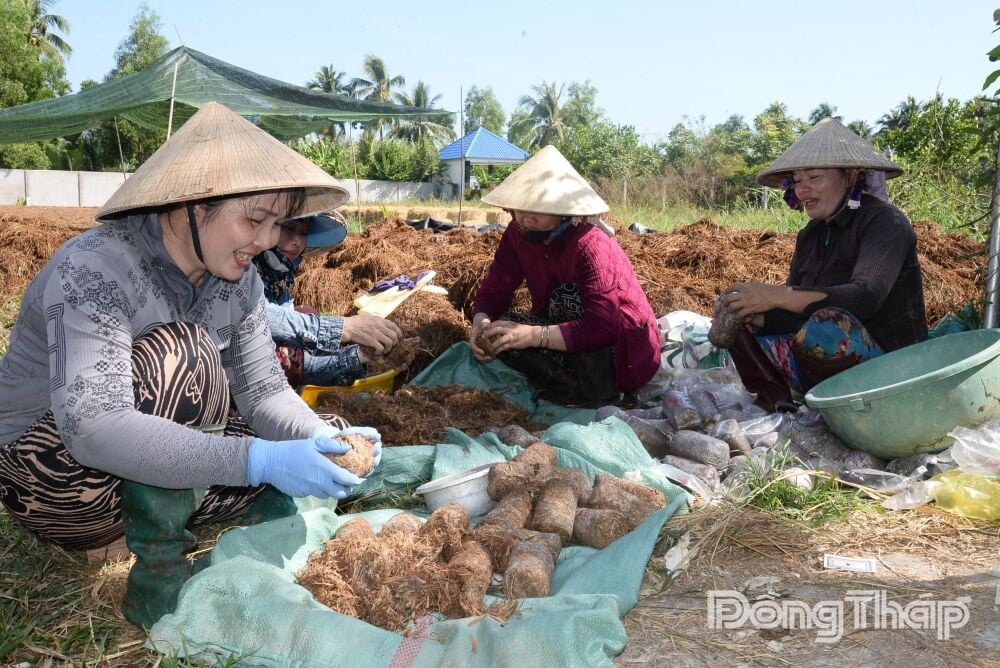
Leading us on a tour of her family's straw mushroom cultivation area, Ms. Nguyen Thi Kieu Trang, residing in Thanh Binh hamlet, Vinh Binh commune, excitedly shared about the transformation brought about by the dry straw bales after the harvest season.
"Previously, after harvesting the rice, I would burn it all to prepare the land for the next crop. But now, I'm willing to buy more straw from my neighbors to grow mushrooms," Ms. Trang said.
According to her, growing straw mushrooms requires much less effort than growing rice or vegetables. The most important thing is to control the temperature and humidity well so that the mushrooms grow steadily.
By utilizing the straw left over after the harvest, her family has a steady source of income year-round. Besides selling fresh mushrooms, the straw after the mushroom crop is also used to make organic fertilizer or sold to vegetable growers. "We utilize everything, nothing goes to waste," she said with a smile.
For Mr. Le Quoc Dat (who has over 10 years of experience growing straw mushrooms in the area), the economic benefits from rice straw are very clear. "Each hectare of rice yields about 6-7 tons of straw."
"If you burn it, only ash will remain, but if you use it to grow mushrooms, each ton of dry straw can yield nearly 200 kg of fresh mushrooms. With stable selling prices, the profit from a mushroom crop is double that of growing rice," Mr. Dat said.
According to Comrade Huynh Hai Son, Chairman of the Farmers' Association of Vinh Binh commune, the area for growing straw mushrooms in the commune is increasing every year. In the future, the locality will encourage farmers to switch to indoor mushroom cultivation models to proactively control temperature and humidity, reduce dependence on weather, and increase productivity.
"From seemingly discarded bales of straw, the people are creating a stable source of income and contributing to environmental protection," Comrade Son remarked.
RETURN NUTRIENTS TO THE SOIL
Besides providing direct economic value, rice straw is also utilized by many farmers in a closed-loop system to produce organic fertilizer and growing media for vegetables.
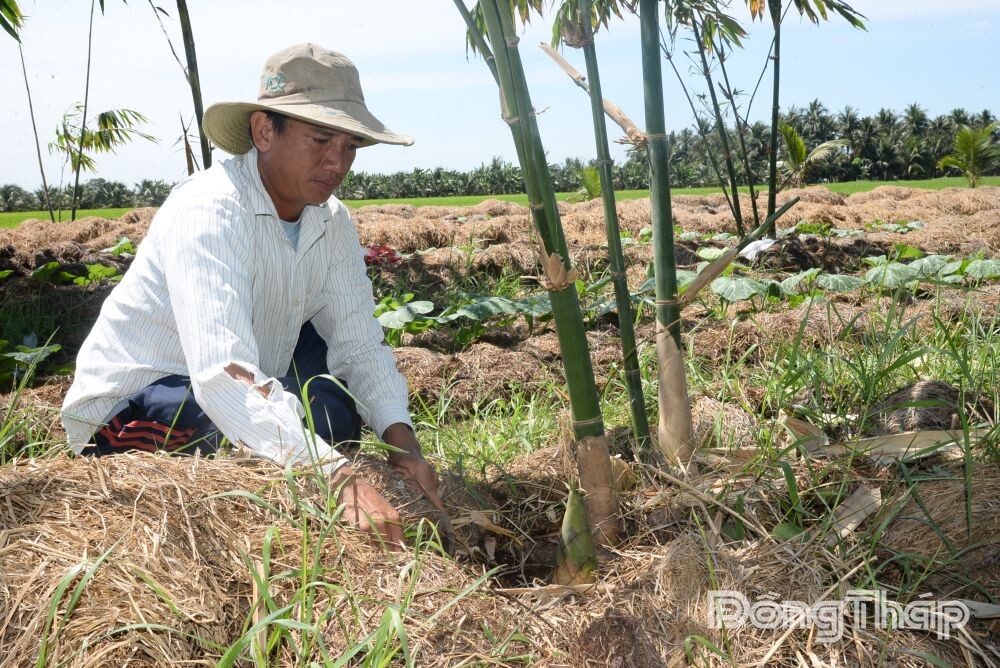
Mr. Tran Duy Khoa, residing in Thanh An hamlet, Vinh Binh commune, said that after harvesting mushrooms, the remaining straw is composted to make organic fertilizer for the production of clean vegetables and flowers.
"When using fertilizer made from straw, the soil becomes more porous, the plants are healthier and less susceptible to pests and diseases than before," Khoa shared.
Based on his practical experience, using organic fertilizer from straw helps reduce the amount of chemical fertilizer in agricultural production by 20% - 30%, thereby significantly reducing investment costs and improving the quality of cultivated land.
Amidst fluctuating animal feed prices, straw is becoming an important feed source for many large-scale cattle farms. Recognizing this demand, many farmers have invested in straw baling machines to supply raw materials to livestock farms.
Ms. Tran Thi Hoa, the owner of a cattle farm in Binh Ninh commune, said that thanks to a properly processed reserve of straw, her family's herd of more than 20 cows always has enough quality feed year-round.
"Utilizing straw significantly reduces the cost of buying fresh grass and mixed feed. As a result, livestock profits have increased noticeably," said Ms. Hoa.
UTILIZING IN THE DIRECTION OF GREEN AGRICULTURE
Utilizing rice straw is no longer just a matter for individual households, but is becoming part of a strategy for developing green agriculture and reducing greenhouse gas emissions.
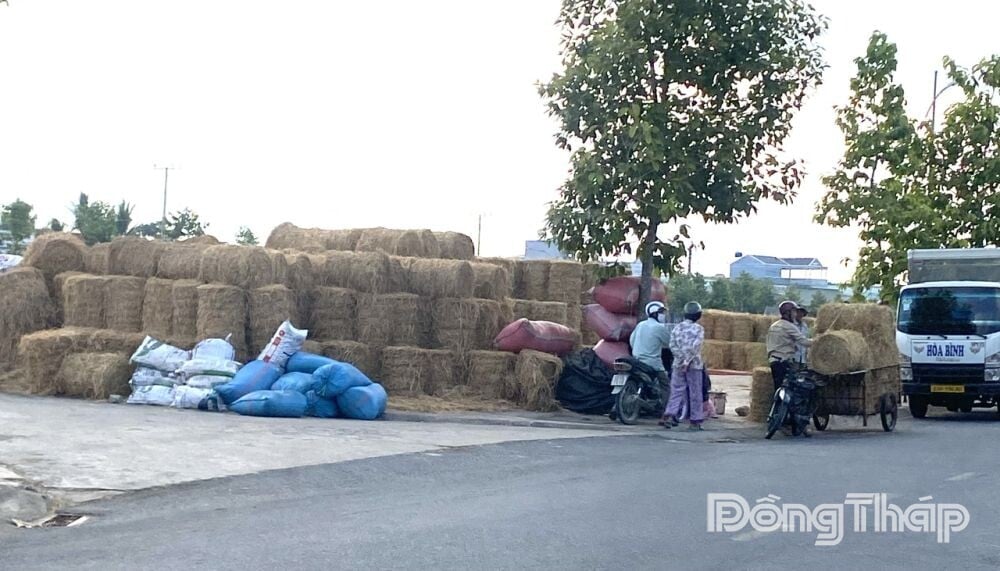
According to experts, the potential of rice by-products in Vietnam is still enormous. If exploited effectively, rice straw not only helps save production costs but also forms a whole new value chain such as: straw collection services, industrial-scale mushroom production, organic fertilizer, or environmentally friendly materials.
However, for the "straw revolution" to develop sustainably, close cooperation is needed among the "four stakeholders": the State, scientists , businesses, and farmers.
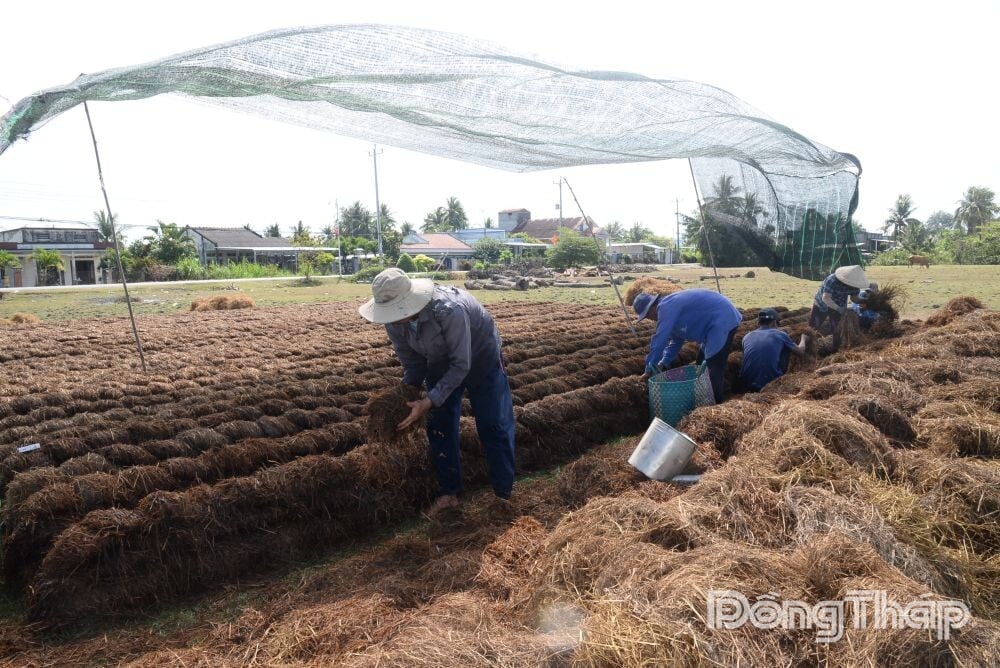
In this regard, the State needs to have policies to support machinery for collecting and preserving straw; businesses need to invest in advanced processing technology to create high-value, environmentally friendly products.
Fields free from straw burning smoke, bountiful mushroom harvests, and lush green vegetable plots grown from straw residue are demonstrating a new production mindset: one that is in harmony with nature and circular economy.
When farmers began to view straw as "brown gold," it marked a powerful transformation in rural areas, moving towards a greener, more sustainable, and higher-value agriculture derived from the simplest things after each harvest.
P. MAI
Source: https://baodongthap.vn/khai-thac-nguon-loi-cua-rom-ra-a240868.html
![[Image] Close-up view of the interchange connecting the two expressways and Long Thanh Airport.](https://vphoto.vietnam.vn/thumb/1200x675/vietnam/resource/IMAGE/2026/05/25/1779703378210_ndo_br_z7863716673926-224453a31600126cce10622af6290afd-4549-jpg.webp)



![[Image] Hanoi's urban life under the challenge of a "scorching hot" environment](https://vphoto.vietnam.vn/thumb/1200x675/vietnam/resource/IMAGE/2026/05/25/1779706979265_nang-nong-t5-2026-minh-duy-7-4636-jpg.webp)




























































Comment (0)