

Lai Da village preserves intact its cultural space, including the communal house dedicated to Nguyen Hien, the first laureate of the Tran dynasty; the shrine dedicated to Saint Mother Tien Dung, who assisted Nguyen Hien; and the Canh Phuc pagoda.
 Lai Da Temple. (Source: Vietnam Buddhist Association)
Located along the Duong River, Lai Da village (Dong Hoi commune, Dong Anh town, Hanoi ) is the birthplace of General Secretary Nguyen Phu Trong, who dedicated his entire life to the country and its people.
According to legend, Lai Da village emerged at the same time as the ancient capital of Co Loa. To this day, despite experiencing many ups and downs over time, the village still preserves many ancient features with structures that bear the distinctive characteristics of the Northern Delta region.
Lai Da village still preserves intact the cultural space including the temple dedicated to Nguyen Hien, the first laureate under the Tran dynasty (1247), the shrine of Saint Mother Tien Dung, who assisted Nguyen Hien, and the pagoda named Canh Phuc.
On September 5, 1989, the Ministry of Culture and Information (now the Ministry of Culture , Sports and Tourism) classified the Lai Da architectural and artistic complex as a National Monument.
Let's explore the historical sites in the ancient village of Lai Da - the hometown of General Secretary Nguyen Phu Trong.
Lai Da communal house, pagoda, and shrine
Lai Da Temple
The Lai Da communal house is dedicated to the scholar Nguyen Hien (1235-1256). Nguyen Hien was born on July 12, 1235 (the year of the Goat), in Vuong Mien village, Thuong Hien district (later renamed Thuong Nguyen, Thien Truong prefecture, Son Nam province), now Duong A village, Nam Thang commune, Nam Truc district, Nam Dinh province. Nguyen Hien was famous for his intelligence from a young age.
Having passed the Imperial Examination in the year Dinh Mui, the 16th year of the Thien Ung Chinh Binh era (1247), during the reign of Tran Thai Tong, at the young age of 13, Nguyen Hien was the youngest ever laureate in Vietnamese imperial examination history.
Nguyen Hien rose to the position of "Minister of Public Works." During his years in the royal court, he devised many excellent strategies to assist the king and serve the country. In the year of the Pig (1785), Vietnam was invaded by Champa. The king, greatly worried, entrusted the task of leading the army to defend the country. Shortly after, the enemy was defeated, and Nguyen Hien led his troops back to Vu Minh Son, held a feast to celebrate, and reported his victory to the king. The king was overjoyed and bestowed upon him the title of "First-ranked and most esteemed official." In agriculture, he ordered the construction of dikes along the Red River, developing production and ensuring bountiful harvests. In military affairs, he expanded martial arts schools to train soldiers.
On August 14th, 1256 (the year of Bính Tý), the top scholar Nguyễn Hiền fell seriously ill and passed away at the age of 21. The king, saddened by his death, posthumously bestowed upon him the title of "Great King Thành Hoàng" and honored him as a deity in 32 places, including Lại Đà communal house in Đông Hội commune, Đông Anh district, Hanoi.
According to historical records, the Lai Da communal house was built after 1276, initially called a temple, and later transformed into a communal house in the late 18th century. The current communal house was built in 1853. It is an ancient and imposing structure, built in a continuous style on a scenic plot of land shaped like a crouching tiger. In front of the communal house are two circular ponds, called the two lakes, with a rock in the middle representing the tiger's tongue. Behind the communal house is the tiger's body, followed by its tail. The communal house faces south, with a field in front and the Duong River in the distance. The Lai Da communal house has undergone numerous renovations. The largest renovation, in 2002-2003, was funded by the State with 1.5 billion VND.
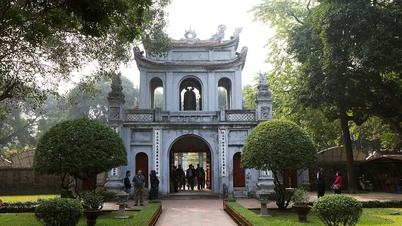
The Lai Da communal house is built with large pillars connected to the surrounding walls running parallel, with the temple's triple-arched gate and shrine entrance on either side. The main hall consists of five bays, with carved wooden trusses in the Late Le Dynasty style (18th century). In the sanctuary, there is a gilded wooden throne, a pair of lion statues in the 17th-century style, and a statue of Nguyen Hien placed in the center.
The Lai Da communal house still preserves 20 royal decrees, the earliest dating back to the Khanh Duc era (Le Thanh Tong) on March 19, 1652 (Year of the Dragon), and the last one from the reign of Emperor Khai Dinh on July 25, 1924.

Lai Da Pagoda. (Source: Vietnam Buddhist Association)
Lai Da Pagoda is located to the east of the communal house, and its official name is Canh Phuc Temple. The Lai Da village pagoda was built a long time ago and has undergone many renovations. Based on the traces and some remaining artifacts, it can be inferred that the pagoda dates back to the Late Le Dynasty; it existed before the Tran Dynasty.
The temple is planned in two sections: the front section is the main sanctuary (Tam Bảo), and the back section is the rear temple (also called the rear shrine). The triple gate is built close to the road leading to the temple, erected in the 8th year of the Canh Thinh dynasty (1800). Due to its long existence, the main sanctuary has deteriorated.
With the approval of the local authorities, the villagers and the temple, presided over by Venerable Dam Nguyen, rebuilt the Ancestral Hall in 2003 and the Three Treasures Hall in 2004 using funds from social contributions (donations from the villagers and sponsors). The current temple is very large and impressive.
Lai Da Temple
The Lai Da Temple, also known as a shrine, is located to the west and right next to the village communal house. The temple is dedicated to Saint Mother Tien Dung (a celestial being), who, according to legend, helped the scholar Nguyen Hien defeat the invading Champa army and was bestowed the title of "Blessed Deity" by the Tran dynasty.

Lai Da Temple (Source: Buddhist Association)
The temple was built around 1276, after the death of Nguyen Hien. The original temple was small and narrow; in the 10th year of Khai Dinh's reign (1925), it was expanded. The temple is laid out in the shape of the Chinese character "二" (two), with the rear building housing the altar and a shrine dedicated to the Holy Mother. Every year on the 11th day of the third lunar month, a team of female officials dressed in ceremonial attire perform a ceremony at the temple.
The Lai Da complex of temples, pagodas, and shrines is situated in a spacious area, with heritage architectural structures harmoniously integrated into a picturesque landscape of greenery and a lake. In the courtyard of the complex stands a more than 300-year-old Bodhi tree providing shade, creating a very peaceful and relaxing atmosphere for visitors.
The Lai Da communal house, pagoda, and shrine were classified as historical and architectural relics by the Ministry of Culture and Information in 1989.
Hoi Phu communal house and temple
Hoi Phu communal house and temple are located in Hoi Phu village, Dong Hoi commune, Dong Anh district, Hanoi. In the past, it was also known as Cu Trinh village in the Coi Giang area, later becoming the Coi Hoi Phu district.
Hoi Phu village is located adjacent to Tien Hoi village, a land associated with the legend of King An Duong Vuong building Co Loa citadel. The Coi district is a region with many events and figures connected to the Trung Sisters' rebellion in the early years of the Common Era.
The Hội Phụ (village association) is associated with the names of scholars such as: Chử Phong - a doctor of philosophy in the Nhâm Thìn year, 3rd year of Hồng Đức reign (1472), Chử Thiên Khái - a doctor of philosophy in the Nhâm Tuất year, 5th year of Cảnh Thống reign (1502), Chử Sư Đổng - a doctor of philosophy in the Giáp Tuất year, 6th year of Hồng Thuận reign (1514), Chử Sư Văn - a doctor of philosophy in the Giáp Thìn year, 4th year of Quảng Hoà reign (1544), and Ngô Thế Trị - a doctor of philosophy in the Ất Mùi year, 36th year of Cảnh Hưng reign (1775). All of them have created a rich cultural and historical heritage for the village, worthy of being called the land of culture in Đông Ngàn.
Hoi Phu Temple
Hoi Phu Temple is a historical and religious site dedicated to Dao Ky and Phuong Dung, two talented generals of the Trung Sisters in the early days of defending the country and fighting for independence for Vietnam. Their achievements are recounted in folklore and in historical documents written in Chinese characters that are still preserved within the site.
The history and achievements of this couple can be summarized as follows: At the beginning of the Common Era, our country was under the rule of the Han dynasty, and the people suffered greatly. The tyrannical policies of To Dinh caused immense hardship for the people. At that time, a couple, Dao Minh and Tran Thi Te, came from Thanh Hoa to live in Coi Giang, Dong Ngan region.
Here, the couple had a son named Dao Ky, who grew up to be a good student and skilled in martial arts. Around the same time, in Luong Tai district, Vinh Te village, Thuan An prefecture, Kinh Bac region, there was the family of Mr. Nguyen Trat and his wife Truong Thi Nghia, who had three sons and one daughter, Phuong Dung, who was virtuous, well-behaved, and skilled in both literature and martial arts.
The two met, admired each other for their virtues, and respected each other for their talents. They pledged their hearts and minds to work together to avenge their families and repay their debt to the nation. When the Trung Sisters launched their rebellion, Dao Ky and Phuong Dung brought over 100 family members to pay their respects and join the rebel army. Together with the main army, they drove out To Dinh and achieved victory.
During a time of peace, the Trung Sisters sent them to oversee the Dong Ngan region. Three years later, Ma Vien invaded Vietnam, and the couple, along with many other generals, were sent to Lang Son to defend the area. The enemy was strong, and the two sisters perished. Dao Ky and his wife were separated; Dao Ky suffered a sword wound to the neck but still managed to run towards Coi Giang via the Co Loa region before collapsing from exhaustion, his body mounded by termites.
Phuong Dung eventually escaped the encirclement and returned to Dong Ngan via Co Loa. She saw a mound of termites on a grave and, after inquiring with an old woman selling water by the roadside, learned that it was her husband. She then drew her sword and committed suicide. Later, termites piled up more termites, forming a parallel grave to Dao Ky's. This happened on the 16th day of the seventh lunar month.
Hoi Phu Temple
Hoi Phu Temple is a place for cultural exchange and gathering of the people during local festivals. The temple is dedicated to King Trieu Quang Phuc, who played a major role in helping Ly Nam De drive out the Liang Dynasty army. After Ly Nam De's death, he succeeded him and reigned for 23 years before his own death.
According to folk legend, Hoi Phu was once the headquarters of Trieu Quang Phuc, where he raised an army to fight against the Liang dynasty's occupying forces. Later, he ordered the granting of land to the people of Hoi Phu, and the villagers requested the construction of a temple to show their respect for him and to honor him as the village's guardian deity, worshipped alongside Dao Ky and Phuong Dung.
The Hội Phụ temple and communal house are religious structures serving the spiritual needs of the people. The temple was originally a shrine built on the former residence of Mr. and Mrs. Đào Kỳ-Phương Dung to be worshipped after their death. The temple has a "two-part" structure, consisting of a front hall and a rear sanctuary. Despite its small size, the architecture retains its ancient traditions, exuding a solemn and venerable atmosphere.
The old communal house was formerly called Cự Trình and was the largest communal house in Cói district. After several renovations, the communal house still retains its original form: the front hall, also known as the Phương Đình, with its two-story, eight-roofed structure, eight corners adorned with floral motifs and dragon-shaped leaf patterns. The roof is decorated with sun motifs and two gable ends featuring dragons, phoenixes, and other mythical creatures; the gable ends are carved with dragons; and the supporting beams are decorated with inverted leaves... The architectural decorations, with their relief and openwork carvings, reflect the artistic style of the 19th century.
The imposing temple, with its seven spacious bays including the main hall and the rear sanctuary, is surrounded by wooden panels in the style of upper and lower latticework, and the entire front features a system of folding doors, creating a solemn atmosphere befitting a religious structure.
The communal house still preserves a number of valuable artifacts of significant importance in many aspects, such as imperial decrees conferring divine status, altars, ancestral tablets, palanquins, and many other religious objects dating back to the 18th and 19th centuries.
Every year, the people organize a festival on the 15th day of the third lunar month. The Phu Association, along with six villages that worship Dao Ky and Phuong Dung, organizes a procession to welcome the deities at Phuc Tho village, Mai Lam commune, to perform the sacred ceremony. The festival demonstrates the solidarity and cultural exchange of the entire large Coi district.
With its historical and architectural values, Hoi Phu Temple and Shrine was classified as a National Historical and Architectural Monument by the Ministry of Culture and Information (now the Ministry of Culture, Sports and Tourism) in 1996.
TH (Vietnam+)
Source: https://baophutho.vn/kham-pha-di-tich-lich-su-lang-lai-da-que-huong-cua-tong-bi-thu-nguyen-phu-trong-215953.htm
![[Photo] Prime Minister Pham Minh Chinh attends the Conference on the Implementation of Tasks for 2026 of the Industry and Trade Sector](/_next/image?url=https%3A%2F%2Fvphoto.vietnam.vn%2Fthumb%2F1200x675%2Fvietnam%2Fresource%2FIMAGE%2F2025%2F12%2F19%2F1766159500458_ndo_br_shared31-jpg.webp&w=3840&q=75)































































Comment (0)