

In Directive No. 21/CT-TTg dated May 20, 2026, the Prime Minister requested the People's Committees of provinces and cities to urgently review and develop a comprehensive plan for rearranging and reorganizing villages and residential areas, reporting to the Party Committee at the same level before issuance, and completing it before June 10. The People's Committees at the commune level are to develop a plan for rearranging villages and residential areas; organize public consultations and submit the plan to the People's Council at the commune level for approval, ensuring transparency and consensus during implementation, and completing it before June 30.
Increased pressure on management levels.
According to the Ministry of Interior , the reorganization of villages and residential areas in recent years, in accordance with Resolution 18-NQ/TW dated October 20, 2017, on "Some issues concerning the continued reform and reorganization of the political system's organizational structure to be streamlined, effective, and efficient," has achieved many important results. Accordingly, in the period 2015-2025, the number of villages and residential areas nationwide decreased from 136,824 to 89,574 units, a reduction of nearly 35%.
However, many villages and residential areas still do not meet the criteria regarding the size of the number of households, and the distribution across regions remains uneven. In particular, after the reorganization of provincial and commune-level administrative units in 2025, the average number of villages and residential areas per commune-level administrative unit increased sharply, from approximately 9 to about 27 villages and residential areas per commune.
The Ministry of Interior assessed that this situation increases the number of administrative layers, creating significant pressure on local governments, while many existing regulations have not been adjusted in a timely manner to suit the current management practices and the two-tiered local government model.
To provide a basis for implementing the reorganization of villages and residential areas, the Government issued Decree No. 185/2026/ND-CP dated May 26, 2020, regulating the organization and operation of villages and residential areas, and the regime and policies for part-time officials in villages and residential areas.
Accordingly, villages in Hanoi and Ho Chi Minh City must have a minimum of 500 households, and residential areas must have a minimum of 700 households, an increase of 200 and 250 households respectively compared to before. In the Northern Midlands and mountainous regions, the minimum is 150 households per village and 300 households per residential area; in the Red River Delta, the minimum is 400 and 550 households respectively; in the North Central region, it is 350 and 450 households respectively. In the South Central coastal region and the Central Highlands, the minimum is 300 households per village and 450 households per residential area. In the Southeast region and the Mekong Delta, the minimum is 400 households per village and 550 households per residential area.
The decree allows for the application of a scale lower than the minimum level in certain specific areas such as mountainous regions, ethnic minority areas, border areas, islands, areas with scattered populations or difficult transportation.
The decree also stipulates that village heads and neighborhood group leaders must be permanent residents of the area, have prestige in the community, possess the ability to mobilize the people, and be capable of applying information technology appropriately to the job requirements. The term of office for village heads and neighborhood group leaders is 5 years. Each village or neighborhood group has no more than 3 non-professional personnel, including: the Party branch secretary, the village head or neighborhood group leader, and the head of the Fatherland Front working committee. According to the regulations, villages include types such as hamlets, villages, and settlements; neighborhood groups include: neighborhood groups, blocks, sub-districts, and sub-districts. These are self-governing organizations of the community within a commune-level administrative unit.
In relation to this work, Deputy Minister of Home Affairs Truong Hai Long also recently signed a document sent to the People's Committees of provinces and cities regarding the implementation of the rearrangement of villages and residential areas, and the arrangement, utilization, and resolution of benefits and policies for part-time officials at the commune, village, and residential area levels.
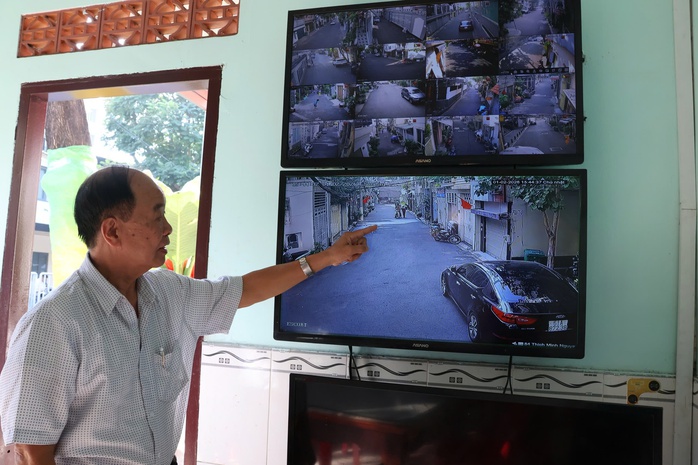
Mr. Nguyen Khac Moc - Secretary of the Party Cell of Ward 19, Tan Son Hoa Ward, Ho Chi Minh City - monitors the security and order situation through the camera system. (Photo: Phan Anh)
Ensure sufficient personnel are available to carry out the task.
Ho Chi Minh City currently has 168 commune-level administrative units, with 5,947 neighborhoods, hamlets, villages, and residential areas. Of these, 155 out of 168 communes, wards, and special zones are designated as key commune-level administrative units for national defense, and 13 communes and wards are currently under consideration for recognition as key commune-level administrative units for national defense.
Regarding reorganization, Ho Chi Minh City requires localities to minimize the division of a neighborhood, hamlet, village, or residential area into multiple clusters for the purpose of rearranging and organizing them into new neighborhoods, hamlets, villages, or residential areas. The rearrangement and reorganization of neighborhoods, hamlets, villages, and residential areas must not change the administrative boundaries at the commune level.
Ho Chi Minh City also requires that infrastructure in neighborhoods, hamlets, villages, and residential areas, after reorganization, must ensure good service for residents in their daily lives and the organization of self-governing activities of the community. At the same time, it must ensure convenience for daily life, production, business, and essential social services for the people.
Mr. Tran Tuan Khanh, Head of the Economic, Infrastructure and Urban Planning Department of Tam Binh Ward, said that the locality is currently reorganizing the boundaries of neighborhoods based on Government Decree No. 185/2026/ND-CP dated May 26, 2026. Accordingly, it is expected that after the reorganization, the ward will reduce the number of neighborhoods from the initial 66 to 39.
"In the coming time, the Vietnam Fatherland Front Committee of the ward will organize a consultation with the local community. From there, they will finalize the draft plan for reorganizing the neighborhood and submit it to the Department of Internal Affairs," Mr. Khanh said.
In Hoa Hung ward, according to Ms. Le Thi Ngoc Hien, Chairwoman of the Ward People's Committee, the locality has established a Steering Committee and developed a plan and project for reorganizing the neighborhoods. The Standing Committee of the Ward Party Committee has approved the draft project for reorganizing the ward's neighborhoods.
Following the reorganization, Hoa Hung ward is expected to reduce its number of neighborhoods from 41 to 26. Regarding personnel matters, Ms. Le Thi Ngoc Hien stated that, based on observations, many part-time neighborhood officials have requested to resign during this period. The reason is that this group faces difficulties in applying technology and other requirements. Therefore, the ward is implementing various plans and solutions to ensure sufficient personnel to perform their duties after the new neighborhoods are established.
According to the Department of Internal Affairs - People's Committee of Khanh Hoa province, the province has 65 communes and wards with 1,234 villages, hamlets, and residential clusters (including 683 villages, 550 hamlets, and 1 residential cluster). As of May 29th, all 65 localities had drafted plans for rearranging villages and hamlets. The Department of Internal Affairs requested that localities continue to carefully review the current organization of villages and hamlets. The leaders of the People's Committee of Khanh Hoa province basically agreed with the proposal of the Department of Internal Affairs and requested that the unit continue to finalize the dossier and draft a comprehensive plan for rearranging and reorganizing villages, hamlets, and residential clusters in the province, to be submitted to the Provincial People's Committee for reporting to the Standing Committee of the Provincial Party Committee. At the same time, they requested that the implementation process ensure democracy, transparency, public consultation, approval by the People's Council at the same level, and strict adherence to legal regulations.
According to Mr. Ngo Minh Tam, Chairman of the People's Committee of Vinh Hai commune, Can Tho city, the locality is implementing the city's plan to reorganize hamlets, expected to be completed in June. After the review, Vinh Hai commune will streamline from 8 hamlets to 7. In particular, because My Thanh hamlet is currently small with fewer than 400 households, the locality is planning to merge it with Huynh Ky hamlet to ensure efficient management.
Hanoi approves new regulations on villages and residential areas.
On June 2nd, at its third session (special session), the Hanoi City People's Council passed two important resolutions related to the organization and operation of villages and residential areas.
Accordingly, villages and residential areas are defined as self-governing organizations of the community within the administrative unit at the commune level, implementing direct democracy and carrying out the policies and guidelines of the Party and State, as well as tasks assigned by the commune-level government. The resolution was issued to concretize the provisions of the Law on the Capital City, creating a legal basis for streamlining community organizations in a way that is practical and enhances the effectiveness of management at the grassroots level.
Regarding organizational structure, each village has a village head and a deputy village head; each residential area has a group leader and a deputy group leader. For villages with 800 or more households, residential areas with 1,000 or more households, or those located in key areas for national defense, security, and order, or particularly disadvantaged villages, a maximum of two deputy leaders may be appointed.
Hanoi will allocate funds to increase the monthly allowance for part-time officials in villages and residential areas to a level higher than the general rate stipulated by the Government.
Specifically, villages with 800 or more households, residential areas with 1,000 or more households, or those located in key areas for national defense, security, and order, and particularly disadvantaged villages, are entitled to an allowance fund equal to 12 times the basic salary. Other villages and residential areas are entitled to an allowance fund equal to 9 times the basic salary.
Non-professional personnel may hold no more than one additional position and receive a concurrent duty allowance equal to 100% of the allowance for the position held. These individuals will continue to receive mandatory social insurance, health insurance, and related benefits as per current regulations. The resolution takes effect from July 1, 2026.
N. Huong
Source: https://nld.com.vn/khan-truong-sap-xep-thon-to-dan-pho-196260602222006163.htm
![[Photo] First session of the 14th Congress of the Vietnam Trade Union](https://vphoto.vietnam.vn/thumb/1200x675/vietnam/resource/IMAGE/2026/06/03/1780465947883_ndo_br_img-3852-jpg.webp)

![[Photo] Secretary of the National Assembly Party Committee, Chairman of the National Assembly presides over the meeting of the Standing Committee and Executive Committee of the National Assembly Party Committee.](https://vphoto.vietnam.vn/thumb/1200x675/vietnam/resource/IMAGE/2026/06/03/1780480353201_ndo_br_bnd-2585-jpg.webp)


![[Photo] General Secretary and President To Lam presides over a meeting with the Central Organizing Committee.](https://vphoto.vietnam.vn/thumb/1200x675/vietnam/resource/IMAGE/2026/06/03/1780482764658_a1-bnd-4741-3342-jpg.webp)










































![[Video] Sunset at Lap An Lagoon – Where the sun sets over the fishing nets](https://vphoto.vietnam.vn/thumb/1200x675/vietnam/resource/IMAGE/2026/05/31/1780192137701_beach-landscape-sea-water-nature-grass-745871-pxhere-com.jpeg)



































Comment (0)