


In Quoc Khanh commune, a border area in Lang Son province, a special letter remains in the drawer of a policy officer. It's not a request for assistance, nor a complaint or petition, but a letter expressing a single wish to be removed from the list of impoverished households. A letter that goes against established practice, contradicting the persistent mentality of "staying on the poverty list to receive assistance" that has existed for generations among some people in mountainous regions.
The story of Mr. and Mrs. Hon
We visited the family of Mr. Be Van Hon in Bo Luong village, Quoc Khanh commune – the author of that petition – on a sweltering summer afternoon. Mr. Hon, born in 1969, a Tay ethnic minority, was busily herding his buffalo back to the barn after a day of grazing under the scorching sun. In their small house nestled on the hillside, his wife, Mrs. Ngo Thi Bach, born in 1967, greeted us with a gentle smile and hands tanned and rough from a lifetime of hard work. The house was simple, with nothing valuable; the large fan was broken, and the smaller one flickered and took a long time to turn on. The heat was unbearable, and sweat still clung to Mr. Hon's faded shirt and soaked his chest. But no one complained. In that simplicity and hardship lay a story so poignant that it was deeply moving.
"I don't want to remain poor forever. I still have strength, land, and my hands and feet are still healthy; I can't keep begging forever. I'm asking to escape poverty so that others who are more disadvantaged can benefit." Mr. Be Van Hon, Bo Luong village, Quoc Khanh commune |
“My family’s old house was built in 2006, with 5 million dong borrowed to construct it temporarily. Back then, the house was only about a dozen square meters, the walls were patched here and there, the roof was made of rotten cement sheets, and when it rained heavily, the whole family had to huddle in a corner, staying awake all night. During the recent Typhoon Yagi , the wind howled all night, and we really didn’t dare sleep. But we had to endure it,” Mr. Hon recounted slowly in the Tay language, his eyes gazing into the distance, his voice low but resolute.
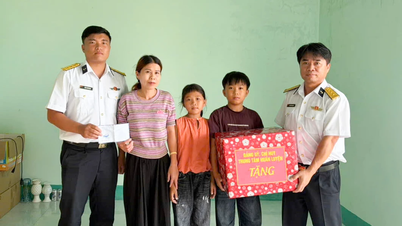
Seeing the difficult circumstances of Mr. Hon's family, in April 2024, the Po Ma Border Guard Station – Lang Son Border Guard Command – coordinated with the local authorities to start construction of a new house. According to Major Vu Trong Tuan, Deputy Political Officer of the Po Ma Border Guard Station, the entire 50 million VND in support was deducted from one day's salary of each officer and soldier in the unit. The People's Committee of Quoc Khanh commune provided an additional 10 million VND along with tables, chairs, beds, and wardrobes. The new house was inaugurated on March 3, 2025 – the traditional day of the Border Guard Force – becoming a major turning point in the lives of Mr. Hon and Mrs. Bach.
Living in a sturdy house and receiving guidance on how to do business, Mr. Hon's family's economy began to improve. From a cow provided in 2015 under the Livelihood Support Project for the Poor, he sold it for money, and with a little savings, he bought a buffalo – the family's most valuable asset and the only source of draft power for their two acres of rice fields. Without machinery or sufficient fertilizer, Mr. and Mrs. Hon still rely on the buffalo and the land to support their family. During the rainy season, they struggle with plowing, and during the dry season, they worry about water shortages, but they never think of giving up. From raising buffalo, they also raise chickens and ducks, and grow vegetables; every penny earned is cherished, saved, and used for essential expenses. "I don't want to be poor forever. I still have strength, land, and my hands and feet are still strong; I can't keep begging forever. I'm asking to escape poverty so that others who are more disadvantaged can benefit," Mr. Hon said simply but with self-respect.
The story of Mr. Hon and Mrs. Bach's family, despite their hardships, and their belief in a brighter future, deeply moved local officials. Mr. Be Van Tuong, Party Secretary and Head of Bo Luong village, shared: “Not everyone understands that escaping poverty is an honor. Initially, Mr. and Mrs. Hon were hesitant, afraid no one would believe them. But when I saw their family proactively planting more trees and saving every penny, I knew Mr. Hon's family was truly determined to escape poverty.”
That application contradicted the ingrained habit of some people who, upon being classified as poor, felt secure, assured of policies and subsidies, and relieved of the burden of contributions. Therefore, this "request to be removed from the poverty list" was not only unexpected but also a significant shift in local policymaking thinking. It wasn't just a change in an individual's mindset, but also proof of the effectiveness of sound, targeted, and humane policies. More importantly, it represented an internal movement, as people realized that poverty wasn't a life raft, but something each person had to overcome on their own two feet.
Poverty reduction, therefore, is not just about providing money, seedlings, or livelihood models. It's about changing mindsets, daring to abandon complacency, dependence, and the habit of enjoying life. When a citizen dares to write a letter "requesting to escape poverty," it's not just the change of an individual, but also the silent achievement of countless policies, persistent efforts in communication and advocacy, and the support of the entire political system.
A warm home – the first step
The story of Mr. Hon and Mrs. Bach's family, which we just recounted, is just one example of many families striving to overcome difficulties and escape poverty. In the border communes and remote areas of the province, the journey to poverty reduction begins with small things like a roof that doesn't leak.
Understanding the initial aspirations and implementing Resolution 188-NQ/TU dated October 25, 2024, of the Provincial Party Committee on eliminating temporary and dilapidated houses, the entire province has identified 2,472 households in urgent need of support, including poor households, near-poor households, people with meritorious services, policy beneficiary families, and people in areas affected by natural disasters and climate change. As planned, by April 2025, 100% of the temporary houses on the list have been started and completed, either rebuilt or repaired on schedule.
Furthermore, the province continues to implement Decision 270/QD-UBND dated January 24, 2025, supporting the construction and renovation of an additional 4,405 houses. The goal is to complete all of them before September 2025.
Each house adheres to the "three solid" standard: solid foundation – solid walls – solid roof. Practical issues at the grassroots level were resolved on the spot by local authorities and technical units. Thousands of man-days of labor from the armed forces, youth union members, and members of political and social organizations were mobilized. Materials were brought directly to the villages, transported along narrow roads by motorbike and human effort. The completed houses are imbued with the love and care of the community, reflecting the concern of local Party committees and authorities, and the joint efforts of neighbors. Each house tells a touching story, not only protecting against rain and sun but also opening up a different life for countless poor households.
Once they had homes, people felt like they had stepped out of a shadow that had lasted for years. A home was not just a place to live, but the starting point of a different kind of life. Each household always expressed a desire to escape poverty and always trusted in the Party's guidelines and the State's policies and laws. From these homes, many family economic models have emerged, from fruit tree cultivation, goat farming, beekeeping for honey, to opening workshops… No one gets rich instantly after owning a house, but it is the beginning of building a future with their own hands.
Escaping poverty is an aspiration.
When poverty is no longer seen as a "policy advantage," and when poor households proactively strive to improve their lives instead of remaining on the support list, that is when genuine poverty reduction begins to take shape.
Ms. Tran Thi Thao, born in 1988, residing in Na Don village, Doi Can commune, Trang Dinh district (formerly), now Quoc Khanh commune, used to live in a dilapidated house. Her husband, Mr. Nguyen Van Luan, passed away suddenly in October 2024, when the house had only just had its foundation laid. Widowed at the age of 36, Ms. Thao single-handedly raised her two young daughters and cared for her mother-in-law, who was over 90 years old. Just when she thought she could no longer recover, the Po Ma Border Guard unit surveyed the situation and provided 50 million VND from the "Eliminating Temporary and Dilapidated Houses" Fund. Local authorities mobilized additional labor and resources to build a new home, fulfilling the unfinished wish of her late husband.
Ms. Thao said emotionally, “If my husband were still alive, he would have finished building the house with the money from selling acacia trees. He passed away suddenly, leaving behind three children and my elderly mother, and the house is still unfinished… Before, we were a near-poor household, but now we’re back to being poor. But I won’t allow myself to give up. Every day I go to work as a hired laborer, planting acacia and eucalyptus trees, doing whatever anyone hires me to do. Earning 100-200 thousand dong makes me happy. I just hope that one day my name will no longer be on the list of poor households.”
According to the multidimensional poverty standard for the period 2021-2025, in 2021, Lang Son province had 23,511 poor households, accounting for 12.2%, and 23,247 near-poor households, accounting for 12.06%; by 2024, the multidimensional poverty rate will only be 3.36%. Significantly, the province is not aiming for mere numbers, but rather for sustainable poverty reduction by linking support policies with responsibility, discipline, and inspiring the will of the people.
To implement the National Target Program for Sustainable Poverty Reduction in the period 2021-2025, the province has issued specific directives. The program is implemented through 7 projects, including: supporting investment in socio-economic infrastructure development; diversifying livelihoods and developing poverty reduction models; supporting production development and improving nutrition; developing vocational education and sustainable employment; supporting housing for poor and near-poor households; communication and information-based poverty reduction; and capacity building and monitoring and evaluation of program implementation.
It's worth noting that no matter how many support projects there are, it's still insufficient if people don't strive to improve themselves. Gone are the resigned shakes of the head, the mentality of "better to be poor and secure," replaced by radiant smiles as children go to school, by calloused hands diligently tending to chickens, buffaloes, and cows, and by the determination to apply to be removed from the poverty list because "I can manage on my own now."
Escaping poverty – not just a destination, but a determination. That determination is spreading throughout the border villages. Escaping poverty opens up a future of self-reliance and self-improvement, ensuring no one is left behind. It is a determination to build a prosperous and harmonious life, gradually narrowing the gap between rural and urban areas, and together with the entire Party and people, we are entering an era of national progress.
Source: https://baolangson.vn/la-don-nguoc-chieu-thoi-quen-5055279.html
![[Photo] The General Secretary, President and his wife begin their state visit to the Philippines.](https://vphoto.vietnam.vn/thumb/1200x675/vietnam/resource/IMAGE/2026/05/31/1780230559452_anh-man-hinh-2026-05-31-luc-19-28-11.png)


![[Photo] Solemn bathing ceremony and Buddha procession in Hue](https://vphoto.vietnam.vn/thumb/1200x675/vietnam/resource/IMAGE/2026/05/31/1780228263543_1-jpg.webp)
![[Photo] Admire the coral "masterpiece" amidst the million-year-old heritage of Dak Lak province.](https://vphoto.vietnam.vn/thumb/1200x675/vietnam/resource/IMAGE/2026/05/31/1780221235105_anh-man-hinh-2026-05-31-luc-16-53-27.png)









![[Video] Sunset at Lap An Lagoon – Where the sun sets over the fishing nets](https://vphoto.vietnam.vn/thumb/340x192/vietnam/resource/IMAGE/2026/05/31/1780192137701_beach-landscape-sea-water-nature-grass-745871-pxhere-com.jpeg)


































![[Photo] Admire the coral "masterpiece" amidst the million-year-old heritage of Dak Lak province.](https://vphoto.vietnam.vn/thumb/402x226/vietnam/resource/IMAGE/2026/05/31/1780221235105_anh-man-hinh-2026-05-31-luc-16-53-27.png)
































Comment (0)