

Wayne Rooney being sacked by Birmingham after just 15 games once again shows that many of Alex Ferguson's former players have largely failed when they transitioned into managerial roles.
Ferguson is the most successful manager in football history, with 49 major and minor titles with St Mirren, Aberdeen, and Manchester United, including 13 Premier League titles and two Champions League titles. Beyond his trophies, he also inspired many players to become coaches after retirement. Dozens of former Manchester United players under his tutelage have managed professional teams, but none have reached world-class level.
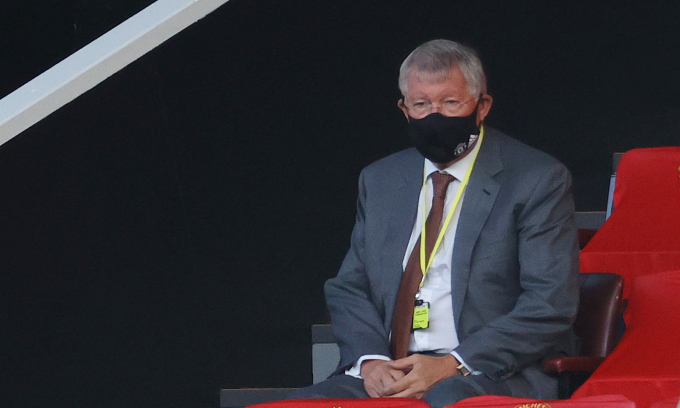
Manager Alex Ferguson watches Manchester United's match against Crystal Palace at Old Trafford in Manchester, in the Premier League on September 19, 2020. Photo: Reuters
Rooney began his managerial career at Derby County from 2020-2022, managing the team in 85 matches with a win rate of only 28%. This rate dropped to 26% at DC United and to 13% at Birmingham. Birmingham also dropped 14 places to 20th during Rooney's tenure. The 39-year-old manager said it would take him some time to recover from this setback before returning to football.
Gary Neville fared little better, unexpectedly being offered the manager's job at Valencia in 2015-2016 despite having no prior head coach experience. Although they were a relatively strong team in La Liga, Neville only won 36% of their matches and was sacked after less than four months. He was removed from the coaching position at the end of March 2016, when the team was only six points above the relegation zone.
Gary's assistant at the time was his younger brother, Phil Neville. Neither of them spoke Spanish, and they weren't well-liked by fans from the start. Phil was also a former Manchester United player who later managed the England women's national team, Inter Miami, and currently Portland Timbers in the US. Under Phil, Miami finished 11th out of 14 teams in the MLS Eastern Conference in their first season, then bottomed the table in their second season, and were sacked by their former teammate, now the club's owner, David Beckham.
The Neville brothers are perhaps not as bad as Paul Scholes. The former talented midfielder tried his hand at managing Oldham Athletic in 2019, in the fourth division, but resigned after only seven games, with a win rate of 14%.
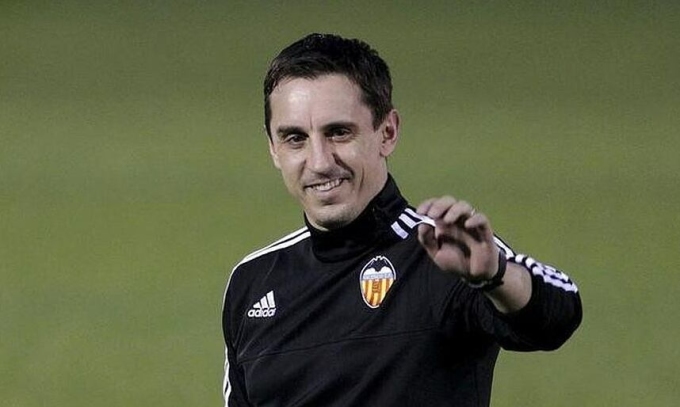
Gary Neville during his debut training session with Valencia in Spain on December 7, 2015. Photo: Reuters
Another legend at Old Trafford is Ryan Giggs, who never officially managed a professional club, but did coach the Wales national team. Before he could make any significant impact, he was arrested on charges of assaulting his former girlfriend. Giggs is considered the most successful player during Ferguson's era, also with 13 Premier League titles, but he faced numerous off-field problems.
Roy Keane was once expected to be a great manager, having displayed leadership qualities during his time at Manchester United from 1993 to 2005. Therefore, the Irish manager was appointed to manage Sunderland in the English Championship immediately after retiring as a player. He led the team to win the Championship, earning them promotion to the Premier League. However, in his first season in the top flight, he only won 29% of his matches, while the team finished 15th. When Keane resigned, Sunderland fans took to the streets to celebrate.
Other managers considered more successful in the Premier League include Mark Hughes, Steve Bruce, and Ole Gunnar Solskjaer. Hughes was the first manager under UAE owner Mansour Al Nahyan at Man City, but his win rate was only 47%, and he was sacked after just one year. In October 2023, he was again dismissed by fourth-tier side Bradford.
Bruce has only managed mid-table Premier League clubs, with his best achievement being leading Hull City to the FA Cup final in 2014. However, he has never had the opportunity to manage a major club. Solskjaer has less experience, but was given the reins at Manchester United from 2018-2021, leading the team to the Europa League final. Since the post-Ferguson era, Solskjaer is the only manager to have led Manchester United to a top-four finish for two consecutive seasons. This is an achievement that Louis van Gaal, Jose Mourinho, or perhaps even Erik ten Hag haven't accomplished.
Gabriel Heinze has spent nearly nine years coaching since retiring, without winning any titles in Argentina. Similarly, Jaap Stam has managed clubs in the Netherlands and the USA. Ruud van Nistelrooy helped PSV win the Dutch Cup, but this wasn't considered a success, leading him to resign shortly afterwards. Michael Carrick is making a slight impact at Middlesbrough, helping the team reach the semi-finals of the English League Cup, but they are currently only 12th in the Championship.
Ferguson's former protégé, Laurent Blanc, is considered the most successful coach. He was a member of the French national team that won the 1998 World Cup and Euro 2000, and played for Barcelona and many other top European leagues. After retiring as a player, the former central defender led Bordeaux to a surprising Ligue 1 title win in 2009, not to mention the French League Cup. He replicated this achievement three times with PSG, but the 59-year-old coach's career is currently on a downward spiral at Lyon.
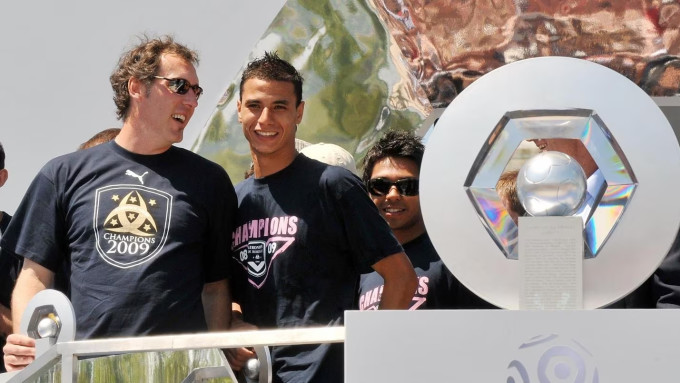
Laurent Blanc (left) led Bordeaux to win the Ligue 1 title in France in May 2009. Photo: UEFA
Ferguson still has pupils from his Aberdeen days like Alex McLeish – who helped Birmingham win the English League Cup in 2011, and Gordon Strachan, who was named Premier League Manager of the Month four times. But their success is still confined to English football.
Not only Ferguson's former pupils, but also his assistants were unsuccessful as managers. Steve McClaren once caused England to miss out on Euro 2008 and is now back as an assistant at Man Utd. Carlos Queiroz failed when trying his luck at Real Madrid or the Portuguese national team, Mike Phelan only won 25% of his games at Hull City, while Brian Kidd and Rene Maulensteen were both quickly sacked by Blackburn Rovers and Fulham respectively.
Ferguson's influence on his successors hasn't quite matched that of other legendary coaches like Johan Cruyff, Bobby Robson, or Marcelo Bielsa. Pep Guardiola became a great coach thanks to his years as Cruyff's student. Robson also molded Jose Mourinho from a translator into a two-time Champions League winner. And Bielsa has mentored many top coaches such as Diego Simeone and Mauricio Pochettino. And although he never played under Bielsa, Zinedine Zidane even went to Marseille to learn from the Argentinian strategist.
McClaren once argued that Ferguson's secret to success lay in his adaptability, saying, "Ferguson can destroy a team and rebuild it successfully because he knows what kind of players are needed." McClaren's view is echoed by football expert Jonathan Wilson, who further stated that Ferguson "is as good at developing football tactics as any other manager."
Before his success at Man Utd, Ferguson also went through four years without winning a trophy. He himself once said that his circumstances back then were different from those of current managers. "These days, the owners of football clubs come from all over the world, are very ambitious and, of course, lack patience," Ferguson told the Mirror in March 2017.
Ferguson is a good adapter, but he also needs time. Rooney himself mentioned this word after announcing his dismissal from Birmingham on January 2nd. "Time is the most valuable thing for a manager," said the former Manchester United and England captain. "And 13 weeks is not enough time for a team to change."
Perhaps a former pupil of Ferguson could achieve the same success if given more time, but no one can guarantee that. Nowadays, many managers can succeed in their first season, or even their first few matches. The number of Ferguson's former players still active is dwindling, and among them, it's difficult to find someone who can truly inherit the legacy he left behind over the past decade.
Xuan Binh
Source link


![[Photo] Prime Minister Pham Minh Chinh presides over a meeting on private sector economic development.](/_next/image?url=https%3A%2F%2Fvphoto.vietnam.vn%2Fthumb%2F1200x675%2Fvietnam%2Fresource%2FIMAGE%2F2025%2F12%2F20%2F1766237501876_thiet-ke-chua-co-ten-40-png.webp&w=3840&q=75)













































































Comment (0)