

Gone are the days of fortune-telling by street vendors, gone are the days of amulets tucked away in pockets. Gen Z can now check their destiny using AI and order feng shui charms based on their zodiac sign with a click of a mouse. When spirituality and technology intertwine, and when "belief" is no longer tied to traditional rituals but transformed into a modern style, could this be a new trend among young people?
AI fortune telling - the "predictor" of the digital age.
While in the past, understanding one's destiny was often linked to palmistry and astrology, now Gen Z can receive "predictions" from artificial intelligence (AI) with just a few clicks. No need to sit for hours in front of a fortune teller, no need to wait in line for a reading; today's youth are gradually shifting from traditional fortune-telling to a digital space where AI acts as a "prophet" in the digital age.
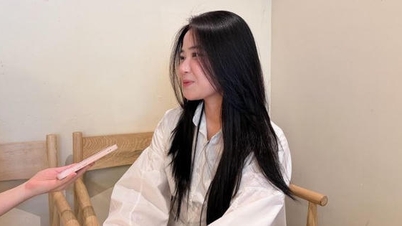
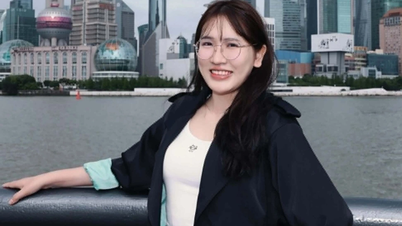
Yen Nhi (20 years old, Hanoi ), a devotee of digital fortune telling, shared: “Before, I used to get tarot readings at cafes, but now I can get the results instantly just by opening my phone. Once, I tried a dream interpretation app, and surprisingly, it predicted my situation correctly 80% of the time.”
 |
| Yen Nhi - a devotee of digital fortune telling. Photo: Nguyet Hoa |
This trend quickly spread thanks to a series of applications such as Co-Star, The Pattern, and AstroGPT, which provide services such as horoscope predictions, tarot card readings, calculating auspicious dates and times, and even interpreting dreams in just seconds.
Instead of relying on the intuition of a fortune teller, AI analyzes personal data, compares it with algorithms, and then provides insights into personality, career, love life, or fortune. Many users have shared surprising experiences: "This app interprets dreams so accurately!", "The AI's tarot readings are 90% correct, I can't believe it!". Videos demonstrating AI fortune telling have also quickly become a trend on TikTok and Facebook, attracting thousands of views and comments.
However, most Gen Z approach this trend with skepticism. Not everyone fully believes in AI predictions, but curiosity is enough to motivate them to try it out. Thu Thuy (21 years old, Tuyen Quang ) also tried AI fortune telling and was surprised by the results: "I don't believe in fortune telling, but when I entered information into a horoscope app, the AI analyzed my personality very accurately. I think it might not be completely accurate, but the way it connects the data is truly impressive."
 |
Thu Thùy found the AI fortune-telling experience enjoyable. Photo: Nguyệt Hòa |
A mix of skepticism and excitement, coupled with its viral spread on social media, has contributed to making AI fortune telling a phenomenon among young people.
Gen Z is "modernizing" spirituality.
Today's youth still believe in spiritual values, but instead of carrying items steeped in traditional religious beliefs, they opt for feng shui charms, energy stone bracelets, and zodiac rings – items that bring good luck while also expressing their fashion personality.
This shift reflects a modern mindset where feng shui is no longer just a spiritual belief, but has become part of a lifestyle. Online shops and jewelry brands quickly embraced the trend, constantly updating their collection with charms based on the 12 zodiac signs, gemstone bracelets according to the five elements, and feng shui rings with enticing claims like: "Increase wealth," "Improve relationships," and "Repel negative energy." This combination of spirituality and fashion has made these items incredibly popular, appearing frequently on TikTok Shops, Shopee, and Instagram with thousands of purchases.
 |
The market for feng shui accessories is booming, with numerous brands specializing in products for young people that are both feng shui-appropriate, sophisticated, and modern. |
It is precisely because of this demand that the market for feng shui accessories is booming, with numerous brands specializing in products for young people that are both feng shui-appropriate, sophisticated, and modern. In a constantly changing world, spiritual beliefs are also "transforming" to better suit the trends of the times.
The balance between reason and belief
It can be seen that young people no longer place complete faith in unfounded pronouncements, nor do they completely deny the existence of spiritual elements. Instead, they seek a balance between reason and belief, where spirituality becomes a tool to maintain mental stability, rather than an absolute truth that governs life.
Instead of traditional fortune-telling, many young people are choosing a more logical approach, combining science and belief. They aren't blindly superstitious, but rather view spiritual practices as a way to relieve stress and find direction in life. AI fortune-telling applications not only provide predictions about destiny but also integrate psychological advice, helping users better understand themselves.
 |
| AstroGPT integrates psychological advice to help users. |
This interplay of information and data analysis makes many people feel more secure when facing the future, because they believe they are receiving information from a data-driven system rather than from unfounded prophecies.
Modern technology has not only changed how Gen Z approaches spirituality, but has also blurred the lines between science and superstition more than ever before. A person can simultaneously believe in AI, astrology, and feng shui charms, creating a new and flexible approach to personal beliefs.
In a world where science and technology are constantly advancing, young people are creating their own belief systems—modern, spiritual, personal, yet not entirely detached from traditional values. This is no longer one-sided superstition, but rather an adaptation of the new generation to the changes of the times.
Source: https://baophapluat.vn/khi-genz-me-tin-theo-thay-boi-ai-post544817.html



![[Photo] Standing Committee member of the Party Central Committee Tran Cam Tu working with the Central Inspection Committee](https://vphoto.vietnam.vn/thumb/1200x675/vietnam/resource/IMAGE/2026/05/28/1779969579668_ndo_br_bnd-2495-jpg.webp)
























































































Comment (0)