

"I was terrified when the two kids argued in English at home, spoke to their grandmother in broken Vietnamese, and when they went out to read Vietnamese billboards, they just read them horizontally," Ms. NH said.
DIFFICULTIES IN COMMUNICATING IN YOUR MOTHER TONGUE
Ms. NH's children have all attended international schools in Ho Chi Minh City since preschool. Their paternal grandparents both reside abroad, so Ms. NH and her husband want to prepare their children for immigration. However, seeing that her two sons were struggling with all four Vietnamese language skills – listening, speaking, reading, and writing – Ms. NH urgently enrolled them in additional Vietnamese language classes.
The parents are 100% Vietnamese, and NH's friends share the same situation. Their children attend international school from morning to afternoon, and then take Vietnamese language classes from afternoon to evening because many struggle with communication in their mother tongue. NH shared: "Once they go abroad, they're immersed in English all day, so they have to be proficient. The opportunities to use Vietnamese are fewer than when they were in Vietnam. But if Vietnamese people forget their Vietnamese, they lose their roots and fail to preserve their national culture."
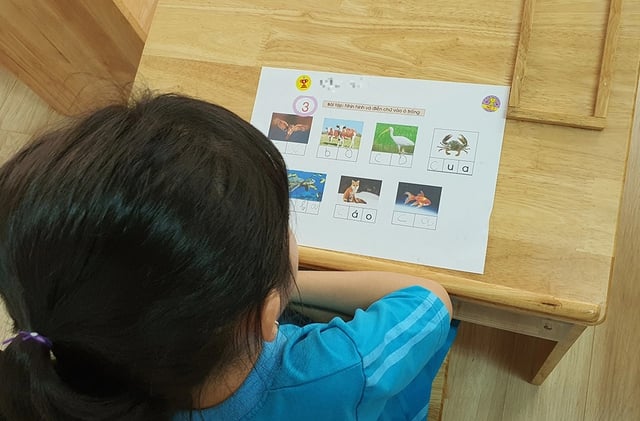
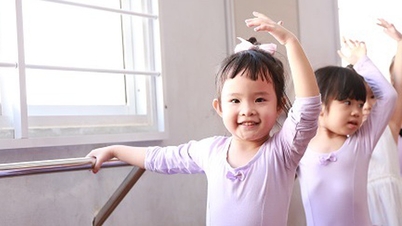
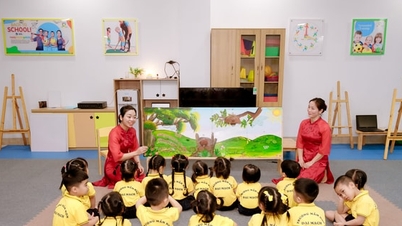
Preschool children during a Vietnamese language introduction session. Being proficient in Vietnamese also means preserving our culture, origins, and national identity.
THUY HANG
The vice principal of a private high school in District 7, Ho Chi Minh City, said he once listened to a father's story about how to find a Vietnamese tutor for his son, who was then in 8th grade. The family always wanted their son to learn English as early as possible. He had been taught entirely by native English-speaking teachers from kindergarten through elementary and middle school. At home, he also practiced English with a tutor. His parents were busy with work and rarely spoke or communicated with him in Vietnamese. As a result, the 8th-grade student could read many English books fluently, but only nodded when communicating with his grandparents. He preferred Western food, disliked Vietnamese food, and only liked playing with friends who also spoke English and attended English-speaking schools like himself.
WEAK SUBJECT: VIETNAMESE
Le Hoang Phong, founder and academic director of Your-E Education and Training Organization, and former teacher in the Teach for Vietnam program, recounts that many years ago he accepted an offer to tutor English for some 6th and 7th grade students at an international school in Binh Thanh District. "Their parents wanted me to tutor them in English, but when I arrived, I realized they were very good at English and their weakest subject was Vietnamese. All the students had Vietnamese parents, but their Vietnamese reading and comprehension skills were only at a very basic level," Phong explained.
Dr. Nguyen Thi Thu Huyen, an education expert and advisor on developing general education curricula for private schools in Vietnam, told Thanh Nien newspaper that she once advised a couple whose eldest child, while attending high school in Vietnam, had "forgotten" Vietnamese. They realized their mistake in letting their child not communicate in Vietnamese at home, allowing him to use almost 100% English in all aspects of life and learning.
"Their family was preparing to emigrate. I advised them to enroll their youngest child, 6 years old and about to enter first grade, in either a bilingual program or a 100% Vietnamese program. Both husband and wife are Masters and PhDs, so their child would quickly become proficient in English once they emigrated abroad, but it would be difficult for them to learn Vietnamese there. Later, they realized the hardship of their children not being able to speak Vietnamese. Being Vietnamese but not being able to speak Vietnamese is very sad, because it completely eliminates an important characteristic that identifies one as Vietnamese," Dr. Huyen recounted.
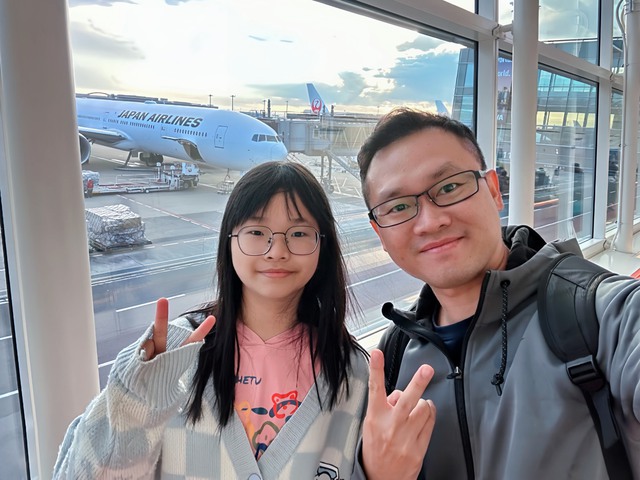
Dr. Do Huu Nguyen Loc and his daughter. The young doctor always prioritizes preserving the Vietnamese language for his child.
NVCC
DO N'T BLAME BEING GOOD AT ENGLISH FOR "FORGETTING" VIETNAMESE .
Dr. Do Huu Nguyen Loc, Vice Rector of the University of Economics and Finance Ho Chi Minh City and President of the Ho Chi Minh City Association for English Language Research and Teaching, stated that from a scientific perspective, learning a second language, or a foreign language, as early as possible is beneficial. In countries where English is a second language, such as the Philippines and Malaysia, or in countries where people use bilingual or trilingual languages, like many European nations, it is normal for a young child to speak 4-5 languages. In Vietnam today, many modern families send their children to international schools, where they use English at school and Vietnamese at home. Similarly, in families where one parent is Vietnamese and the other is a foreigner, it is not uncommon for children to alternate between Vietnamese and a foreign language.
"Personally, I encourage children to learn foreign languages early. My daughter speaks three languages and always studies Vietnamese. I once had the opportunity to visit the Canadian International School in District 7. While waiting for the bus, I heard the students talking to each other in standard American accents, making me feel like I was in America. But a little later, the security guard came, and the children spoke to him politely in Vietnamese. They showed flexibility in using the language. This is to affirm that being good at English doesn't necessarily mean being bad at Vietnamese, and vice versa," said Dr. Loc.
"I know some people who aren't good at English but are also 'poor' at Vietnamese. Some people are very good at English and also excellent at Vietnamese. Therefore, you can't blame being good at English for not being good at Vietnamese. Vietnamese is also intertwined with culture. Being good at Vietnamese is also about preserving our culture, origins, and national identity. Therefore, 'preserving the Vietnamese language' is the responsibility of individual students, and also the responsibility and obligation of their families. When I lived and worked abroad, I saw many Vietnamese families who were very conscious of preserving the Vietnamese language for their children. Outside, the children spoke English, German, French, etc., but at home, they used Vietnamese to converse with their parents and grandparents. Families that lack this awareness and effort will gradually see their children and grandchildren forget Vietnamese," Dr. Loc shared. (to be continued)
Losing one's mother tongue can come at a high price.
Ms. Ha Dang Nhu Quynh, Academic Director of DOL English and a PhD student at the University of Reading, UK, stated that the current situation of many young Vietnamese people being proficient in English but "forgetting" Vietnamese is common and a normal consequence of language learning. Language is a living entity, so not using it will lead to its loss. Even Vietnamese people born in Vietnam who only communicate in English will gradually lose their Vietnamese language skills.
"English is just a tool, not the destination, unless you want to specialize in teaching and researching English. It's true that having English will greatly assist in your work, but without specialized knowledge, you can't succeed. Furthermore, working in Vietnam without being proficient in Vietnamese is more disadvantageous than beneficial. Even foreigners coming to Vietnam want to learn Vietnamese to integrate, so why would Vietnamese people take away the ability to speak Vietnamese from their own children?" Ms. Nhu Quynh raised the issue.
Mr. Le Hoang Phong observes that there is currently a segment of parents who "worship" English, believing that being proficient in English makes one a global citizen, leading to success and a better life.
"Many young Vietnamese people go abroad and face crises. They may speak English well, but they don't belong to the American or European community; they can't have lively discussions with them about American or European culture and history. Outwardly, they are Vietnamese, with Vietnamese citizenship, but they can't speak Vietnamese or tell stories about Vietnamese culture and identity. So, which community do these young people belong to?", Mr. Le Hoang Phong posed the question.
He frankly stated his opinion: "English is a tool for connection and trade; it opens up opportunities in the wave of globalization, but having English doesn't mean you have everything. And if you are only good at English and lose your mother tongue, you lose your culture, your roots, your national identity, and you may have to pay a very high price."
Source: https://thanhnien.vn/khi-hoc-sinh-quen-tieng-viet-185240707181625917.htm
![[Image] Checking the security conditions at the exam site, ready for the 10th grade exam.](https://vphoto.vietnam.vn/thumb/1200x675/vietnam/resource/IMAGE/2026/05/28/1779943458889_z7872507660648-d764421a26e8cd7b61d70d142a48a685-jpg.webp)


![[Photo] Opening Ceremony of the National People's Council Conference on the Implementation of Directions and Tasks for the 2026-2031 Term](https://vphoto.vietnam.vn/thumb/1200x675/vietnam/resource/IMAGE/2026/05/28/1779939257690_ndo_br_bnd-1991-jpg.webp)



































































Comment (0)