

This was the assertion of Dr. Nguyen Thanh Nghi, Member of the Politburo and Head of the Central Policy and Strategy Committee, at the national scientific conference on the theme "Innovating the national development model based on science, technology, innovation, and digital transformation" on May 26th.
The workshop, organized by the Central Policy and Strategy Committee in coordination with the Hai Phong City Party Committee, People's Council, and People's Committee, along with the Ho Chi Minh National Political Academy and the Central Theoretical Council, aimed to provide theoretical and practical arguments to support the development of the project "Renewing the national development model based on science , technology, innovation, and digital transformation" to be submitted to the Third Plenum of the 14th Central Committee of the Communist Party of Vietnam.
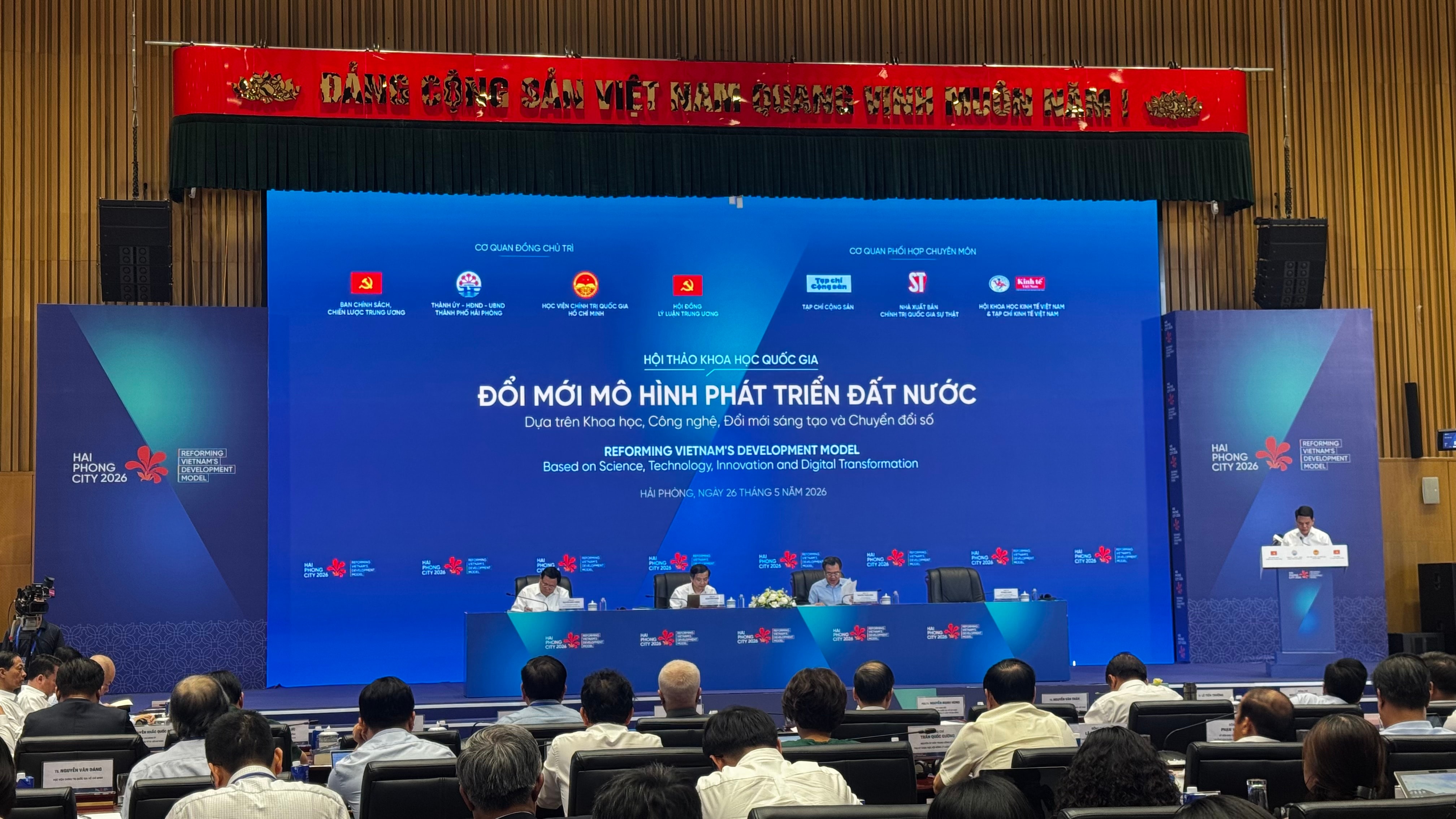
From the achievements of 40 years of reform to the need for a transformation of the development model.
At the seminar, Dr. Nguyen Thanh Nghi, Head of the Central Policy and Strategy Committee, stated that after nearly 40 years of Doi Moi (Renovation), the model of national development has been gradually formed, supplemented, and perfected through various stages, consistently reflected in the Party's documents.
From an underdeveloped economy , Vietnam has risen to become one of the most dynamic economies in the region and the world. Vietnam's GDP currently ranks 32nd globally, placing it among the top 15 countries with the largest trade volumes worldwide. Per capita income has steadily increased, the material and spiritual lives of the people continue to improve, while Vietnam's international standing and prestige are increasingly enhanced.
However, alongside the achievements, the current growth model also reveals many structural limitations. The economy remains heavily dependent on capital, labor, and resource exploitation; labor productivity, growth quality, and competitiveness are not yet high; and the capacity for innovation and technological mastery is limited.
Notably, national governance, social governance, inter-sectoral coordination, and data-driven governance have not kept pace with the demands of the digital economy and digital society. New challenges such as population aging, cybersecurity risks, climate change, green transition, and global technological competition are putting significant pressure on the current development model.
The Head of the Central Committee's Policy and Strategy Department stated that, in this context, reforming the national development model based on science, technology, innovation, and digital transformation is not only an objective requirement but also a strategic choice of decisive significance for the country's future development.
At the 14th National Congress, the Party set forth the orientation for establishing a new growth model, requiring a strong shift from relying primarily on capital, resources, and low-skilled labor to using science, technology, innovation, digital transformation, quality human resources, and modern management capabilities as the main driving forces.
This is not just an adjustment of the development model, but a comprehensive transformation of the national development approach aimed at creating new growth drivers, improving labor productivity and national competitiveness, and strengthening the country's strategic autonomy and self-reliance, emphasized Dr. Nguyen Thanh Nghi, Head of the Central Policy and Strategy Committee.
Reforming the development model is not just about economic reform.
According to Professor Nguyen Xuan Thang, former Politburo member and Chairman of the Central Theoretical Council, the growth model, development model, and socialist model of Vietnam should be approached as "three concentric circles." Therefore, reforming the development model is not only about economic reform, but also about a comprehensive reform of development thinking, leadership methods, national governance, social organization, and the way resources are mobilized and allocated.
One of the points he particularly emphasized was the central role of people in the new development model. Accordingly, people are both the goal and the endogenous resource and driving force of development. Vietnam needs to build a new type of person in the 21st century with patriotism, civic consciousness, innovative thinking, digital skills, and the capacity for lifelong learning.
The Chairman of the Central Theoretical Council also mentioned the need to build strategic autonomy in the context of a fragmented and fiercely competitive world. Strategic autonomy does not mean isolation, but rather proactiveness in institutions, technology, data, energy, food, defense, security, and foreign affairs, based on deep international integration and stronger endogenous capacity.
According to Professor Hoang Van Cuong, Vice President of the Vietnam Economic Science Association, the national development model should be viewed as a comprehensive mechanism to mobilize and effectively utilize resources to serve strategic economic, social, and human goals in each historical period. This model comprises five components: national governance, economic development, social development, environmental governance, foreign relations, and national defense.
In this context, the restructuring of the administrative apparatus needs to continue towards streamlining and clearly defining responsibilities, while simultaneously ensuring inter-sectoral and inter-regional coordination to avoid fragmentation in governance.
Along with decentralization, the delegation of power requires the improvement of mechanisms for monitoring power in order to limit institutional risks and create space for innovation in public service. In particular, the operation of the system cannot continue in a rigid or "robotic" manner, but needs to form a team of dynamic, creative officials who dare to think and act, and have mechanisms to protect those who innovate for the common good.
Another requirement is a strong shift from a managerial mindset to a development-oriented one. While previously laws were primarily designed for management, they now need to create a framework for development; while previously governance relied heavily on processes and compliance, it must now shift to governance based on objectives and outputs. Simultaneously, national governance in the AI era must be based on data and digital technology, with a synchronized and comprehensive digital governance ecosystem.
In the economic field, Professor Hoang Van Cuong argues that reforming the development model is placed within the requirement of perfecting the socialist-oriented market economy institutions, while simultaneously paving the way for new economic models such as the digital economy, green economy, circular economy, and digital assets. In particular, science and technology and innovation should not only play a role as drivers of growth, but should also become the overarching foundation for the entire process of reforming the country's development model in the new era.
Source: https://daibieunhandan.vn/khoa-hoc-cong-nghe-la-tru-cot-cua-mo-hinh-phat-trien-moi-10418221.html

![[Photo] The General Secretary, President and his wife begin their state visit to the Philippines.](https://vphoto.vietnam.vn/thumb/1200x675/vietnam/resource/IMAGE/2026/05/31/1780230559452_anh-man-hinh-2026-05-31-luc-19-28-11.png)

![[Photo] Admire the coral "masterpiece" amidst the million-year-old heritage of Dak Lak province.](https://vphoto.vietnam.vn/thumb/1200x675/vietnam/resource/IMAGE/2026/05/31/1780221235105_anh-man-hinh-2026-05-31-luc-16-53-27.png)
![[Photo] Solemn bathing ceremony and Buddha procession in Hue](https://vphoto.vietnam.vn/thumb/1200x675/vietnam/resource/IMAGE/2026/05/31/1780228263543_1-jpg.webp)

















![[Video] Sunset at Lap An Lagoon – Where the sun sets over the fishing nets](https://vphoto.vietnam.vn/thumb/340x192/vietnam/resource/IMAGE/2026/05/31/1780192137701_beach-landscape-sea-water-nature-grass-745871-pxhere-com.jpeg)
































![[Photo] Admire the coral "masterpiece" amidst the million-year-old heritage of Dak Lak province.](https://vphoto.vietnam.vn/thumb/402x226/vietnam/resource/IMAGE/2026/05/31/1780221235105_anh-man-hinh-2026-05-31-luc-16-53-27.png)































Comment (0)