

The immediate consequences are that it disrupts public sentiment, affects social order and security, gradually transforms and diminishes people's trust in the Party, and poses a threat to the Party and the regime at the grassroots level if not promptly adjusted.
Lesson 1: Receiving information based on "what the internet says"
Surveys on information reception among workers, farmers, students, Catholics, and ethnic minorities in several provinces and cities across the country... have helped us to some extent to understand the reality of information and propaganda gaps within the Party and the political system at the grassroots level.
I don't watch the news, I don't listen to the radio.
At around 5:30 PM, the main road leading from But Son town to the coastal communes of Hoang Hoa district (Thanh Hoa province) was crowded with workers returning home. As usual, at 6 PM, Ms. Le Thi Tinh from Khang Doai village, Hoang Yen commune, arrived home. She began cleaning the house and preparing dinner for her family. At this time, the Hoang Yen commune radio station was broadcasting the "News" program from the Voice of Vietnam radio station .
Ms. Tinh said: "The local radio station still broadcasts regularly in the morning and evening, but honestly, because I'm so busy, I don't pay attention to what information is on. My family usually eats dinner early, finishing by 7 pm, then I let my children study, so I don't watch the news on television. When I'm done, I check social media. Therefore, much of the information I know comes from social media."
This situation is not only common among young families in rural areas but is also not uncommon in urban areas of Thanh Hoa province. In Hoang Long Industrial Park, Thanh Hoa City, there are more than 3,000 workers renting accommodation. At 7 PM, entering the rented housing areas, most workers after their shifts are busy preparing rather simple dinners, and the rest of the time they "keep company" with their phones to watch movies, browse Zalo, Facebook, TikTok...
This reality shows that the only means of connecting with the outside world for young, single workers is their mobile phone. Nguyen Thi Hanh (20 years old), from Tho Xuan district (Thanh Hoa province), confided: "After stressful and tiring work hours, and quick meals, we just stay at home to rest and entertain ourselves via our phones... All the information we receive from the outside world is solely through our mobile phones."
In Nghe An province, as night fell, we were taken on a motorbike tour around Trung Thanh hamlet, Dien Hong commune (Dien Chau district), by Comrade Nguyen Van Tri, Secretary of the Party Branch. This hamlet has a population of 95% Catholic. At 7:15 PM, most families in the hamlet closed their doors, only turning on their lights, creating a very quiet atmosphere. Comrade Nguyen Van Tri explained: "At this time, Catholics are attending church services, so few houses are watching the 7 PM news program on Vietnam Television. The usual church times for the parishioners are from 4:30 AM to 5:30 AM and from 7:30 PM to 8:30 PM."
The following morning, we visited the family of Catholic parishioner Nguyen Van Thanh in Trung Thanh hamlet. Walking along the inter-hamlet road, we saw various forms of visual propaganda through signboards installed by the authorities, clearly displaying slogans and socio-economic development targets of the locality. Mr. Thanh said: "I work all day, attend church services in the morning and evening, and whenever I have free time, I check the internet for information. If there's anything important in the village, the officials announce it over the loudspeaker."
From Nghe An, we traveled 150km to Chuoi village, in the mountainous Lam Hoa commune (Tuyen Hoa district, Quang Binh province). Chuoi village has 65 households with 262 inhabitants, mostly Ma Lieng people belonging to the Chut ethnic group. Comrade Cao Van The, Secretary of the Chuoi Village Party Branch, shared: "Chuoi village now has electricity and television signals, so the lives of the Ma Lieng people are gradually changing. They have more access to useful information channels."
However, interacting with many villagers revealed the "poverty" in their access to information. In her stilt house, Mrs. Pham Thi Luong said: "Our family only has one television, but it broke down more than two years ago; the commune's loudspeakers haven't been broadcasting for a long time. In this cluster of more than 10 households, no one has a television; the people here are still very poor! Young people here also use smartphones, but they only go online to watch movies and listen to music... Now, I only know about any information related to the village or the commune when officials inform me."
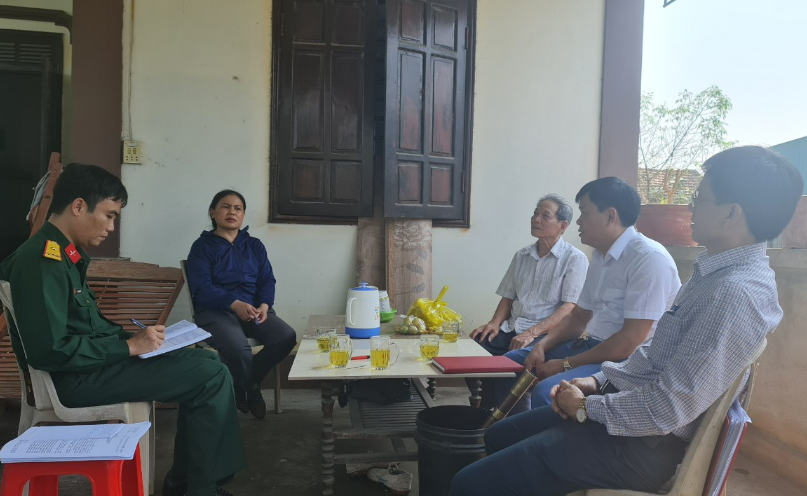
During our on-site survey, we observed that various forms of information and propaganda at the grassroots level, including radio and television broadcasts; electronic information portals/websites and newsletters of local agencies and units; community post offices and cultural centers; legal libraries in communes (wards, towns), agencies, and units; cultural houses, community cultural and learning centers; libraries; visual promotional activities; and the activities of speakers and propagandists, are generally implemented and operated quite regularly and systematically. However, their effectiveness remains a matter of serious discussion, even concern and worry.
Undeniably, the grassroots information and propaganda system has played a crucial role in fostering consensus among all segments of the population, implementing socio-economic development solutions, ensuring political security, social order and safety, and maintaining political stability at the grassroots level. Simultaneously, through this system, local Party committees and authorities can understand the thoughts, feelings, and aspirations of the people, thereby developing solutions appropriate to the local context.
However, surveys conducted in various localities show that: In lowland, urban, and border areas, the majority of people aged 18 to 55 receive information primarily through social media via mobile phones; while the elderly and retired officials often receive information through radio and television programs, books, and newspapers. This is creating an imbalance in content, methods, and personnel on the Party's "information and propaganda battlefield" against harmful and subversive information against the Party and the State on the internet. This is truly a major gap in providing official information to people at the grassroots level.
It is difficult to distinguish between real and fake information.
With the rapid development of digital technology in the information world on social media platforms, it is difficult for people to distinguish between legitimate information and fake news.
Ms. Nguyen Thi Duyen (born in 1978), residing in Kim Lien hamlet, Quan Hanh town (Nghi Loc district, Nghe An province), sells goods at the market daily. In her free time, she often uses her phone to browse social media sites like Facebook, Zalo, and TikTok. Receiving a lot of information, especially from online shopping sites, online job postings, advertisements for various medicines and services, and content about officials and government levels, Ms. Duyen admits that she cannot distinguish between real and fake information, or information from government agencies and those from organizations or individuals with malicious intentions, fraud, or slander against officials.
Indeed, upon visiting the communes, we observed that every locality was utilizing social media to inform and educate the people. Most communes had official fan pages and Zalo groups for the local government and various organizations such as the commune police, youth union, and women's association. However, the people were not enthusiastic about the information on these local pages and groups. Furthermore, some fan pages or personal accounts of local leaders were exploited by malicious forces who used images to spread false information, leaving the people confused about what was true and what was false.
We conducted a short interview with Mr. Truong Van Nghia (45 years old, a worker) in Thuong Nam village, Hai Nhan commune (Nghi Son district, Thanh Hoa province).
- Through which channels do you primarily receive information?
- Primarily through social media platform Facebook.
- Do you often like, share, or comment on pages, groups, or forums?
- Sometimes.
- Have you heard about the information related to Party officials and our regime that some social media sites often mention?
- Yes.
Do you think it's right or wrong?
- I don't know either. It's very difficult to know if it's right or wrong.
Comrade Nguyen Thi Thuy, Secretary of the Party Committee of Hoang Yen commune (Hoang Hoa district, Thanh Hoa province), shared the following story: "Many days, after returning from work and chatting with villagers, many people asked me: 'Is the information circulating on social media about Mr. X being disciplined true? Why was Mr. Y arrested? Was it due to internal power struggles? Do you know?' Upon investigation, it became clear that this was information spread by reactionary social media accounts, distorting and speculating about the anti-corruption and anti-negative practices campaign that our Party is currently conducting. However, the public's concern partly reflects a reality: it is difficult for people to distinguish between truth and falsehood in the online space."
Taking advantage of rapid dissemination, some individuals and organizations exploit the "information vacuum" when official news sources haven't yet published information to spread misinformation on cross-border online platforms. They exploit people's curiosity and interest in distorted and fabricated information about issues of public concern. Many organizations and individuals use the logos and images of Party organizations, government agencies, mass organizations, and even officials at all levels as profile pictures, thereby spreading false and distorted information, deliberately causing misunderstanding among the public.
Comrade Cao Xuan Tin, Head of the Propaganda Department of the Tuyen Hoa District Party Committee (Quang Binh province), stated: "Typically, fake news is created for profit, aiming to attract viewers to like, share, and comment on social media, generating revenue for the account owner. However, many fake news stories are created with the purpose of infringing upon national security, social order and safety, and the rights and interests of organizations and individuals. Many fake news stories contain private content, fabrications, distortions, or a mix of truth and falsehood aimed at psychological terror and creating public opinion on social media, serving dark intentions and harming political stability and social order and safety."
This is a danger that needs to be warned about early. Malicious elements exploit the "information vacuum" and the limited understanding of the people to spread false and distorted information, firstly to disrupt public morale, and secondly to slander Party organizations and government at all levels, aiming to erode public trust in the Party's leadership and the State's administration and management. We will discuss the consequences of receiving false information in the next article.
According to statistics, as of April 2022, Vietnam had 93.5 million smartphone subscribers, with the percentage of adults using smartphones reaching approximately 73.5%. As of February 2022, there were 76.95 million social media users in Vietnam, representing 78.1% of the population at the beginning of 2022. |
KHANH TRINH - MINH TU - DUY THANH (According to qdnd.vn)
Source link
















![[Photo] Reception to welcome General Secretary and President To Lam and his wife on their State visit to the Philippines](https://vphoto.vietnam.vn/thumb/1200x675/vietnam/resource/IMAGE/2026/06/01/1780295488620_vna-potal-chieu-dai-chao-mung-tong-bi-thu-chu-tich-nuoc-to-lam-va-phu-nhan-tham-cap-nha-nuoc-toi-philippines-8798060-7855-jpg.webp)






















































Comment (0)