

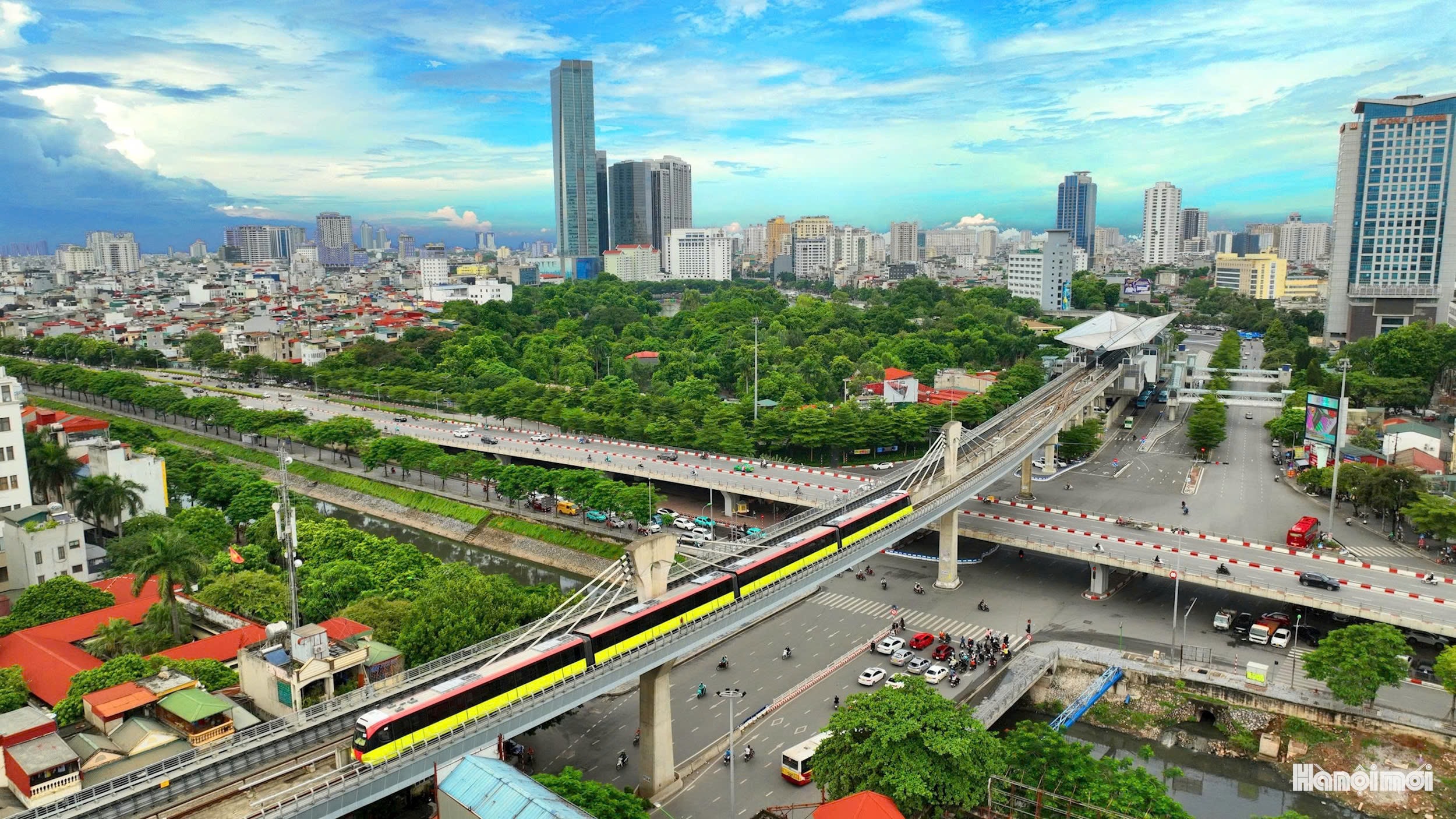
Important resources
In the process of urban development, land is always a particularly important resource. However, it is precisely here that many infrastructure, transportation, and urban renovation projects are delayed due to legal obstacles, compensation issues, resettlement problems, and a lack of public consensus. Therefore, unlocking land resources must first begin by removing specific bottlenecks at the grassroots level, where individual households are directly affected by land acquisition policies.
Mr. Dang Minh Tuan, Head of the Economic, Infrastructure and Urban Planning Department of Thanh Xuan Ward People's Committee, said that propaganda and mobilization are identified as top priority tasks and must be implemented one step ahead in the land clearance process. The ward government not only announces the policy but also focuses on providing complete information about the land acquisition, compensation, support, and resettlement policies to each household.
Notably, the approach goes beyond administrative documents; the People's Committee of the ward also organizes dialogue sessions and citizen receptions to allow people to directly discuss and report difficulties and obstacles. Issues that people are still concerned about are addressed on the spot, thereby reducing the gap between policy and real-life situations. According to Mr. Tuan, resolving land clearance issues is also a way to unlock land resources for infrastructure development in particular and socio-economic development in general.
From the perspective of the residential area, Mr. Cao Dan Chu, Head of Residential Group 20, Thanh Xuan Ward, said that initially, many households with land subject to land clearance were hesitant due to a lack of full understanding of the compensation and resettlement support policies. However, through dissemination of information to each household and direct dialogues with ward leaders, the people gradually agreed and proactively handed over the land early.
This reality shows that social consensus doesn't come naturally. Consensus is formed through policy transparency, direct dialogue, and the collaboration between local authorities and the people in addressing specific issues. When households see their legitimate rights protected, policies clearly explained, and relocation supported promptly, their anxieties will gradually dissipate.
A crucial principle can be seen at the grassroots level: to unlock land resources, we must first unlock information, policies, and trust. Clean land is not just the result of administrative decisions, but the result of consistent advocacy, dialogue, explanation, and implementation.
Transparency and accountability
Mr. Trinh Quoc Thang, Vice Chairman of the Thanh Liet Ward People's Committee, stated that the biggest bottleneck in land clearance work currently is the complexity of land ownership. Through various management stages, legal documents in many areas are still inconsistent. In some cases, people have lived there stably for a long time but have not been granted land use rights certificates; in other cases, land has been bought and sold through handwritten agreements passed down through many owners. Therefore, when implementing projects, determining the origin of the land takes a long time and easily leads to complaints and questions.
These obstacles demonstrate that land acquisition cannot be effectively addressed if only superficial efforts are made. A transparent, accurate, "cleaned," and regularly updated land data platform is needed. Architect Tran Huy Anh, a standing member of the Hanoi Architects Association, believes that transparent land data is the most important factor in gaining public trust and acceptance when implementing land acquisition policies. When land ownership, planning, compensation plans, and resettlement funds are clearly disclosed, the gaps of doubt will be narrowed.
Along with data transparency comes the requirement to clarify responsibilities. According to Mr. Trinh Quoc Thang, in the past, land clearance was sometimes considered the sole responsibility of a single agency or specialized unit. When progress was slow, some places showed a tendency to avoid responsibility, pass the buck, and wait for instructions from higher levels. The city's identification of land clearance as a key task, linked to the assessment of leadership and management capabilities of officials, has created a clearer change in implementation.
When responsibility is assigned to individuals and groups, leaders cannot remain detached. They must directly engage with the people, understand the local situation, address obstacles, and be accountable for the results. This is a significant change in governance, because land resources can only be unlocked when the administrative apparatus operates with a clear understanding of tasks, responsibilities, timelines, and accountability.
The "six clear principles" should therefore be considered a consistent requirement: clear objectives, clear resources, clear land allocation, clear resettlement housing allocation, clear planning information, and clear responsibilities for implementation. In particular, before assigning tasks to local authorities, the city level must also fully prepare the necessary input conditions, from resettlement funds to planning information, so that the local authorities have a basis for implementation with the people.
Unlocking land resources goes beyond simply providing more land for projects. More importantly, it creates the conditions for infrastructure development to precede other investments, paving the way for urban restructuring and the creation of new added value. As experts have pointed out, developing transportation infrastructure "one step ahead" is the right approach, because infrastructure will provide the impetus for other development resources.
However, land should not be viewed as the sole resource. If growth relies solely on land exploitation, the potential for development will soon be limited. Land needs to be used as a springboard for the development of digital infrastructure, the creative economy, high-quality urban services, and more sustainable development models. With the land freed up after land clearance, new ways of exploiting its value should be considered, where people are not just displaced but can become active participants and beneficiaries of the urban development process.
Therefore, unlocking land resources essentially means unlocking a series of conditions for development: transparent data, fair policies, clear accountability, social consensus, and a long-term growth vision. When these conditions are ensured, land will no longer be a bottleneck for projects, but will become a driving force paving the way for infrastructure, for modern cities, and for the economic growth of the capital.
Source: https://hanoimoi.vn/khoi-thong-nguon-luc-dat-dai-de-mo-duong-tang-truong-763312.html





















![[Photo] Reception to welcome General Secretary and President To Lam and his wife on their State visit to the Philippines](https://vphoto.vietnam.vn/thumb/1200x675/vietnam/resource/IMAGE/2026/06/01/1780295488620_vna-potal-chieu-dai-chao-mung-tong-bi-thu-chu-tich-nuoc-to-lam-va-phu-nhan-tham-cap-nha-nuoc-toi-philippines-8798060-7855-jpg.webp)






































































Comment (0)