

In mid-October 2024, the IELTS co-organizers released data related to the global IELTS exam for 2023-2024. According to this data, for the Academic test only, the average IELTS score for Vietnamese people was 6.2, similar to 2022 and ranking 28th out of 39 countries that administer the IELTS exam. Regarding score distribution, 23% of candidates in Vietnam achieved an IELTS score of 7.0 or higher. Currently, Vietnam has approximately 20 people who have achieved an IELTS score of 9.0.
X INEVITABLE TREND
Ms. TT, a parent whose child attends Tran Dai Nghia Secondary and High School in District 1, Ho Chi Minh City, said that many students in the school have IELTS scores of 7.5 and 8.0. She said: "In one 8th grade class, I know of two students who recently achieved an IELTS score of 8.0. This score didn't surprise other parents."
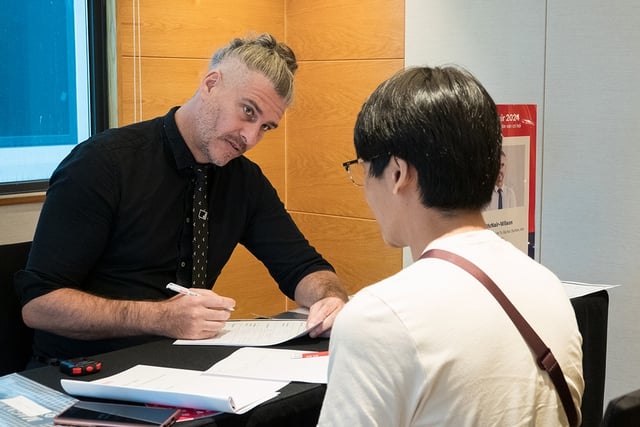
Candidates take a mock test with a foreign expert at the IELTS event held in March 2024.
PHOTO: NGOC LONG
Mr. Truong Chan Sang, a member of the Ho Chi Minh City Association for English Language Research and Teaching and an English teacher at Phan Chu Trinh Primary, Secondary, and High School in Di An City, Binh Duong Province, stated that in recent years, students' IELTS scores have been steadily increasing, a natural trend. This can be explained by several factors, such as students' access to a wider range of learning resources, from online courses and English learning apps to the increasingly developed international learning environment. Furthermore, teachers have improved their teaching methods, focusing on developing all four skills—listening, speaking, reading, and writing—helping students enhance their overall English proficiency. In addition, the awareness of students and parents regarding the importance of IELTS in opening up international study and career opportunities is becoming clearer, motivating students to strive harder to improve their scores.
Ms. Ha Dang Nhu Quynh, Academic Director at DOL English and PhD candidate at the University of Reading (UK), stated that today's students have earlier access to English, more abundant and easily accessible learning materials. IELTS is becoming increasingly popular, and the benefits of having an IELTS certificate for university admissions lead many students to invest more money, effort, and time in preparation to achieve high scores. Simultaneously, English teaching and learning methods are becoming more sophisticated; instead of rote memorization and shortcuts, students are shifting towards critical thinking and understanding the underlying principles. This allows them to improve their scores in a shorter time and develop all four language skills (listening, speaking, reading, and writing) along with critical thinking.
Mr. Le Hoang Phong, founder of YOUREORG Education and Training Organization, believes that the increasing number of students achieving high IELTS scores is not only a result of educational advancements but also reflects profound changes in learning approaches and the educational environment.
Today's high school students grow up in a globalized environment where English is not just a language but also a necessary tool for accessing knowledge and opportunities. This has led to a shift in educational thinking. Previously, English learning focused heavily on grammar and translation, but now teaching methods emphasize practical skills and language reflexes. It can be said that modern education helps students learn in a practical, proactive, and clearly-oriented way, especially for exams like IELTS.
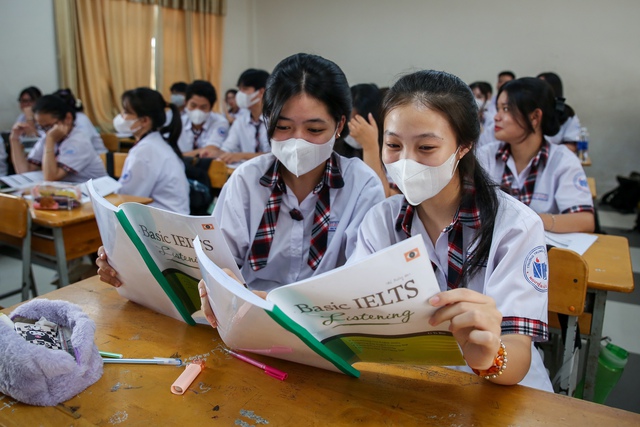
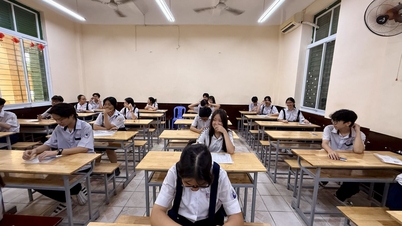
Students in Ho Chi Minh City during an IELTS lesson.
PHOTO: NHAT THINH
LEARN TO USE, NOT TO PASS EXAMS
While an IELTS certificate can be a "passport" to studying abroad, immigrating, or applying for admission, educators believe that a high IELTS score isn't everything. One of the biggest challenges today is that many students view IELTS as a short-term "destination" to meet exam requirements, then neglect maintaining their skills. This is not only wasteful but also diminishes the true value of the English learning process.
Graduate student Ha Dang Nhu Quynh frankly stated: "If you only study English to pass the IELTS exam, it's a waste. If students don't maintain a good level of English, it will be very difficult to communicate with foreign lecturers, access English-language academic materials, and communicate with international partners when studying abroad or pursuing higher education. Therefore, students should focus on genuinely excelling in English, not just learning tricks to pass exams. Students should choose a method that helps them develop fundamental skills and improve their logical thinking to gain an advantage in their future careers and higher education."
Mr. Le Hoang Phong emphasized: "IELTS is not the ultimate goal, but a tool. Students should ask themselves: After achieving IELTS 7.0, what will I do with this skill? Instead of stopping, they should continue to practice and apply English to bigger goals such as research, international communication, or in-depth study in specialized fields."
Mr. Phong advised students to learn English for practical use, not just for exams. An IELTS score is proof of language ability, but the real value lies in how you can use it as a "key" to unlock doors in your studies, career, and communication.
"Instead of viewing IELTS as a ticket, students should see it as a tool to help build their future. Only when English becomes a part of life will it truly bring lasting value," Mr. Phong shared.

![[Photo] General Secretary and President To Lam presides over a meeting on preparations for the review of one year of operation of the three-tiered government system.](https://vphoto.vietnam.vn/thumb/1200x675/vietnam/resource/IMAGE/2026/06/02/1780391821195_a1-bnd-4595-9717-jpg.webp)





























































































Comment (0)