

Editor's Note : Why, in a developing society like Vietnam, has reading not yet become a widespread habit? This series of articles by author Pham Quang Vinh suggests a different approach: Reading is not a single individual choice but a product of an ecosystem – where policies, education , the market, and social values all come together to shape it.
VietNamNet presents this series as an open forum, hoping to receive diverse perspectives from readers, managers, educators, and publishers: How to build a reading society in the context of a knowledge-based economy ?
Lesson 1: From the dream of "gold and jewels in a book" to the reality of the knowledge economy
Lesson 2: The Disruption of the "Scholar" Tradition and its Consequences for Reading Culture
Looking deeper into the infrastructure and foundation of reading habits, several relatively easy-to-identify factors become apparent. For example, in countries with high reading rates, strong reading habits, and a developed publishing industry, such as the US or Europe, public libraries can be easily found in almost every community, from small towns to city and national libraries. Organizations and businesses also have a "habit" of maintaining their own book collections and libraries to serve the reading needs of their employees.
Japan also maintains a system of bookstores and libraries as part of its cultural infrastructure, funded by public finances and community support.
Meanwhile, in Vietnam, the infrastructure for reading can be said to have been significantly weakened.
People's bookstores, which used to have branches in even the smallest towns and villages, are now almost nonexistent. The main bookstores in provinces and cities have largely disappeared, replaced by commercial buildings, after book publishing companies were privatized and new owners lost interest in the book business, especially in the context of declining reading demand during the early stages of economic reform. Meanwhile, the locations used for these bookstores were all in prime urban areas with high commercial value.
The disappearance of bookstores not only weakens the distribution system, but culturally, it deprives people of a place to access books, of the opportunity to stumble upon them by chance.
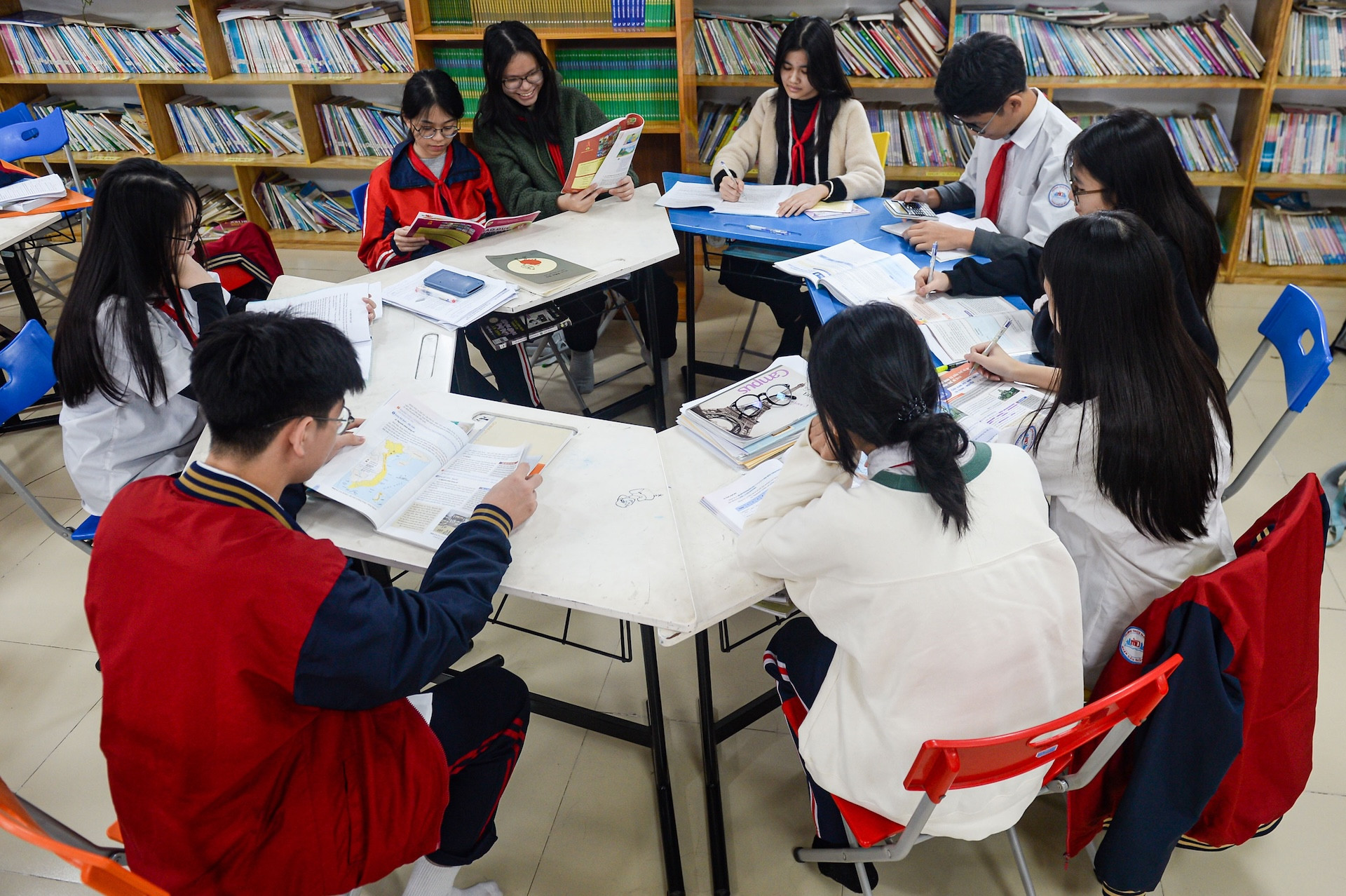
Our public library system has also weakened considerably. Except for a few localities that maintain a certain level of existence (and mainly at the provincial level), there are almost no public libraries at the grassroots level, and school libraries focus primarily on educational books. There are hardly any new books, reading guides, or community activities, and the complete lack of a grassroots library system is a significant weakness that contributes to the decline of reading habits.
In a society without access to books, reading becomes a solitary individual act, rather than a social activity.
Publishing industry: From a tool of knowledge to a weak business sector
Against the backdrop of declining reading habits and low demand, Vietnam's publishing market also exhibits unique characteristics reflecting its difficulties. Perhaps the most significant is the weak and fragmented nature of book companies and publishers. Even the leading companies in the Vietnamese publishing market are too small in scale and capacity, with very limited financial resources. It's evident that most of the best-selling books over the years bear the personal imprint of their authors, including manuscript organization, production decisions, and even distribution.
The publishing market is fragmented, with small-scale publishers and a lack of large enough publishers or book companies to invest long-term in foundational book lines. Bestselling books are often those that cater to short-term needs, while those that require time to accumulate value struggle to survive.
In large cities, bookstores still exist (although they mainly sell educational books and stationery), but outside these centers, access to books decreases rapidly. In many places, buying a book is no longer a simple matter.
This is different from developed economies, where publishing is an industry, with large-scale publishers capable of long-term investment and well-organized manuscripts, playing a role in shaping knowledge.
In today's publishing market, publishers primarily function in a managerial role, while book-making businesses are often small, fragmented, lack capital for large projects, and rely on fast-selling books.
For example, in Vietnam, there is almost a complete lack of publishing consultants who help authors organize manuscripts, develop their works, and work with authors and publishers to publish and bring books to market.
This leads to a vicious cycle: the market lacks good books, so there are no readers; few readers mean a small market; and a small market means no investment in good books. The fact that publications mostly sell only a few thousand copies, or even fewer, paints a relatively bleak picture.
Breaking this cycle is one of the biggest challenges.
Vietnam needs to cultivate reading habits in the context of developing reading habits worldwide ; it may be lagging behind, but it is not without opportunities.
Looking at global publishing figures, we can easily identify several key points. Firstly, the publishing industry worldwide is far from dead; people's reading habits around the world haven't declined, despite the increasing influence of other information sources. The US and Europe still have huge book markets, China's book market continues to grow strongly, and Japan and South Korea maintain sustainable reading ecosystems.
Secondly, a common characteristic of "highly read" countries, where people have good reading habits, is that they all have a developed and knowledge-based economy, a high standard of living, and create added value from understanding, creativity, and knowledge, rather than just from manual labor.
For Vietnam, we are at a crucial crossroads, where the potential for development based on cheap, unskilled labor is diminishing, and the development of a knowledge-based economy is becoming a viable option for a new development model.

Vietnam has no other choice but to promote reading habits; reading and self-learning must necessarily become a crucial foundation if we want to pursue a development model based on a knowledge-based economy. The future of reading habits is the future of the new economic development model.
The new circumstances and the widespread use of smart devices should certainly be seen as an opportunity, and the lessons learned from the rapid development of China's digital reading market can and should be considered a model worth emulating.
China's digital reading market has nearly doubled in five years, from 30.25 billion yuan to 59.48 billion yuan. 80.8% of Chinese adults now read digitally, and 689 million Chinese readers have access to approximately 70 million different digital books. Artificial intelligence technology has helped Chinese people access and use digital reading more effectively. In the new decree of the State Council of China on policies to promote reading among the entire population, promoting digital libraries and digital reading is also a key component.
Over the next 10-20 years, our reading community will undergo a significant polarization. A large segment of the population will read less, primarily consuming content quickly and becoming increasingly reliant on AI-powered tools to find answers to life's problems. Meanwhile, another group will emerge, reading more selectively, delving deeper into their reading, and using the knowledge gained from reading as a competitive advantage. This smaller group will grow and exert increasing influence, potentially leading the formation of a community with improved reading habits.
If we successfully transition to a knowledge-based economy, this group will expand. Otherwise, it will remain a separate, elite minority.
What should Vietnam do?
Reading habits are not a personal matter, but a product of a social structure; restoring and rebuilding reading habits cannot simply be achieved through appeals.
It must start with policies, and at a deeper level, with institutions.
Looking at China's experience, a valuable approach can be observed. In December 2025, the Chinese government issued a Government Decree "Regulations on Promoting Public Reading," effective February 1, 2026. Beyond policy slogans, this Decree, with its six chapters and 45 articles, includes specific policy regulations aimed at building a supportive structure for reading habits, as part of China's strategy to develop into a cultural powerhouse. The Decree provides a legal framework and constraints to promote reading throughout society, ranging from measures to improve the quality and increase the output of excellent works to fostering a reading culture and developing effective reading skills.
China also has regulations to establish public reading facilities, encouraging government agencies, schools, businesses, social organizations, etc., to set up reading centers. This includes policies to encourage and support the provision of reading services, the establishment of public reading spaces, and book exchange activities. Rural and underdeveloped areas are prioritized for establishing reading promotion facilities.
What is noteworthy is not the administrative and legal measures to promote reading mentioned in this document, but rather the approach: promoting reading habits is no longer seen as merely fostering an individual habit. Reading has come to be considered a component of the social infrastructure, similar to education or healthcare.
Reading is placed within legal texts, supported by budgets, and organized within community life, with a clear policy structure, rather than depending entirely on individual choice.
From that perspective, Vietnam's problem is not just that its people read little, but that reading has not been placed within a sufficiently prioritized social structure to be established and maintained.
In this article, I would like to offer some ideas as suggestions for a national policy to promote reading habits.
First and foremost, we must frankly acknowledge that a reading society is impossible if knowledge has no real value in allocating opportunities within society.
This means that changes are needed to prioritize intellectual values. In public sector recruitment, the focus should be on practical competence, analytical skills, and foundational knowledge, rather than solely on qualifications or seniority. Appointments and promotions should be evaluated based on critical thinking and continuous learning, not just administrative experience. In social life, spaces should be created where the voices of knowledgeable individuals carry real weight, not just formality.
If knowledgeable people lack social advantages, reading will always be a weak option.
Secondly, reading infrastructure needs to be developed as part of the cultural infrastructure.
This requires a policy approach from the highest levels, and not just a budgetary priority, but an institutional and policy priority, linked to development targets and social infrastructure construction. Every city, every district, every county needs a proper public library with new books, reading spaces, and reading guidance activities.
Libraries must be built and reading support provided to rural communities, remote areas, underdeveloped regions, revolutionary base areas, etc. The school system needs to have functional libraries, not just symbolic reading rooms.
Bookstores and book shops should become essential amenities in new residential areas, driven by incentives that should be seen not just as a business activity, but as part of community cultural life, just like parks or museums…
A child who grows up in an environment without books, without access to books, will find it difficult to develop a reading habit.
Third, the publishing industry needs to be restructured as a knowledge-based industry.
This requires policies that allow and encourage the formation of sufficiently large publishing houses capable of long-term investment in content, with mechanisms to support foundational book genres: social sciences, natural sciences, classics, and books that may not sell quickly but have lasting value. It also requires promoting cooperation in translation and copyright, creating conditions for Vietnamese books to better access global knowledge. If the publishing industry only focuses on quick-selling books that serve current needs, society will lack books that form the foundation of knowledge.
Fourth, we need to re-examine the role of education in developing reading skills. Schools today teach a lot of knowledge, but teach little about reading, and offer little encouragement for independent reading and reading habits. Students and curricula need to be encouraged to read to understand, to question, and to critically analyze. In an education system where students read only to pass exams, they will stop reading after leaving school.
To have a reading society, we must have a generation that can read.
And finally, we need to accept something that may not be easy to accept: not everyone will read books.
In any society, there is always a certain percentage of people who read deeply and extensively, and a larger proportion who read little or not at all.
The goal of policy should not be to turn the entire society into avid readers, but rather to create conditions that allow those who want to read to do so, ensuring that a sufficiently strong and broad knowledge-based class exists within society. This class will be the foundation for a knowledge-based society.
The phrase "there is gold and jade in books," which I read as a child in a small book, no longer holds true in its literal sense.
Books don't contain gold or jewels in the material sense. But in a world where knowledge increasingly determines the position of each individual and each nation, books remain one of the surest paths to accumulating knowledge.
A society without reading books can still exist.
But a society without reading will find it difficult to achieve sustainable development. Reading is not a condition for survival; reading is a condition for not being left behind by history in the process of development.
Ultimately, building a reading society is not just an individual matter, but requires a national strategic policy, serious investment, and a vision for a sustainable cultural infrastructure.
Source: https://vietnamnet.vn/khung-hoang-ha-tang-doc-hieu-sach-thu-vien-va-khong-gian-tri-thuc-2513198.html

![[Image] Nearly 125,000 Hanoi students completed the Literature exam for the 10th grade entrance exam.](https://vphoto.vietnam.vn/thumb/1200x675/vietnam/resource/IMAGE/2026/05/30/1780117233041_ndo_br_thiet-ke-chua-co-ten-2-png.webp)




































![[Photo] Admire the coral "masterpiece" amidst the million-year-old heritage of Dak Lak province.](https://vphoto.vietnam.vn/thumb/1200x675/vietnam/resource/IMAGE/2026/05/30/1780107638639_y25-jpg.webp)


































































Comment (0)