

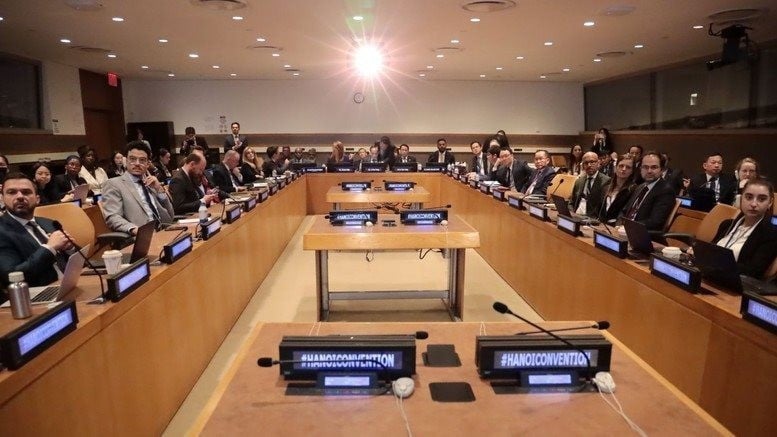
Therefore, a global convention serves as a mechanism for collective protection, creating principles that enable countries to coexist peacefully and develop together in the digital environment.
Vietnam is ready for the signing ceremony of the United Nations Convention against Cybercrime on October 25th and 26th in Hanoi. Prior to this, the UN General Assembly adopted the Convention on December 24th, 2024. This is considered a landmark document aimed at strengthening international cooperation in combating cybercrime.
President Luong Cuong will preside over the Convention's signing ceremony, with the participation of United Nations Secretary-General Antonio Guterres, along with many high-ranking leaders from countries, regional and international organizations. Within the framework of the signing ceremony, several discussions and seminars revolving around the theme "Combating Cybercrime - Sharing Responsibility - Towards the Future" will take place.
The "Hanoi Convention," comprising 9 chapters and 71 articles, is the result of nearly five years of negotiations among member states aimed at establishing a comprehensive multilateral legal framework to combat cybercrime.
The United Nations Convention against Cybercrime, also known as the "Hanoi Convention," is the first global legal framework addressing the urgent need for international cooperation in promoting the rule of law in cyberspace. It provides a basis for law enforcement agencies to respond more quickly to threats targeting individuals, businesses, and governments .
The United Nations Convention against Cybercrime, also known as the "Hanoi Convention," is the first global legal framework addressing the urgent need for international cooperation in promoting the rule of law in cyberspace. It provides a basis for law enforcement agencies to respond more quickly to threats targeting individuals, businesses, and governments. This is particularly significant given the increasingly complex nature of cybercrime, both domestically and internationally.
The United Nations predicts that cybercrime could cost the global economy approximately $10.5 trillion by 2025, exceeding the GDP of most of the most developed economies. This demonstrates the scale, complexity, and devastating impact of this type of crime.
On an international level, cybercrime is often transnational in nature. Cyberattacks, online fraud, ransomware attacks, cyber espionage, etc., are often not limited by national borders. Hackers can operate from one country but cause damage to many other countries. Most recently in Vietnam, the hacking incident that stole information from the National Credit Information Center (CIC) also involved transnational hacking groups. Without a unified international legal framework, tracing, extraditing, and cooperating in investigations will be very difficult.
Regarding legal gaps and disparities in information security capabilities, it can be seen that some EU countries, the US, and China have strict domestic laws, while many other countries lack or have inconsistent institutional frameworks. Completing an international convention would create a common legal framework, helping to bridge the gap, reduce the risk of hackers exploiting loopholes in the legal framework and the potential for extradition, and prevent the sharing of investigative information to continue committing crimes.
Given the current state of cybercrime in Vietnam, what issues will the "Hanoi Convention" help address?
Dr. Le Quang Minh, Deputy Director of the Institute of Information Technology, Vietnam National University, Hanoi, believes that the Convention will help Vietnam achieve several things.
Firstly, harmonizing domestic laws with international standards: Vietnam already has the Law on Information Security (2015), the Law on Cybersecurity (2018), and the Law on Personal Data Protection (2025), but still lacks strong tools for international cooperation. Participating in the Convention will help Vietnam standardize its legal framework, facilitating coordinated investigations and handling of cross-border cases.
Secondly, supporting the investigation and handling of cross-border crimes: Vietnam is among the countries heavily affected by online fraud, data encryption attacks, and transnational cyber espionage. Every year, cybercrime causes us an estimated $800 million in losses. The United Nations Convention on Cybercrime Prevention and Control can provide a mechanism for exchanging electronic data, digital evidence, extraditing cybercriminals, and receiving technological and other resource assistance from advanced countries in this field.
Joining the Convention on Cybercrime will also help Vietnam strengthen its national security capabilities. Through international cooperation, we can access advanced digital forensics technology, develop human resource training programs, enhance the ability to protect critical information infrastructure in sectors such as energy, banking, and e-government; participate in cybercrime and cyberattack prevention and control exercises with cybersecurity defense forces of other countries, and share intelligence, digital forensics technology, and incident response skills – something that a single country would find difficult to do effectively. At the same time, it affirms our international standing and responsibility through a strong commitment to cybersecurity, protecting national interests, and contributing to global cybersecurity.
This is also a step in line with the national digital transformation strategy, creating a safe, stable, and developing digital environment and digital space.
Source: https://nhandan.vn/khung-phap-ly-toan-cau-chong-toi-pham-mang-post911066.html


![[Image] Nearly 125,000 Hanoi students completed the Literature exam for the 10th grade entrance exam.](https://vphoto.vietnam.vn/thumb/1200x675/vietnam/resource/IMAGE/2026/05/30/1780117233041_ndo_br_thiet-ke-chua-co-ten-2-png.webp)
















![[Video] Hanoi accelerates round-the-clock construction of inner-city flood control projects.](https://vphoto.vietnam.vn/thumb/402x226/vietnam/resource/IMAGE/2026/05/31/1780185647369_dung01-02-03-35664still008-png.webp)














































































Comment (0)