

In the 2026 smartphone market, users from the entry-level to high-end segments have more options if they want to take professional-quality photos.
Maximize the power of algorithms.
In the race to upgrade the photography and videography capabilities of mobile devices, manufacturers are constantly investing in both hardware (lenses, image sensors) and software (AI algorithms).
Currently, AI-powered features are widely applied to mobile photography. The term "AI Camera" appears in almost all smartphone segments to meet the demand for more vivid, natural, and highly personalized visual recordings. Mobile photography and smartphone camera technology are now key factors in the competition among tech companies to attract users; shifting from a purely hardware race to a comprehensive combination of large sensors, specialized lenses, and AI. While previously, high-end photography features and AI camera applications were only found in mid-range or high-end smartphones, they are now widespread in the budget segment. Unable to equip high-end hardware to reduce costs, manufacturers have maximized the power of AI algorithms to improve image quality.
In early January 2026, ZTE Corporation's Nubia brand introduced the Nubia V80 Series smartphones to Vietnamese users, priced from just 3.2 million VND. These smartphones are equipped with a camera system capable of AI-powered image processing in various contexts. The devices support intelligent modes such as gesture-based shooting, simultaneous recording with both front and rear cameras, or capturing moving images for instant sharing on social media. Samsung also offers the Galaxy A07 5G smartphone, priced at 4.3 million VND, with an advanced image processing system that reproduces sharp details and balances light and dark areas well, ensuring clear images in various shooting conditions, even when zoomed in or cropped without losing focus.
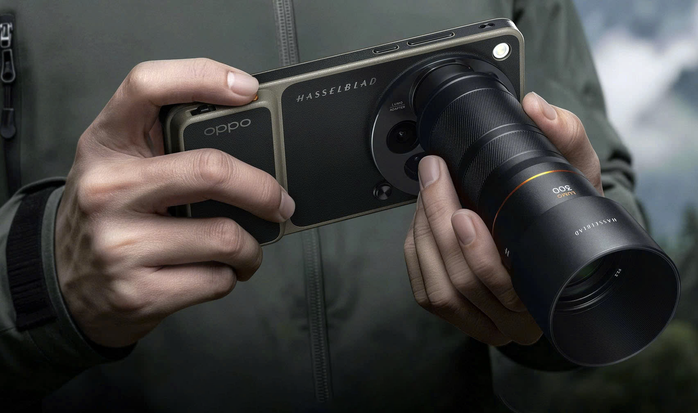
Smartphones with detachable lenses. Photo: OPPO
Unique and unusual detachable lens
In the mid-range segment, Xiaomi launched the Xiaomi 17T Series on May 28th, priced from 20.9 to 26.9 million VND depending on the version. The Xiaomi 17T Series features a Leica 5x Telephoto camera, a first for both the Xiaomi 17T and 17T Pro versions, along with Leica Motion Visual features that can capture vivid moments.
The Xiaomi 17T Series is equipped with a triple rear camera system, combining Xiaomi's imaging technology with Leica's optics. Both versions feature a 50MP main camera using a Leica Summilux lens, capturing strong light, reproducing sharp details, and maintaining the characteristic image quality of Leica cameras in various shooting conditions. With a 50MP resolution, optical image stabilization (OIS), an equivalent focal length of 115mm, and AI Ultra Zoom up to 120x, the telephoto camera system on the Xiaomi 17T Series offers versatile shooting capabilities in many situations. From stage performances and portraits to street life and everyday moments, the device allows you to capture images from a distance with high detail, tight composition, and greater depth. Additionally, the telephoto camera supports macro photography at a minimum distance of 30cm, expanding creative possibilities from close-up details to distant shots.
Realme also impressed mobile photography enthusiasts with its Realme 16 Series, priced at 11.5 - 14.5 million VND, featuring "Portrait Master" powered by NextAI, reproducing natural colors and harmonizing the subject with the background. The Realme 16 Pro has a 200MP multi-focal camera with a selfie mirror on the camera bar, allowing users to take selfies, including group selfies, simply by rotating the phone and raising their hand to say "Hi". Vivo has the Vivo V70 Series, priced at 14 - 20 million VND, with all four cameras co-designed with Zeiss. The Vivo V70 FE has a 200MP AI main camera with an AI Aura Light ring flash. The OPPO Find X9s, priced at 25 - 27 million VND, was recently launched in collaboration with Hasselblad and features a triple rear camera setup with a 50MP Hasselblad camera.
In the high-end segment, Samsung offers the Galaxy S26 Series, priced from 26 to 52 million VND, boasting superior image sensors, Galaxy camera technology, and the Galaxy AI platform. The Galaxy S26 Ultra features a larger aperture (f/1.4 compared to f/1.7 on the Galaxy S25 Ultra), allowing more light to enter the sensor, resulting in sharper and more detailed photos in low-light conditions, even when zoomed. The Xiaomi 17 Series utilizes Leica lenses for all three rear cameras. Notably, the Xiaomi 17 Ultra features a 1-inch Light Fusion 1050L sensor with Leica Lofic HDR technology, improving light handling in complex situations. The most impressive model in this series is the Leica Leitzphone, directly inheriting the design language of the legendary Leica M DSLR cameras. The Xiaomi 17 Ultra is priced from 27 to 43 million VND; the Leica Leitzphone costs 50 million VND. The Vivo X300 Ultra flagship, launched on May 4th, is the highest-end version in the Vivo X Series, priced at 50 million VND. The Vivo X300 Ultra stands out with its Zeiss lens collection, featuring all main cameras with large sensors, golden focal lengths, and optical image stabilization (OIS). Both the main camera and the periscope telephoto camera are 200MP. The OPPO Find X9 Ultra, launched on May 5th, 2026, is also the first Ultra version of the Find X Series priced at 50 million VND, designed in the style of Hasselblad cameras (a legendary Swedish camera brand). In addition to the two 200MP Hasselblad cameras, the device also features a 50MP Hasselblad camera.
The most notable smartphone camera improvements from the beginning of 2026 to the present are the interchangeable lens kits with a 300mm optical focal length and a high-quality 690mm optical focal length found in the OPPO Find X9 Ultra and Vivo X300 Ultra, supporting telephoto photography similar to a dedicated camera. The Vivo ZEISS Gen 2 Ultra's dual telephoto lenses offer two options: 400mm and 200mm optical focal lengths. These interchangeable lens kits are sold separately for those who need them. The official price from OPPO is 10 million VND.
Many "unusual" features
On the Vivo V70 Series, the "AI Magic Weather" feature can transform gloomy skies into bright sunshine, remove unwanted passersby, and automatically correct tilted frames. "AI Magic Landscape" switches between diverse geographical themes, creating stunning travel portraits that highlight both the subject and the surrounding scenery. "AI Photo Editor Expert" offers one-touch editing, including object removal, magic movement, image enlargement, and color correction, optimizing travel photos, portraits, and shots taken in crowded or low-light conditions.
Source: https://nld.com.vn/camera-ai-pho-cap-smartphone-thach-thuc-may-anh-196260530211725615.htm



![[Video] Sunset at Lap An Lagoon – Where the sun sets over the fishing nets](https://vphoto.vietnam.vn/thumb/1200x675/vietnam/resource/IMAGE/2026/05/31/1780192137701_beach-landscape-sea-water-nature-grass-745871-pxhere-com.jpeg)




![[GALLERY] The series of stylish "brick phones" that will be a sensation in 2026](https://vphoto.vietnam.vn/thumb/402x226/vietnam/resource/IMAGE/2026/05/31/1780200957638_ba-1-png.webp)







![[Video] Sunset at Lap An Lagoon – Where the sun sets over the fishing nets](https://vphoto.vietnam.vn/thumb/800x450/vietnam/resource/IMAGE/2026/05/31/1780192137701_beach-landscape-sea-water-nature-grass-745871-pxhere-com.jpeg)


















































![[Video] Sunset at Lap An Lagoon – Where the sun sets over the fishing nets](https://vphoto.vietnam.vn/thumb/402x226/vietnam/resource/IMAGE/2026/05/31/1780192137701_beach-landscape-sea-water-nature-grass-745871-pxhere-com.jpeg)



































Comment (0)