

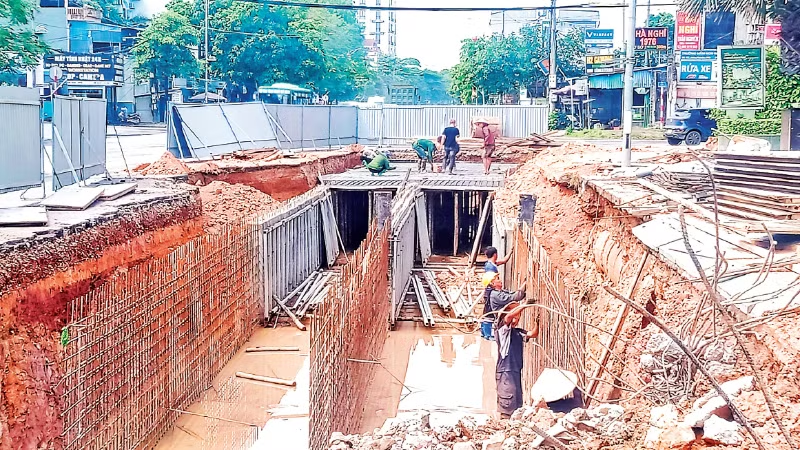
Shortcomings in planning and investment in drainage infrastructure.
In reality, the cause of flooding in lowland, coastal, and mountainous urban areas is climate change, leading to frequent heavy rains, while urban planning management and infrastructure investment, including drainage infrastructure, remain inadequate. In recent years, Hanoi has paid attention to investing in drainage infrastructure, but it has not kept pace with the rate of urban development. To date, the city has only completed the investment in drainage infrastructure for the To Lich River basin; construction is underway in the left and right banks of the Nhue River. The total capacity of drainage pumping stations and the area of regulating lakes only reach about 20% of the drainage plan.
In mountainous urban areas such as Thai Nguyen, Cao Bang , and Da Lat (Lam Dong), the drainage systems, built many years ago on a small scale, are dilapidated and have not been upgraded, failing to keep pace with current urban development. Areas of vacant land with natural water infiltration capacity are gradually being replaced by houses, roads, and construction projects. When it rains, almost all the water flows directly into the drainage system or accumulates into floods. Dr. Ngo Viet Nam Son, an architect, believes these factors contribute to flooding, even severe flooding, in urban areas with high elevations, with Da Lat being a prime example.
Explaining the reasons for the emergence of new flood-prone areas as well as the prolonged flooding in many areas of Ho Chi Minh City, Mr. Trinh Quoc Dung, Deputy Head of the Technical Infrastructure Department (Department of Construction), stated that rapid urbanization has reduced the natural water infiltration area; the problem of waste clogging water inlets and manholes, along with encroachment on canals and drainage corridors, has exacerbated flooding.
According to a survey by the Department of Construction, in more than 28 wards and communes, nearly 40,000 houses are located along canals and waterways, narrowing the flow of water and increasing pollution and flooding. Experts also warn that the city is facing a worrying phenomenon of subsidence. In the last 5 years, the city has subsided by about 2cm each year, and in some areas even by 7-8cm. Dr. Le Trung Chon, Director of the Institute for Sustainable Development Research (Ho Chi Minh City University of Natural Resources and Environment), said that the city is among the top 10 fastest-sinking cities in the world. Therefore, strengthening monitoring, simulation, and forecasting to develop solutions to combat flooding and adapt to climate change is an extremely urgent requirement.
Shift from “passive response” to “proactive adaptation”
To address flooding during the rainy season, many localities prioritize allocating significant resources to invest in and upgrade drainage systems and regulating reservoirs. In late 2025 and early 2026, Hanoi issued an emergency order to construct 12 flood control projects with a total investment of nearly 5,600 billion VND, applying special mechanisms to accelerate implementation. The city prioritizes investment in a system of drainage canals and culverts combined with pumping stations and seven large-scale regulating reservoirs with a total surface area of nearly 100 hectares, capable of storing and regulating over 4 million cubic meters of water.
According to Mr. Le Van Du, Head of the Water Supply and Drainage Infrastructure Management Department (Department of Construction), the main components of the flood control project have been basically completed and put into operation since the beginning of May; the goal is to complete all supporting components by the end of June. The city has simultaneously tested 15 pumping stations, with initial results showing positive effectiveness. After the rain on May 28th in the western part of the city, the rainfall exceeded 80mm, but the water receded quickly, and there were no longer any deep, prolonged flooding points as before. This year, Ho Chi Minh City plans to complete 24 flood control projects with a total capital of nearly 38,000 billion VND, aiming to address 29 flood-prone areas in the city. Key projects such as the Tham Luong-Ben Cat-Rach Nuoc Len canal, the Thu Duc market drainage system, and the Rach Cau Ngang culvert are being accelerated.
Immediately following the historic floods of October 2025, Thai Nguyen province implemented several urgent flood control projects for the central urban area, expanding drainage capacity into the Cau River. Units mobilized manpower and equipment, working continuously to complete these projects before the rainy season. The flood control project in Phan Dinh Phung ward, with an investment of over 100 billion VND, has just been completed and has proven effective, as even heavy rains no longer cause deep flooding. The province is investing over 600 billion VND in the construction of the new Gia Bay bridge and the Huu Cau dike, over 16.5 km long, totaling over 8,500 billion VND, to improve flood drainage capacity and protect the central urban area.
However, investing solely in drainage and flood control projects is insufficient for local authorities. At the recent scientific conference "Mountainous Cities Adapting to Extreme Climate Change" held in Cao Bang, Deputy Minister of Construction Nguyen Tuong Van emphasized that climate change is becoming increasingly extreme, and without a proactive adaptation mindset, it will be very difficult to ensure sustainable development.
Climate change is becoming increasingly extreme, and without a proactive adaptation mindset, it will be very difficult to ensure sustainable development.
Deputy Minister of Construction Nguyen Tuong Van
According to experts, localities need to plan flood control spaces, develop green infrastructure, and implement a "sponge city" model to absorb, retain, and filter rainwater through vegetation, permeable surfaces, and reservoirs. This will reduce pressure on drainage systems, replenish groundwater, and mitigate the impact of extreme weather events. Besides investing in technical infrastructure, localities need to implement a comprehensive set of structural and non-structural solutions on a regional and inter-provincial scale, such as developing upstream forests, building reservoirs, dredging silted river sections, and improving flood drainage capacity.
Chairman of the People's Committee of Cao Bang province, Le Hai Hoa, affirmed that the province will put an end to "incorrect adaptation" practices in planning such as filling in rivers and streams and lowering the ground level in low-lying areas. Urban space must make room for water and develop in accordance with natural laws. Hanoi is implementing an urban restructuring strategy based on the principle of "Positive Renovation - Adaptive Reconstruction," focusing on restoring the inner-city river system such as the Nhue River, To Lich River, Day River, Tich River, etc., combining landscape beautification with the construction of multi-functional technical infrastructure to ensure sustainable urban development in the context of increasingly severe and unpredictable climate change.
Source: https://nhandan.vn/he-thong-thoat-nuoc-do-thi-thich-ung-bien-doi-khi-hau-post965985.html

![[Photo] Solemn bathing ceremony and Buddha procession in Hue](https://vphoto.vietnam.vn/thumb/1200x675/vietnam/resource/IMAGE/2026/05/31/1780228263543_1-jpg.webp)

![[Photo] The General Secretary, President and his wife begin their state visit to the Philippines.](https://vphoto.vietnam.vn/thumb/1200x675/vietnam/resource/IMAGE/2026/05/31/1780230559452_anh-man-hinh-2026-05-31-luc-19-28-11.png)
![[Photo] Admire the coral "masterpiece" amidst the million-year-old heritage of Dak Lak province.](https://vphoto.vietnam.vn/thumb/1200x675/vietnam/resource/IMAGE/2026/05/31/1780221235105_anh-man-hinh-2026-05-31-luc-16-53-27.png)




![[Video] Weather forecast for tonight and tomorrow, June 1st, 2026: Northern Vietnam experiences rising temperatures, Southern Vietnam continues to have thunderstorms.](https://vphoto.vietnam.vn/thumb/402x226/vietnam/resource/IMAGE/2026/05/31/1780232471628_thumb-toi-3105-png.webp)






![[Video] Sunset at Lap An Lagoon – Where the sun sets over the fishing nets](https://vphoto.vietnam.vn/thumb/340x192/vietnam/resource/IMAGE/2026/05/31/1780192137701_beach-landscape-sea-water-nature-grass-745871-pxhere-com.jpeg)




![[Photo] The General Secretary, President and his wife begin their state visit to the Philippines.](https://vphoto.vietnam.vn/thumb/402x226/vietnam/resource/IMAGE/2026/05/31/1780230559452_anh-man-hinh-2026-05-31-luc-19-28-11.png)

































![[Photo] Admire the coral "masterpiece" amidst the million-year-old heritage of Dak Lak province.](https://vphoto.vietnam.vn/thumb/402x226/vietnam/resource/IMAGE/2026/05/31/1780221235105_anh-man-hinh-2026-05-31-luc-16-53-27.png)






























Comment (0)