

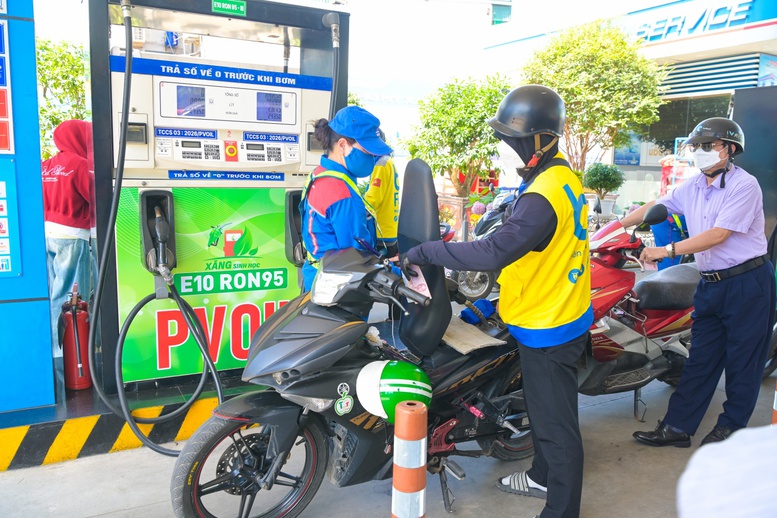
E10 gasoline started being sold on the market from the end of April.
Globally , the United States has been using E10 gasoline since the 1980s and is now expanding to E85. Meanwhile, the Philippines and Thailand are popularizing E15 gasoline and plan to upgrade to E20 from 2026.
In Vietnam, the mandatory use of E10 gasoline nationwide will be implemented from June 1, 2026. Many major fuel distributors are even accelerating the implementation process to reduce pressure on importing conventional gasoline amidst ongoing tensions in the Middle East.
4 benefits of promoting the use of biofuels
The head of the Department of Innovation, Green Transformation and Industrial Promotion ( Ministry of Industry and Trade ) emphasized: "E10 gasoline is just the beginning; the Ministry of Industry and Trade will continue to research a roadmap for E15, E20, or higher." This shows that Vietnam is catching up with the trend of the United States and the world in deploying E10 bioethanol gasoline, while also aiming for higher blending levels such as E15 and E20 to increase energy self-sufficiency, reduce emissions, and create sustainable outlets for agricultural products.
Representatives from the Ministry of Industry and Trade highlighted four benefits of promoting the use of biofuels.
Firstly, the ethanol in biofuels is produced from renewable resources such as cassava, corn, and sugarcane, contributing to national energy security.
Secondly, there are environmental benefits and support for climate change mitigation. Ethanol's lower net carbon emissions contribute to emissions reduction efforts, thereby providing long-term health benefits. Lifecycle analyses in several tropical countries show that replacing conventional gasoline with bioethanol can help reduce greenhouse gas emissions in transportation by approximately 37% to 84%. Reducing CO2 and black carbon emissions also contributes to slowing global warming.
Thirdly, there are benefits for public health. In the long term, even a 10% ethanol blend contributes to mitigating health risks caused by climate change. The development of biofuels improves air quality and public health. Reduced pollution has yielded significant health benefits, lowering healthcare costs by reducing respiratory illnesses and premature mortality, far exceeding the cost of policy implementation.
Fourthly, it protects the engine. Many major car manufacturers such as Toyota, Honda, Ford, and technical organizations like the Society of Automotive Engineers (SAE) affirm that E5 and E10 bioethanol fuels do not harm engines. On the contrary, E10 fuel has a higher octane rating, helping the engine run more efficiently and reducing knocking.
According to Mr. Do Van Tuan, Chairman of the Vietnam Biofuel Association, Vietnam currently has over 500,000 hectares of cassava with an annual production of over 10 million tons. However, the output of this commodity still heavily depends on the export of raw cassava to the Chinese market, so prices frequently fluctuate.
"As the ethanol industry develops, cassava will have a more stable market, giving farmers peace of mind in their production," Mr. Tuan said.
He also stated that many domestic ethanol plants have improved their technology, not only producing fuel ethanol but also utilizing by-products to recover liquid CO₂, fusel oil, and DDGS for animal feed production, contributing to cost reduction and enhanced competitiveness in line with the circular economy model.
It is estimated that Vietnam currently consumes more than 10 million tons of gasoline per year. If E10 is implemented for both RON92 and RON95, the demand for blended ethanol would be approximately 1 million tons per year. If upgraded to E15, the ethanol demand could reach around 1.5 million tons per year.
Currently, there are 6 ethanol production plants nationwide, of which 4 are operational but only utilizing about 35% of their capacity due to limited market demand. When the E10 gasoline program is implemented comprehensively, the plants can increase their operating capacity, and new projects can be added to meet domestic demand.
"Domestically produced ethanol is fully competitive with imported products in terms of price. We only import when domestic supply is insufficient," said the Chairman of the Vietnam Biofuel Association.
Anh Tho
Source: https://baochinhphu.vn/kien-tri-muc-tieu-chuyen-doi-xang-sinh-hoc-e10-102260516154451478.htm
![[Image] Hanoi's urban life under the challenge of a "scorching hot" environment](https://vphoto.vietnam.vn/thumb/1200x675/vietnam/resource/IMAGE/2026/05/25/1779706979265_nang-nong-t5-2026-minh-duy-7-4636-jpg.webp)




![[Image] Close-up view of the interchange connecting the two expressways and Long Thanh Airport.](https://vphoto.vietnam.vn/thumb/1200x675/vietnam/resource/IMAGE/2026/05/25/1779703378210_ndo_br_z7863716673926-224453a31600126cce10622af6290afd-4549-jpg.webp)






















































































Comment (0)