

 |
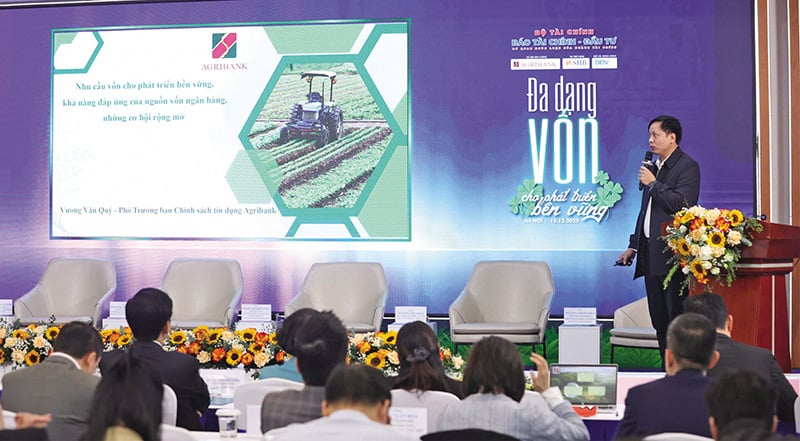
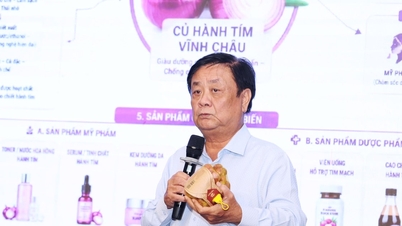
| A representative from Agribank presented a paper at the seminar. Photo : Dung Minh |
Green credit and green bonds are increasing sharply.
At the "Diversifying Capital for Sustainable Development" seminar recently organized by the Finance and Investment Newspaper, Deputy Governor of the State Bank of Vietnam, Nguyen Ngoc Canh, stated that, according to the carbon neutrality scenario, by 2050, the total long-term investment need for green and sustainable economic development will be approximately 670-700 billion USD, requiring the mobilization of diverse resources, from green credit to green bonds, carbon markets, etc., in addition to budget funds.
According to the State Bank of Vietnam's leadership, the banking sector has played a pivotal role in providing capital for the green economy. As of November 30, 2025, outstanding green credit reached approximately VND 750,000 billion, with an average growth rate of over 21% per year during the 2017-2025 period – higher than the overall credit growth rate of the economy. However, green credit only accounts for nearly 5% of the total outstanding credit in the entire economy.
Meanwhile, Ms. Pham Thi Thanh Tam, Deputy Director of the Department of Financial Institutions ( Ministry of Finance ), stated that as of October 2025, the outstanding balance of green corporate bonds reached approximately US$1 billion. Although green bonds have seen a breakthrough increase compared to previous years, they remain small compared to the scale of bank credit and the total market demand.
- Deputy Governor of the State Bank of Vietnam, Nguyen Ngoc Canh
 In recent years, green credit has continuously expanded, increasing by an average of 21% per year during the period from 2017 to September 2025, higher than the overall credit growth rate of the entire economy. However, reality shows that it is necessary to diversify financial resources, requiring the participation of domestic and foreign capital channels, especially from the private sector and capital markets (in this case, the stock market), working together with the banking system to meet the requirements of green transformation and sustainable development of the country.
Expanding green finance investment channels from various regions and markets not only helps reduce pressure on the banking system, but most importantly, it facilitates the mobilization of medium- and long-term capital more flexibly, safely, and effectively for the nation's overall goals, in line with global green finance trends.

According to commercial banks, the recent issuance of Decision 21/2025/QD-TTg dated July 4, 2025, by the Prime Minister, which stipulates the environmental criteria and green classification list, has resolved many difficulties and obstacles for banks. Accordingly, banks can more easily identify, assess, and accurately grant green credit, avoiding the risk of "greenwashing"...
Currently, banks and businesses are still awaiting guidance on the implementation of Decision 21/2025/QD-TTg regarding the agency responsible for certifying green projects. Once an agency is established to certify green projects, banks will feel more confident in lending to this sector, instead of struggling to independently assess green projects.
Nevertheless, to further boost capital flows for sustainable development, Mr. Vuong Van Quy, Deputy Head of the Credit Policy Department (Agribank), suggested building a national database on emissions, energy, and biodiversity, making it accessible to businesses and financial institutions when evaluating projects.
Simultaneously, specific incentive policies should be implemented, such as reducing corporate income tax for green loans; providing interest rate subsidies or refinancing with preferential interest rates, especially for energy transition and sustainable agriculture sectors; establishing a national green guarantee fund to share risks with banks; and creating mechanisms to encourage banks to expand their green credit portfolios…
A three-pronged approach to promoting green capital development.
According to Ms. Pham Thi Thanh Tung, Deputy Director of the Department of Credit for Economic Sectors (State Bank of Vietnam), commercial banks previously offered incentives and encouraged green credit using their own resources. However, according to Resolution 68-NQ/TW dated May 4, 2025, of the Politburo on the development of the private economy and Resolution 198/2025/QH15 of the National Assembly, the budget will provide a 2% annual interest rate subsidy for private enterprises, business households, and individual businesses borrowing capital to implement green, circular projects or those applying ESG (environmental, social, governance) standards through the Small and Medium-sized Enterprise Development Fund and commercial banks.
“Currently, the State Bank of Vietnam is coordinating with the Ministry of Finance to submit to the Government a Decree on supporting interest rates of 2% per year from the state budget through commercial banks, expected to be submitted to the Government this week. Accordingly, the 2% interest rate support mechanism will be implemented from 2026, and the budget support will be allocated to localities,” Ms. Tung said.
According to Ms. Tung, for the 2% interest rate subsidy policy to be effectively implemented, a synchronized "three-legged stool" is needed: a Decree on interest rate support through banks; a Decree on support through state funds; and most importantly, the Ministry of Agriculture and Environment needs to promptly issue a decision on criteria for identifying green projects as a basis for disbursement.
Besides green credit, the green economy is also being actively supported by green bonds. Ms. Pham Thi Thanh Tam stated that the green bond market has experienced breakthrough growth since the issuance of Decision 21/2025/QD-TTg. Businesses have begun proactively seeking long-term capital from the market, instead of relying entirely on banks. The Ministry of Finance is also studying a pilot project for issuing green service bonds, expected to be submitted to the Government in 2026.
On the business side, Ms. Nguyen Thi Hai Hoa, Deputy General Director of Sun Group, affirmed that large enterprises like Sun Group always want to cooperate with and develop green projects, because green is the long-term sustainability of society, the country, and its people.
Ms. Hoa suggested that the State Bank of Vietnam and the Ministry of Finance could coordinate with local authorities to incorporate green criteria into the bidding and auction process for projects from the outset. When businesses accept and are ready to develop green projects from the beginning, they will receive corresponding support mechanisms from regulatory agencies and credit institutions.
"If adjustments to 'green' the project are only requested after it has already been awarded, it will be very slow. Including green criteria right from the bidding stage for infrastructure, tourism, or urban projects will be more effective and better aligned with the needs of businesses," Ms. Hoa noted.
Source: https://baodautu.vn/kieng-ba-chan-cho-von-xanh-but-toc-d461544.html

![[Photo] First session of the 14th Congress of the Vietnam Trade Union](https://vphoto.vietnam.vn/thumb/1200x675/vietnam/resource/IMAGE/2026/06/03/1780465947883_ndo_br_img-3852-jpg.webp)

![[Photo] General Secretary and President To Lam presides over a meeting with the Central Organizing Committee.](https://vphoto.vietnam.vn/thumb/1200x675/vietnam/resource/IMAGE/2026/06/03/1780482764658_a1-bnd-4741-3342-jpg.webp)
![[Photo] Secretary of the National Assembly Party Committee, Chairman of the National Assembly presides over the meeting of the Standing Committee and Executive Committee of the National Assembly Party Committee.](https://vphoto.vietnam.vn/thumb/1200x675/vietnam/resource/IMAGE/2026/06/03/1780480353201_ndo_br_bnd-2585-jpg.webp)








































![[Video] Sunset at Lap An Lagoon – Where the sun sets over the fishing nets](https://vphoto.vietnam.vn/thumb/1200x675/vietnam/resource/IMAGE/2026/05/31/1780192137701_beach-landscape-sea-water-nature-grass-745871-pxhere-com.jpeg)




























Comment (0)