

Trinh Dung, a fellow student and colleague of mine, lives near the breezy Thu Bon River in Duy Xuyen district ( Da Nang ). Once, Dung took me sightseeing in Duy Xuyen and told me many stories. Proud of his hometown river, Trinh Dung emphasized: “The Thu Bon is the mother river of Quang Nam, brimming with historical and cultural sediments. It is the only river in Central Vietnam where we have found a complete range of Sa Huynh-Champa archaeological sites and artifacts.”
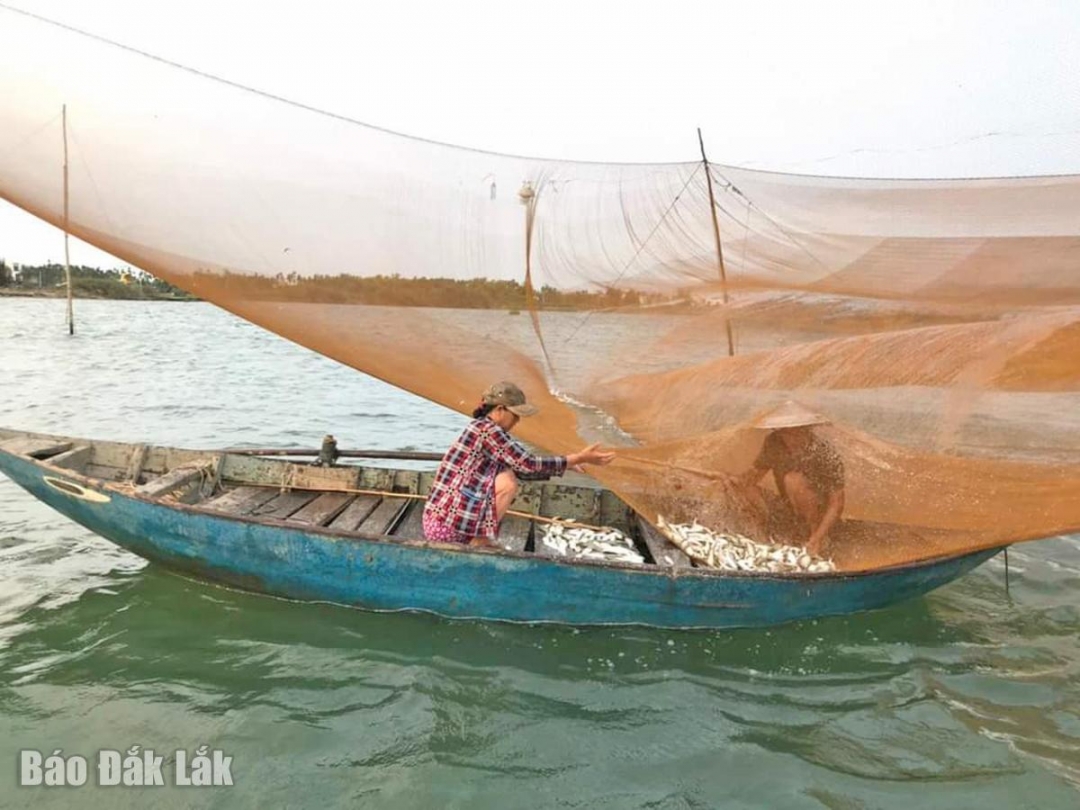 |
| Fishing on the Thu Bon River. |
I gazed out at the winding, turbulent, and majestic Thu Bon River. Originating from Ngoc Linh Mountain, it was initially just a small stream in the former Quang Nam province. Only when it merged with the Vu Gia River in Que Son and Duy Xuyen districts did it become a large, magnificent river. The Thu Bon River has a drainage basin of over 10,000 km² , making it one of the largest inland rivers in Vietnam. This cool, refreshing water has shaped many prosperous and picturesque villages and hamlets for generations, giving birth to the highlands and lowlands of Quang Nam, which boast world-class heritage sites.
At night, while chatting with friends over a glass of wine, I suddenly remembered a rather special poem by the wise and virtuous Emperor Lê Thánh Tông, written when he came here to pacify Champa in 1471. The Emperor had been away from the capital since the previous winter and hadn't returned by the following spring. Then, one night, stopping by this river, this accomplished and accomplished monarch was moved to write the poem "Thu Bồn Dạ Bạc" (Night at Thu Bồn Wharf). The poem has two lines: "Viễn biệt thần kinh ức khứ niên/Bồn giang kim hữu tải ngâm thuyền," which translates to: "Recalling the long separation from the capital since last year / Now the poet's boat has docked at Thu Bồn Wharf."
The exact origin of the Thu Bon River's name remains unknown, but the earliest mention of it in the poetry of a wise ruler, poet, or writer comes from the aforementioned poem by King Le Thanh Tong, dating back over 550 years.
It turns out that there is a unique festival associated with the Thu Bon River, named after a woman whose name is also the name of the river: the Thu Bon Lady Festival (held from the 10th to the 12th of February in the lunar calendar every year).
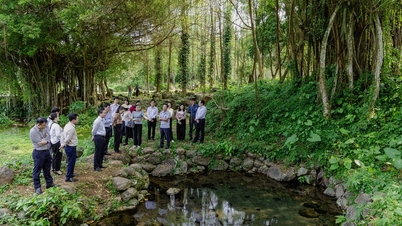
According to researchers, the Thu Bon River has long been a sacred river for the local inhabitants, steeped in folk beliefs. The Thu Bon Goddess Festival has existed for a long time, at least several centuries, along the Thu Bon River from mountainous areas like Nong Son to the Duy Xuyen plain, vividly demonstrating the close bond of brotherhood among the ethnic groups throughout generations. The festival prays for favorable weather, prosperity, and peace for the people and the nation. It has been recognized by the State as a national intangible cultural heritage; currently, the festival is held annually and attracts many local people and tourists.
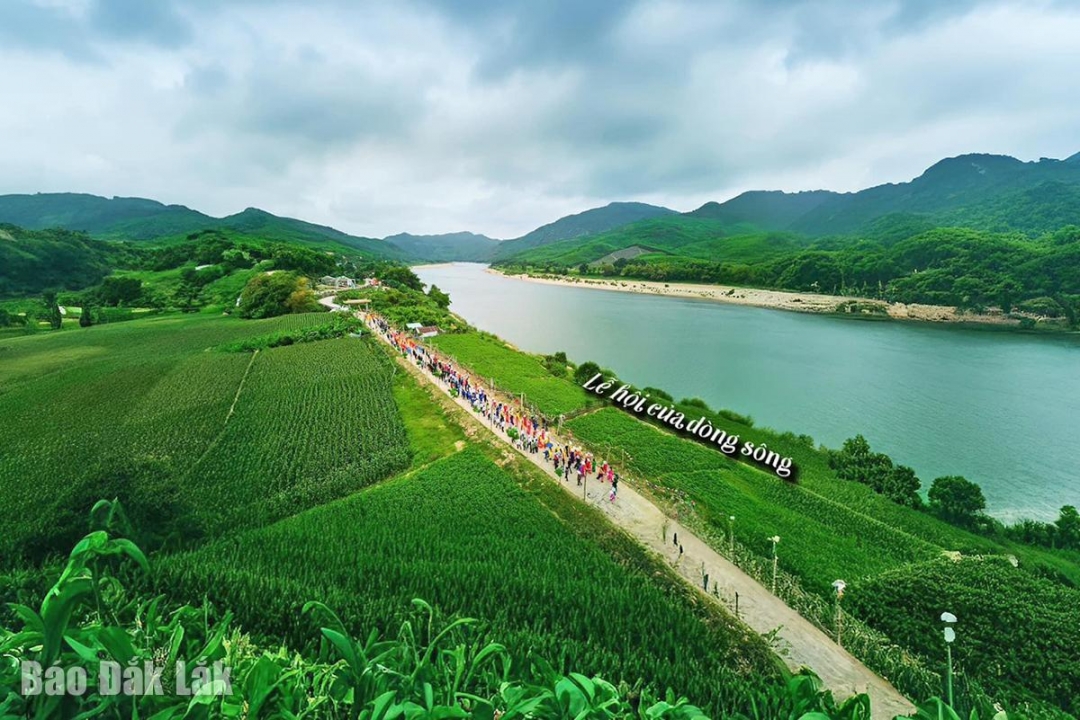 |
| The Thu Bon Goddess Festival. |
The legend of Lady Thu Bon is not just one story, but many. She could be a princess, or perhaps a female general… but whoever she was, the legend always aims to honor the image of a heroic woman who sacrificed herself for the people and fell on the Thu Bon River, revered by the villagers, buried, and then deified in the folk consciousness.
Upon arriving at the festival venue, I was further astonished to see the sign pointing to Thu Bon village, and later learned about Thu Bon East and Thu Bon West hamlets. So, alongside the Thu Bon River, there was a festival and villages sharing the same name. The scene was one of vibrant colors, with people and vehicles bustling about. Here, rituals were being performed; there, people were playing chess, singing traditional folk songs... everyone was as happy as during Tet (Vietnamese New Year), everywhere was joyful and lively.
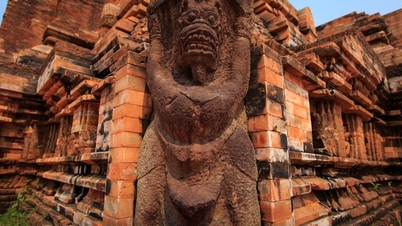
In this land, we not only had the opportunity to attend the Thu Bon Goddess Festival but were also stunned by the majestic, classical, and mysterious beauty of My Son Sanctuary – “The Valley of the Gods,” as the ancient Cham people respectfully called the land near the Thu Bon River, where there were 70 temples and towers built from the 7th to the 13th centuries, of which 32 remain today. Although we had visited many places with Cham towers, it was only at My Son Sanctuary that we truly appreciated these architectural and artistic masterpieces, arguably unique to the Champa kingdom.
The Thu Bon River, like a mother river, has given birth to fertile fields and beautiful, peaceful villages renowned for their beauty. But that's not all…
The advantage of waterway transportation dates back to ancient times, as evidenced by the folk song supposedly originating from the Thu Bon River: "Young jackfruit is sent down, flying fish swim upstream," connecting provinces and cities. With a long, wide, and picturesque river like the Thu Bon, exploiting its potential for river tourism , visiting famous villages, and exploring heritage is a very feasible direction. There's also the suggestion to establish a Thu Bon River museum, which is also a good idea; why not?
Source: https://baodaklak.vn/du-lich/202601/ky-dieu-qua-thu-bon-ffc134e/


![[Photo] General Secretary and President To Lam presides over a meeting on preparations for the review of one year of operation of the three-tiered government system.](https://vphoto.vietnam.vn/thumb/1200x675/vietnam/resource/IMAGE/2026/06/02/1780391821195_a1-bnd-4595-9717-jpg.webp)














































































Comment (0)