

Eleda Stadion, home of Malmö FF football club in Sweden, began a project on May 24th to collect 1,000 liters of urine from spectators for research into producing a fertilizer as an alternative to synthetic fertilizers derived from fossil fuels.
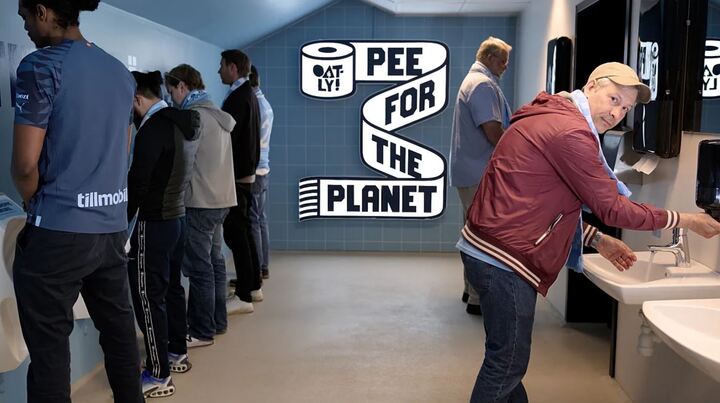
The message "Pee for the planet" is displayed in the restroom of Malmö FF's Eleda Stadion. (Photo: Euronews)
According to the Centre for Environmental Law International (CIEL), nitrogen-containing fertilizers currently generate approximately 1.13 billion tonnes of CO2 equivalent emissions annually globally, more than the total emissions of the entire aviation industry.
The supply of compound fertilizers is also under significant pressure due to geopolitical instability. Iran's continued blockade of the Strait of Hormuz – a vital global shipping route – has brought approximately one-third of global fertilizer trade to a standstill.
This strait is also an important transit route for natural gas, an essential raw material for the production of synthetic nitrogen fertilizers that are widely used in Europe and elsewhere.
Researchers suggest that human urine could be a potential alternative because it contains high levels of three essential nutrients for plants: nitrogen, phosphorus, and potassium – the main components of industrial fertilizers.
The project is a collaboration between the Swedish University of Agricultural Sciences (SLU), the oat milk company Oatly, Malmö FF, and the Sanitation360 organization. The urine collected at the stadium will be processed to create fertilizer for research purposes.
"We are wasting a valuable resource," said Björn Vinnerås, professor at SLU and expert at Sanitation360.
Vinnerås argues that reusing urine is not much different from recycling plastic, while people have long been accustomed to using animal manure such as cow, pig, or chicken manure to fertilize crops.
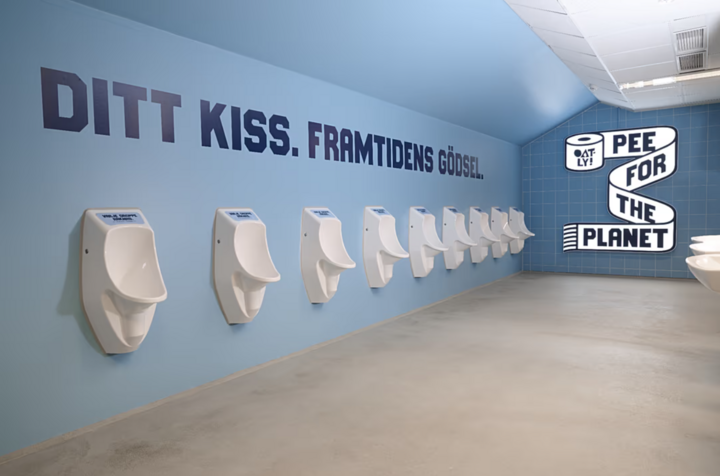
Toilets used for the "Pee for the Planet" campaign at the MFF Eleda Stadium. (Photo: Euronews)
Malmö FF's home ground has been fitted with 15 urinals and a toilet capable of collecting urine for the project.
From the match on May 24th until Malmö FF's final home game of the season at the end of November, the stadium will become a testing ground for urine collection technology, while also evaluating factors related to hygiene, logistics, and public acceptance.
The research team is also testing the safety of this type of fertilizer for food crops, particularly regarding the risk of pharmaceutical residues or pathogens, before the technology can be deployed on a large scale.
If successful, the project could pave the way for improvements to toilet infrastructure and the development of large-scale urine collection systems in the future.
Researchers say that urine could theoretically replace up to 30% of the synthetic fertilizers currently used in Sweden.
The project is also expected to help reduce the pressure on wastewater treatment at crowded locations such as the 22,500-seat Malmö FF stadium. Currently, many nutrients in urine are not recovered and instead become pollutants in rivers, lakes, and the sea.
In the long term, the research team wants to find out whether consumers are willing to accept food produced using recycled nutrients from urine.
Source: https://vtcnews.vn/ky-la-chien-dich-di-tieu-vi-hanh-tinh-ar1019984.html

![[Photo] General Secretary and President To Lam presides over the meeting to approve the draft report on the results of the second inspection by the Politburo of the Standing Committee of the Hanoi City Party Committee.](https://vphoto.vietnam.vn/thumb/1200x675/vietnam/resource/IMAGE/2026/05/26/1779789811432_a2-bnd-4430-9620-jpg.webp)




































































Comment (0)