

To salvage the disastrous failure of the "Special War" strategy, the US imperialists, through every conceivable scheme, launched a "War of Destruction" to prevent the supply of aid from the North to the South. Among the 60 "bottlenecks" identified by the US on the vital transportation routes, the Ham Rong Bridge was considered the "ideal chokepoint." Therefore, the US favored Ham Rong with a meticulously planned attack using the most brutal methods possible.
 The Ham Rong Bridge proudly spans the Ma River. Photo: Minh Khoi
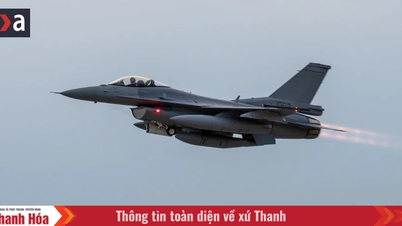
The primary objective of this air raid on Ham Rong Bridge was assigned by the US to the 2nd Tactical Air Force Group – the "big brother" of the US tactical air force – and equipped with F-105s, the most advanced and modern aircraft at the time. These aircraft were nicknamed "Thunderbolts" because they relied on their roaring sound to intimidate the enemy. According to US military sources, "when a force of Thunderbolts roars overhead, the enemy loses its composure and cannot aim properly. At that moment, the F-105s simply dive down one by one to drop bombs." However, the enemy pilots did not realize that this very tactic of diving down one by one created opportunities for the air defenses at Ham Rong to fire at each aircraft individually.
Understanding the schemes and tactics of the American aggressors, and under the guidance of the Central Party Committee, the Government, and the Ministry of National Defense , the army and people of Thanh Hoa, along with the troops, entered the war with a proactive mindset, ready to defeat the American "War of Destruction." In the last days of February and the beginning of March 1965, the atmosphere of preparation for battle in Ham Rong was extremely vibrant. Loudspeakers constantly announced the enemy situation and issued orders for thorough evacuation. Ham Rong faced a new challenge; they could not yet imagine the ferocity and scale of the war, but in their hearts, they deeply cherished President Ho Chi Minh's call to arms: "Let us all unite as one. Let us be determined to defeat the American invaders."
On the afternoon of April 3, 1965, the US mobilized a large number of jet aircraft and bombs to bombard the Ham Rong Bridge. Every mountain, river, construction site, and factory became a target of fierce attack. Following the battle plan and assigned tasks, the 57mm cannons fired effectively at the longest range, followed by the 37mm cannons, then the 14.5mm cannons, machine guns, and rifles... all were in a state of readiness. The order to fire was given from the command post as the F105 aircraft began its dive. The shouts of "fire!" spread throughout the battlefields from the North to the South bank, despite the roar of numerous aircraft overhead trying to intimidate the artillerymen. Never before had there been such a fierce encounter with American aircraft. The 1st Company of 57mm cannons at the Dong Tac battlefield, the 4th Company on the unnamed hill, the 5th Company at Dinh Huong... were simply waiting for the enemy to come within range before firing. At Company 17, the 37mm anti-aircraft guns at the Yen Vuc battleground were buried under mud and debris from bombs, but the gunners refused to leave their positions. Squad leader Mai Dinh Gan fainted several times, but each time he regained consciousness, he continued fighting.
Along with the fighting forces, the militia of Yen Vuc village coordinated closely according to the practiced anti-aircraft shooting plan. In the midst of fierce fighting, when units needed ammunition, and the gunners couldn't leave their positions, Ms. Nguyen Thi Hien led the Yen Vuc village militia team, nimbly moving across the bridge on the rails to resupply our troops fighting the enemy. Ms. Ngo Thi Tuyen, defying danger, carried two heavy ammunition boxes weighing nearly 100kg at once for the naval ship. In this battle against the American enemy, the entire village of Nam Ngan went to the front. Mr. Ngo Tho Lan and his sons Ngo Tho Sap, Ngo Tho Xep, Ngo Tho Dat, and Ngo Tho Sau each did their part, ready to replace the gunners on the warships when needed. Buddhist nun Dam Thi Xuan participated in boiling water, bandaging the wounded, and using the main hall of the temple as a first aid station for the soldiers.
On the summit of Ngoc Mountain, the soldiers fought with extraordinary bravery. Their guns glowed red-hot from firing, and they refrained from drinking water to cool the barrels. On the very first day of fighting, the army and people of Ham Rong and Nam Ngan shot down 17 American jet aircraft, including the F105 "Thunderbolt," which was the first to appear in the skies of North Vietnam. The whole country was thrilled by the victory of the army and people of Ham Rong and Nam Ngan. That same night, a large number of local self-defense forces and militia were deployed to the battlefields to repair trenches and bunkers. The General Staff deployed three 57mm artillery companies from the Tam Dao Regiment, marching rapidly from western Nghe An to Ham Rong to prepare for a day of fighting that was predicted to be much more intense than what had already taken place.
Having failed on the first day, the very next morning (April 4th), the US mobilized hundreds of modern aircraft, frantically dropping thousands of tons of bombs and ammunition on Ham Rong and surrounding areas. The forces on the southern bank of Ham Rong were incredibly strong at this time. Company 1, 57mm artillery, Tam Dao Regiment, opened fire on the reckless F105 bomber. Other companies waited until the bombers were within effective range before firing. The people and soldiers of Ham Rong had never imagined the enemy would use so many aircraft. Unwilling to accept defeat, the US deployed aircraft from both the air force and navy simultaneously. However, the coordinated combat between our anti-aircraft, air force, navy, self-defense forces, and militia created a continuous defensive line, encircling the "enemy aircraft." At exactly 5 PM, the extremely fierce battle ended, with the people and soldiers of Ham Rong and Nam Ngan shooting down 30 American aircraft. No one could believe it, but it was true.
In just two days, April 3rd and 4th, 1965, the US mobilized 454 sorties, dropping thousands of tons of bombs and ammunition on a small piece of land less than 1 square kilometer. Yet, the Ham Rong Bridge still stood firm, while 47 American planes were destroyed. These were truly "two dark days for the US Air Force," as commented by American and Western media at the time. For our army and people, those two days set a record for an unprecedented battle.
In that resounding victory, beautiful images of the people's war strategy emerged. Many examples of tenacious and courageous fighting have forever become beautiful symbols of the unwavering will to fight and win of the people of Ham Rong, Nam Ngan, and of the land and people of Thanh Hoa province. Today, 59 years after that "historic confrontation," the spirit of "unwavering victory" remains deeply etched into the mountain rocks, and Ham Rong has entered history as a beautiful legendary chapter of the nation.
Minh Khoi
(This article uses some material from the book "Ham Rong - A Symbol of Thanh Hoa People," by Tu Nguyen Tinh, Thanh Hoa Publishing House, 2021).
Source


















![[Photo] Reception to welcome General Secretary and President To Lam and his wife on their State visit to the Philippines](https://vphoto.vietnam.vn/thumb/1200x675/vietnam/resource/IMAGE/2026/06/01/1780295488620_vna-potal-chieu-dai-chao-mung-tong-bi-thu-chu-tich-nuoc-to-lam-va-phu-nhan-tham-cap-nha-nuoc-toi-philippines-8798060-7855-jpg.webp)






























































Comment (0)