

Rapid development
According to the Vietnam Coconut Association, Vietnam's fresh coconut exports have only been developing for about 8 years, but they have grown very rapidly, with export value increasing tenfold. To date, fresh coconuts have been exported to more than 40 countries worldwide , reaching an export value of approximately US$250 million in 2023, accounting for about 20-25% of the total export value of the country's coconut industry.
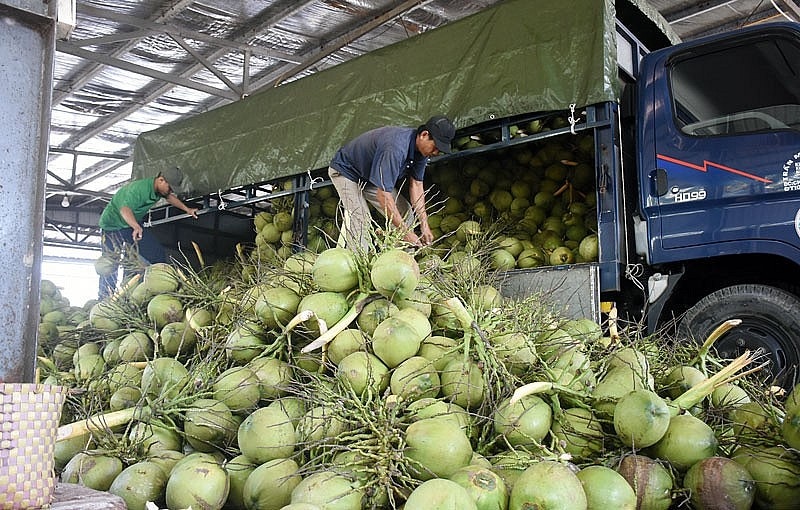 |
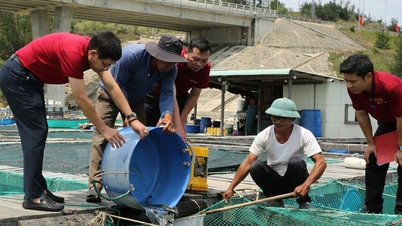
| Exporting fresh coconuts: A new opportunity for Ben Tre province's key economic sector. Photo: BT |
Notably, the Vietnamese Ministry of Agriculture and Rural Development and the General Administration of Customs of China (GACC) recently signed a Protocol on the export of fresh coconuts to this massive market.
According to Mr. Hoang Trung, Deputy Minister of Agriculture and Rural Development, China consumes over 4 billion coconuts annually, with 2.6 billion for immediate consumption and 1.5 billion for processing. However, China's production capacity is insufficient to meet this demand, creating a significant opportunity for Vietnam. Therefore, this presents a very good chance to reorganize production, establish linkages, and expand the market.
Sharing this view, Mr. Huynh Tan Dat – Director of the Plant Protection Department (Ministry of Agriculture and Rural Development of Vietnam) – believes that this is an opportunity for the Vietnamese coconut industry to develop further. However, it also presents challenges for management agencies and localities in inspecting and monitoring processes. Therefore, all parties must cooperate closely and work together to create the most favorable conditions for exporting fresh coconuts to China.
Besides the opportunities offered by the market, according to Mr. Cao Ba Dang Khoa – General Secretary of the Vietnam Coconut Association, the coconut industry is currently facing certain difficulties. These include challenges for businesses in purchasing large quantities of fresh coconuts with uniformity in type, size, and quality, and a lack of concentrated coconut raw material areas.
Mr. Cao Bá Đăng Khoa cited an example: due to the lack of concentrated growing areas for each type of coconut intended for export, if a business signs a contract to export 50 containers of green Siamese coconuts, it is very difficult to procure only this type of coconut. The business is forced to buy all types of coconuts in the same area and then sort them to obtain coconuts that meet the partner's requirements.
Local authorities get involved.
As the province with the 5th largest coconut cultivation area in the country, after Ben Tre, Tra Vinh, Tien Giang, and Vinh Long, Mr. Kieu Van Cang – Head of the Plant Protection and Crop Production Sub-Department of Binh Dinh – said that as of 2023, the coconut area in Binh Dinh was 9,353 hectares; of which, the area of Siamese coconuts (drinking coconuts) accounted for 24.5%, equivalent to about 2,292 hectares; the average yield reached 119.3 quintals/hectare, with a production of 111,358 tons/year.
According to the plan, by 2025, Binh Dinh will increase its coconut cultivation area to 10,000 hectares, including 9,700 hectares of commercial coconuts, with a production of 116,400 tons per year. The official export of fresh coconuts to China presents an opportunity for farmers currently owning nearly 3,000 hectares of Siamese coconuts in Binh Dinh. The locality is currently finalizing procedures to obtain planting area codes for over 70 hectares of Siamese coconuts for drinking in Phu Cat and Hoai An districts. This is because planting area codes are a prerequisite for exporting fresh coconuts to the Chinese market.
Considered the coconut capital of the country, Ben Tre province currently has nearly 80,000 hectares of coconut trees, yielding over 688,000 tons of fruit; of which approximately 15,865 hectares are green Siamese coconuts for drinking, accounting for 20.53% of the total coconut area. The estimated annual production is about 145 million coconuts.
To prepare for exporting fresh coconuts to the US and Chinese markets, the agricultural sector in Ben Tre province is perfecting coconut production processes, improving coconut quality, supporting businesses in establishing cultivation areas, and preparing relevant documents according to regulations before sending coconuts for export to these two markets.
Regarding the Chinese market, according to the Ben Tre Department of Agriculture and Rural Development, the province has piloted six concentrated coconut production areas; five areas produce coconuts according to organic standards, and one area produces coconuts for drinking. Ben Tre has developed over 23,700 hectares of coconut plantations participating in the value chain, accounting for over 30% of the province's total coconut area, yielding over 230,000 tons. Currently, 20 enterprises are involved in building packaging facilities and obtaining planting area codes for export to the Chinese market; of which, 13 packaging facilities and 35 planting areas with 2,343 hectares have submitted applications to the Plant Protection Department to prepare for the Chinese market.
Vietnam's coconut industry ranks fourth in terms of total market value globally, with exports of coconuts and coconut products exceeding US$900 million in 2023. The main importers of Vietnamese fresh coconuts are the United States, Japan, and South Korea. The expansion of official export markets to China will incentivize businesses to register for export-standard planting area codes and packaging facility codes, opening up a brighter future for Vietnam's coconut industry.
According to businesses, signing the Protocol on the official export of coconuts to China will give this commodity the opportunity to surpass the $1 billion mark in the near future, while also opening up opportunities for many key coconut-producing localities to thrive.
Coconut is one of the six key industrial crop development projects. Currently, the country has approximately 200,000 hectares of coconut plantations with an annual production of over 2 million tons. Mr. Dang Phuc Nguyen – General Secretary of the Vietnam Fruit and Vegetable Association – stated that with a population of 1.4 billion, China is one of the world's largest coconut consumers. Being allowed to export officially to China opens up significant opportunities for the Vietnamese coconut industry. This is because China is geographically close, with short transportation times and low costs, making the product competitive with other countries.
Source: https://congthuong.vn/xuat-khau-dua-tuoi-ky-vong-thu-ve-ty-usd-345329.html

![[Photo] General Secretary and President To Lam works with the Party Committee of the Ministry of Health on the work of Vietnamese traditional medicine.](https://vphoto.vietnam.vn/thumb/1200x675/vietnam/resource/IMAGE/2026/05/20/1779294323718_a1-bnd-2978-3319-jpg.webp)

![[Photo] National Assembly Chairman Tran Thanh Man working with the Standing Committee of the National Assembly's Delegation Affairs Committee.](https://vphoto.vietnam.vn/thumb/1200x675/vietnam/resource/IMAGE/2026/05/20/1779294340023_ndo_br_1-1691-jpg.webp)












































































Comment (0)