

Given the impacts of climate change, the shift to high-tech and smart agriculture is considered an inevitable trend. Ms. Tran Thi Sen from Dong Yen commune (Thanh Hoa City) - who has many years of experience in growing tomatoes, flowers, and Kim Hoang Hau melons - said that although investing in greenhouses requires a high initial investment, it is advantageous for growers in caring for crops, minimizing the use of pesticides; flowers and fruits develop uniformly, and quality is improved.
High investment, high returns.
With this model, it's also possible to proactively create a planting schedule with various types of flowers and fruits, meeting market demands at different times to maximize sales. Besides investing in infrastructure, she also applies automated drip irrigation technology; the care processes are automatically set up, and the ratios of fertilizers, nutrients, and techniques are implemented scientifically . This saves on labor costs, as only the system operation and supervision are required. Notably, thanks to the investment in greenhouse systems and modern care equipment, she was able to easily experiment with planting several new crops.
Meanwhile, Mr. Hoang Van Tham, Director of the Chuc Son Clean Vegetable and Fruit Cooperative, said that the cooperative is the first unit in Chuong My district ( Hanoi ) to cooperate with scientists to install the iMetos 3.3 AG smart weather monitoring station system. With a coverage radius of 15km, the monitoring station accurately forecasts temperature, wind speed, rainfall, etc., providing a basis for farmers to develop plans for caring for and protecting vegetables and fruits. In addition, the cooperative has invested in installing 10 cameras in the fields, connected to computers and smartphones, helping the management board easily manage the production area according to the process... Thanks to high-tech vegetable and fruit production, the cooperative collects nearly 2 tons of clean vegetables and fruits every day without being affected by the weather. Currently, the cooperative's vegetable products are supplied to 4 hospitals, 2 supermarket chains, and 15 convenience stores under contract with stable selling prices.
To achieve effective investment models for smart agriculture, banks have played a crucial role as a bridge connecting capital to support farmers, cooperatives, and businesses. As a key provider of capital and financial services for the agricultural and rural sectors, Agribank prioritizes lending to this sector, with high-tech and clean agriculture receiving special incentives. The bank has allocated 50,000 billion VND to implement a lending program to encourage the development of high-tech and clean agriculture. To date, since the program began, Agribank's lending volume has exceeded 25,000 billion VND, benefiting over 40,000 borrowers (of which over 98% are individuals, households, and farm owners).
These results will be further amplified by the Politburo's Resolution No. 57-NQ/TW on breakthroughs in the development of science, technology, innovation, and national digital transformation, and the National Assembly's Resolution on piloting some special mechanisms and policies to remove obstacles in science and technology activities. These are important policies and guidelines for the high-tech industry in general and have a strong impact on the development of high-tech agriculture and smart agriculture in particular. This will create favorable conditions for research and application of modern technology, attract investment in smart agriculture, improve productivity and product quality, and help Vietnamese agriculture meet international standards for sustainable development.
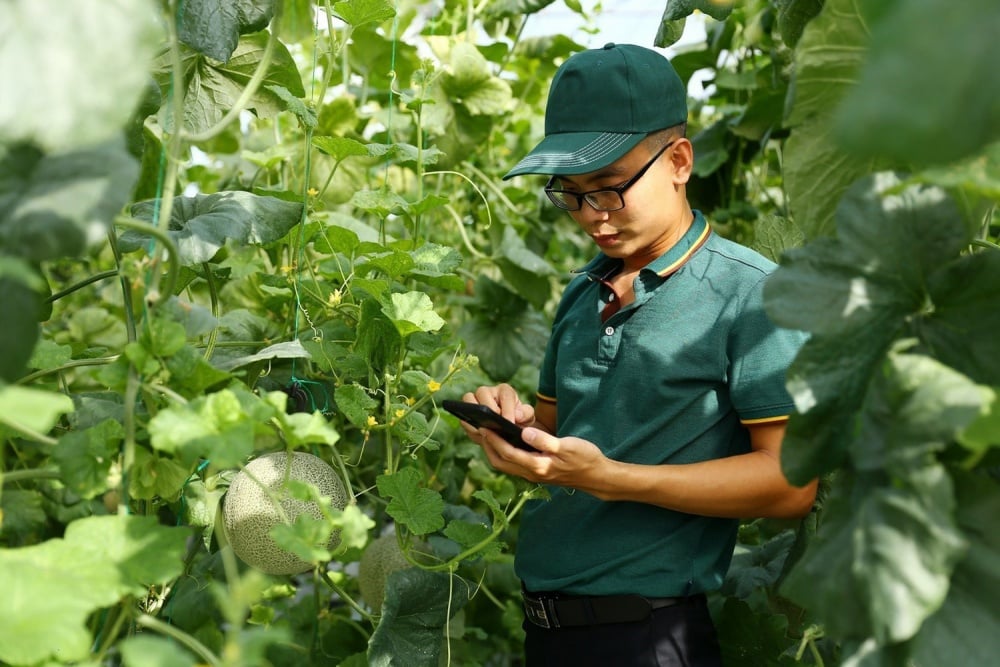 |
| Hanoi's smart agricultural production model |
Expedite the opening of the legal framework.
However, the majority of farmers and small businesses still face difficulties in accessing advanced technology due to limitations in capital, human resources, and technical infrastructure. In many localities, limitations in technological infrastructure hinder access to and application of digital technology in agricultural production; there is a shortage of human resources with expertise in information technology in the agricultural sector, especially in rural areas; agricultural data remains fragmented, not digitized, and not managed centrally and synchronously, making the deployment of analytical, forecasting, and decision-making systems difficult. The government has issued many major policies, but detailed implementation has not met actual needs, causing difficulties for localities in the implementation process.
Despite numerous challenges, developing smart agriculture remains a crucial foundation for building a green agricultural system that meets international standards for environmental protection and climate change adaptation. Therefore, experts believe that supportive policies are needed to assist businesses investing in high-tech agriculture. This includes the rapid issuance of legal frameworks, regulations, and guidelines related to high-tech agriculture, and the facilitation of legal procedures for businesses and financial institutions to participate in the high-tech agriculture and green finance markets. Furthermore, the government should implement policies to support the costs of field design and infrastructure development, creating concentrated production zones for specialized commodity production, facilitating the application of mechanization in high-tech agriculture, and developing markets and services to support the application of high technology in agricultural product consumption.
Furthermore, Associate Professor Dr. Nguyen Dinh Tho and his research team at the Institute of Agricultural and Environmental Strategy and Policy proposed the need for in-depth training programs in agricultural technology, ranging from data management and automated machinery operation to the use of artificial intelligence, to help workers improve their skills and easily adapt to modern production trends. Developing sustainable smart agriculture in Vietnam requires a comprehensive strategy with coordination between the government, businesses, research institutes, and farmers. Only by maximizing the potential of technology and innovation can Vietnamese agriculture compete in the international market, meet increasingly stringent standards, and move towards a green, efficient, and sustainable production system.
Source: https://thoibaonganhang.vn/ky-vong-vao-nong-nghiep-thong-minh-161394.html

![[Image] Hanoi Police officially crowned champions of V-League 2025/2026](https://vphoto.vietnam.vn/thumb/1200x675/vietnam/resource/IMAGE/2026/05/31/1780244769054_ndo_br_039d561b692be875b13a-jpg.webp)

![[Photo] The General Secretary, President and his wife begin their state visit to the Philippines.](https://vphoto.vietnam.vn/thumb/1200x675/vietnam/resource/IMAGE/2026/05/31/1780230559452_anh-man-hinh-2026-05-31-luc-19-28-11.png)
![[Photo] Solemn bathing ceremony and Buddha procession in Hue](https://vphoto.vietnam.vn/thumb/1200x675/vietnam/resource/IMAGE/2026/05/31/1780228263543_1-jpg.webp)
![[Photo] Admire the coral "masterpiece" amidst the million-year-old heritage of Dak Lak province.](https://vphoto.vietnam.vn/thumb/1200x675/vietnam/resource/IMAGE/2026/05/31/1780221235105_anh-man-hinh-2026-05-31-luc-16-53-27.png)







![When forestry is a 'weakness' of Nghe An?: [Part 1] Living a precarious life amidst the golden forests](https://vphoto.vietnam.vn/thumb/402x226/vietnam/resource/IMAGE/2026/05/30/1780156547904_1-2-001514_717-225327.jpeg)





![[Video] Sunset at Lap An Lagoon – Where the sun sets over the fishing nets](https://vphoto.vietnam.vn/thumb/340x192/vietnam/resource/IMAGE/2026/05/31/1780192137701_beach-landscape-sea-water-nature-grass-745871-pxhere-com.jpeg)
































![[Photo] Admire the coral "masterpiece" amidst the million-year-old heritage of Dak Lak province.](https://vphoto.vietnam.vn/thumb/402x226/vietnam/resource/IMAGE/2026/05/31/1780221235105_anh-man-hinh-2026-05-31-luc-16-53-27.png)


























Comment (0)