Bringing legal aid closer to the elderly.
Elderly people currently face numerous legal risks such as land disputes, inheritance issues, domestic violence, property fraud, and difficulties in accessing social security policies. However, due to limitations in health, economic conditions, and access to information, many still struggle to protect their own rights. In response to this reality, several policies aimed at strengthening legal assistance for the elderly have been enacted, including the Law on Legal Aid, the National Action Program on the Elderly for the period 2021-2030, and the Plan for Implementing Legal Aid Policies for the Elderly for the period 2022-2030.

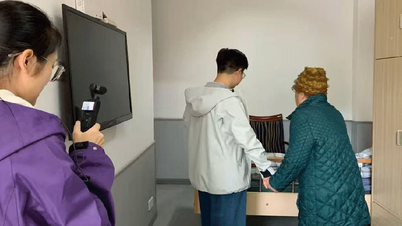
Legal aid workers distribute leaflets promoting legal assistance for the elderly. Photo: Ninh Chinh
According to the Department of Legal Dissemination, Education and Legal Aid ( Ministry of Justice ), in the period 2022-2025, legal aid for the elderly has achieved many positive results. State-run legal aid centers nationwide have handled a total of 4,639 cases for elderly people with financial difficulties.
Of these, participation in litigation accounted for the largest number with 2,582 cases; legal consultation reached 1,959 cases; and representation outside of litigation totaled 98 cases. The cases mainly involved civil, criminal, family law, land disputes, inheritance, social policy, and administrative complaints. Most cases were assessed as being of good or high quality; notably, there were no complaints regarding the quality of legal aid provided.
Communication efforts regarding legal aid have been identified as one of the key solutions to help the elderly raise their legal awareness, understand their right to legal aid, and proactively seek support when needed. Over the years, the Ministry of Justice, along with other ministries, sectors, and localities, has implemented various communication methods tailored to the characteristics of the elderly and the specific conditions of each area.
In the digital environment and mass media, information about the right to legal aid, eligible beneficiaries, and addresses of state-run legal aid centers is regularly published on the National Legal Education and Dissemination Portal, the Vietnam Legal Aid website, etc. Many news reports, legal communication programs, courtroom dramas, and practical legal case studies are also broadcast on the Voice of Vietnam (VOV), Vietnam Television (VTV), and local radio systems to help people easily access, understand, and apply this information.
At the local level, direct communication efforts continue to be emphasized through the distribution of legal leaflets and guidebooks, the installation of information boards and legal aid information boxes at commune-level People's Committee offices, cultural centers, and community centers. Regularly organized outreach and mobile legal counseling sessions are held in remote areas, ethnic minority regions, and areas where the elderly still face difficulties in accessing legal information and public services.
Removing bottlenecks in access to justice
Although legal aid for the elderly has achieved many positive results, the implementation process in practice still faces numerous difficulties and limitations.
According to experts, legal education and dissemination activities in some localities are still integrated into other programs and have not yet developed specific content tailored to the elderly. The methods of information delivery are sometimes heavily theoretical, using many difficult-to-understand legal terms, and are not truly suitable for the psychological characteristics and information processing abilities of the elderly, especially those in remote areas and ethnic minority communities.
Another major difficulty is the psychological barrier faced by the elderly themselves. Many still fear legal repercussions, worried about the impact on family relationships or economic dependence, and therefore choose to remain silent and accept disadvantages instead of proactively seeking legal assistance. In reality, many elderly people whose property, land, or inheritance rights are violated, or who experience domestic violence, do not report the incidents or seek assistance for fear of causing further family conflict.
While the legal aid team possesses professional expertise, there is still a lack of in-depth training programs on skills for working with the elderly... In addition, funding for mobile communication activities, surveys of actual needs, development of specialized materials, or organization of in-depth training at the grassroots level does not meet practical requirements.
To ensure that the elderly have more equal, effective, and substantive access to justice, according to the Department of Legal Dissemination, Education, and Legal Aid, there is a need for a strong reform of legal communication methods, focusing on the elderly. Communication content should be concise, easy to understand, and relevant to real life; prioritizing specific situations related to land, inheritance, policies, fraud prevention, and domestic violence.
Besides applying digital platforms, it is necessary to strengthen direct communication methods in residential areas, senior citizen clubs, healthcare facilities, cultural centers, and social welfare institutions to make it more accessible to the elderly. Simultaneously, emphasis should be placed on in-depth training and development for legal aid assistants, lawyers, mediators, and grassroots officials on skills for working with the elderly. In addition to legal knowledge, this team needs to be equipped with skills in psychological counseling and support for cases of violence, fraud, or signs of rights violations.
Another crucial solution is to improve the inter-sectoral coordination mechanism between legal aid organizations and the Association of the Elderly, prosecuting agencies, local authorities, healthcare facilities, and social organizations. Establishing a mechanism for information exchange, early detection, and timely support will help reduce the number of elderly people who are overlooked or unaware of how to access legal aid services.
Most importantly, legal aid for the elderly should be viewed not only as a simple legal support activity but also as a solution to ensure social security in the context of Vietnam's rapidly aging population.
Source: https://daibieunhandan.vn/la-chan-tro-giup-phap-ly-10417867.html











































































































Comment (0)