

Vietnam's major cities, generally considered less susceptible to earthquakes due to not lying on major seismic belts like Japan or Indonesia, experienced unexpected tremors on March 28th due to a magnitude 7 earthquake in Myanmar.
Although those tremors did not cause serious damage, they heightened the risk of earthquakes in Vietnam and clearly revealed the lack of preparedness and response experience among the population.
According to experts from the Institute of Geophysics, Vietnam is not located in a major geological fault zone, but it can still be indirectly affected by strong earthquakes in countries in the region such as Myanmar, China, or Indonesia. The recent earthquake, with its epicenter thousands of kilometers from Vietnam's border, only caused slight tremors in many areas of Hanoi and Ho Chi Minh City.
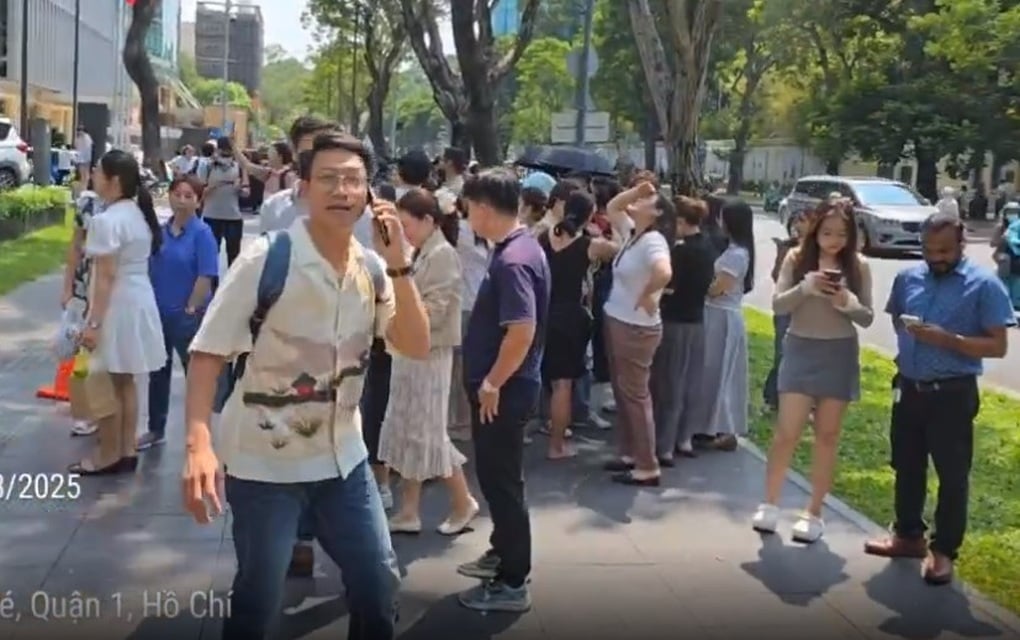
People panicked and fled a building in the heart of Ho Chi Minh City on March 28 (Photo: Tung Le).
Media reports indicated that the tremors were insignificant, posing no tsunami risk or major damage, but they were still enough to surprise and worry residents.
In reality, the risk of earthquakes in Vietnam is not entirely zero. Some areas, such as the Northwest, near the Lai Chau- Dien Bien fault, and the Central Highlands, have recorded small earthquakes in the past, although rarely exceeding 5 magnitude. With the rapid development of large cities, where numerous high-rise apartment buildings and dense populations are concentrated, even slight tremors from afar can have consequences if adequate preparations are not made.
The public's reaction to the events of March 28th partly reflected this reality. In Hanoi, many people recounted moments of flickering lights, shaking beds, and clanging sounds from household items, leading to scenes of residents in high-rise apartment buildings rushing down the stairwells to escape.
Similarly, in Ho Chi Minh City, people in central districts like District 1 and District 7 panicked when they felt the tremors; some even crowded emergency exits instead of seeking safe shelter. In Thailand, the Vietnamese community also described feeling the floor shaking, causing them anxiety despite not understanding the cause. These images show that many Vietnamese people are unfamiliar with earthquakes and lack basic response skills.
This is not entirely surprising, as Vietnam rarely experiences significant seismic events, leading to a lack of emphasis on earthquake education and drills. However, this spontaneous response carries significant risks, especially in densely populated urban areas, where the risk of being trampled or hit by falling objects can have far more serious consequences than tremors themselves.
Some argue that Vietnam doesn't need to worry about earthquakes because mild tremors pose no danger, or that major earthquakes don't occur there. This view is partly true considering Vietnam's geographical location, but it overlooks the fact that even mild tremors can cause panic and indirect damage, especially in the context of rapid urbanization. High-rise apartment buildings, if not designed to earthquake-resistant standards, can be easily affected by remote oscillations. Furthermore, a lack of preparation and awareness can easily lead to panic, as reported in the press.
Another limitation is the over-reliance on information from authorities without individual initiative. Even though the Institute of Geophysics quickly confirmed the low impact of the earthquake in Myanmar, many people still spread rumors on social media, increasing unnecessary fear. This shows the need for a more comprehensive strategy, not just relying on official announcements, but also equipping people with the knowledge and skills to respond independently.
From my years of experience living in Japan—where earthquakes are a part of daily life—I've observed that the Japanese people's ability to respond stems not only from advanced technology but also from awareness and preparation at all levels.
The Japanese always keep an emergency kit at home, containing water, dry food, a flashlight, a hand-crank radio, and a first-aid kit, usually placed in an easily accessible location such as near the front door. They practice the "Drop, Cover, and Hold On" principle as a reflex, avoiding the immediate rush outside – a potentially risky action often taken by Vietnamese people. According to experts, people should only move to a safe place when the shaking has completely stopped; if living in an apartment building, prioritize using the stairs, not the elevator.
Houses in Japan, from traditional wooden houses to modern apartments, adhere to earthquake-resistant standards, with heavy furniture secured to walls and evacuation maps readily available. They also have early warning systems that broadcast signals via TV, radio, and telephone, allowing residents to use those precious seconds to open doors, turn off gas stoves, or find shelter.
Foreigners applying for residency in Japan are always provided with specific information such as maps, addresses, and features of each shelter in the area. They are also encouraged to independently research and memorize directions to the nearest shelter.
After the earthquake, the Japanese spontaneously organized support in their neighborhoods, sharing water and food, and helping the elderly and children, demonstrating a strong sense of community. Japanese children are taught about earthquakes from kindergarten through picture books, videos, and practical sessions, helping them protect themselves without needing adult reminders.
Vietnam can flexibly apply these lessons, not only to respond to earthquakes but also to various other natural disasters. Each household should prepare an emergency kit, placed in an easily accessible location, to ensure safety in case of an emergency. People can inspect and reinforce their interiors themselves, while the government needs to consider building regulations for new constructions in urban areas.
Leveraging international applications and enhancing communication through TV and social media will help raise awareness, combined with community drills to build solidarity and collective response capabilities. More importantly, Vietnamese people need to learn to be proactive instead of just waiting for instructions, and residential areas and apartment complexes should be encouraged to establish emergency response teams.
The March 28 earthquake served as a warning that Vietnam is not entirely immune to seismic activity. The panicked reaction of the population revealed a lack of preparedness, but it also opened up opportunities for change. While it's impossible to replicate Japan's model entirely, flexibly applying these lessons will help Vietnamese people better prepare for future tremors, transforming a potential threat into a manageable challenge.
Author: Pham Tam Long holds a PhD in Sustainable Development in Business Administration from Osaka University, Japan; currently a lecturer at the School of International Management - Ritsumeikan Asia Pacific University, Japan. Dr. Pham Tam Long's research focuses on issues of sustainable management in businesses and the management of the United Nations Sustainable Development Goals (SDGs).
The HIGHLIGHTS section welcomes your feedback on the article's content. Please go to the Comments section and share your thoughts. Thank you!
Source: https://dantri.com.vn/tam-diem/lam-gi-khi-dong-dat-20250328213400625.htm

![[Photo] Prime Minister Pham Minh Chinh receives the Chinese Ambassador to Vietnam](https://vphoto.vietnam.vn/thumb/1200x675/vietnam/resource/IMAGE/2026/04/05/1775397481797_ndo_br_dsc-5512-jpg.webp)
































































Comment (0)