
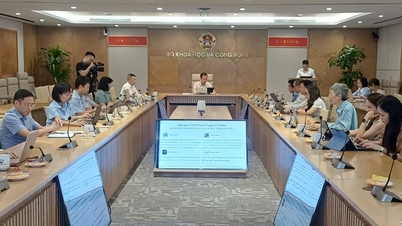
Nguyen Thi Hanh, Director of the Department of Criminal and Administrative Law and Management of Administrative Violations, requested the drafting agency to study and incorporate the opinions of the delegates. (Photo: Ministry of Justice's electronic portal)
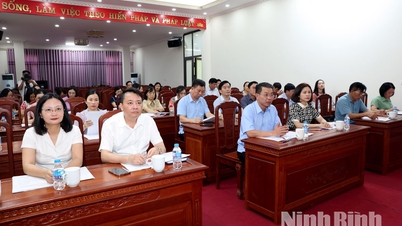
On May 8th, the Ministry of Justice held a meeting of the Council for evaluating the policy dossier on the amended Law on Food Safety.
Reporting at the meeting, a representative from the Ministry of Health stated that the draft Law on Food Safety (amended) comprises four major policies, including a policy on managing food safety along the value chain. The goal of this policy is to manage food safety throughout the entire food value chain, from initial production, cultivation, livestock farming, harvesting, fishing, exploitation, slaughtering, processing, trading, and distribution to the consumer, ensuring that products circulating in the market are safe and of high quality for consumers, aiming towards the food safety control methods of developed countries.
Accordingly, the draft still stipulates that the production, initial processing, cultivation, animal husbandry, harvesting, fishing, exploitation, and slaughter control activities shall be carried out in accordance with relevant laws as prescribed in the 2010 Food Safety Law, but adds regulations on the limit levels of residues of veterinary drugs, pesticides, and other contaminants in food.
The draft also adds regulations requiring food production facilities to meet the General Principles of Food Hygiene (GHP) and regulations for certain groups of food production facilities that must meet advanced global production standards such as HACCP, ISO 22000, IFS, BRC, FSSC 22000, etc., along with an implementation roadmap.
Regarding regulations for managing food products before market circulation, the current system of declaring conformity has shifted from outdated practices to a system of registering declarations or declaring applicable standards for specific product groups. The remaining food groups will be inspected and monitored during their circulation in the market.
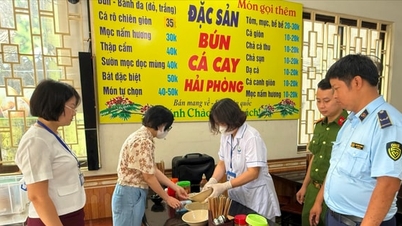
Many regulations concerning restaurants, collective kitchens, school kitchens, street food vendors, those directly involved in the business, as well as the responsibilities of local authorities in coordinating inter-agency efforts to manage these types of establishments, have also been added to the draft.
The draft also includes provisions on post-inspection (planned or unannounced); the form, time, and frequency of inspections; regulations on maximum penalties for administrative violations; recall and handling of food products that do not meet quality and safety standards; recall and suspension of administrative procedures; enhancing the role of the testing system in serving state management; and proactively taking samples for market surveillance.
Speaking at the meeting, a representative from the Hanoi Department of Health stated that the policy on managing food safety along the value chain is the most important part of the draft, but it only outlines management requirements without clarifying what tools will be used to manage the chain, who will be ultimately responsible, where chain data will be stored, what the mandatory traceability mechanism will be, and the criteria for determining a safe chain…
This policy has also failed to fully address the gap regarding fresh food, street food, and local markets. Policies still tend to focus on managing packaged food, declared food, and large-scale production facilities, while in reality, the majority of current food safety risks lie in the raw materials such as fresh food, unpackaged food, street food, and local markets.
Sharing the same concern, representatives from the American Chamber of Commerce in Vietnam (AmCham Vietnam) argued that the current policy implementation is heavily reliant on pre-approval and that clear regulations on post-approval, focusing on risk management, are needed to facilitate implementation by local authorities.
Authorized by Deputy Minister of Justice Dang Hoang Oanh, the Chairperson of the Council, Director of the Department of Criminal and Administrative Law and Management of Administrative Violations Nguyen Thi Hanh requested the drafting agency to research and incorporate the opinions of the delegates; noting the need to add regulations related to digital transformation; and to enhance community awareness, communication, education, and culture regarding food safety...
The draft law is expected to be submitted to the National Assembly for consideration and approval at its second session at the end of 2026.
ANH PHUONG
Source: https://www.sggp.org.vn/lam-ro-cong-cu-quan-ly-an-toan-thuc-pham-theo-chuoi-post851704.html



![[Image] Hanoi's urban life under the challenge of a "scorching hot" environment](https://vphoto.vietnam.vn/thumb/1200x675/vietnam/resource/IMAGE/2026/05/25/1779706979265_nang-nong-t5-2026-minh-duy-7-4636-jpg.webp)
![[Image] Close-up view of the interchange connecting the two expressways and Long Thanh Airport.](https://vphoto.vietnam.vn/thumb/1200x675/vietnam/resource/IMAGE/2026/05/25/1779703378210_ndo_br_z7863716673926-224453a31600126cce10622af6290afd-4549-jpg.webp)






































































Comment (0)