Mr. Le Van Hoang, Director of MTM Bazan Dak Nong Coffee Company Limited, had an exchange with a reporter from the Industry and Trade Newspaper regarding this issue.
The quality of coffee doesn't start at the counter.
- What led you to coffee, cocoa, and your entrepreneurial journey?
Mr. Le Van Hoang: Previously, I worked in finance and accounting at the local level. After about two years, I decided to find my own path, hoping to start my own business like many other young people.
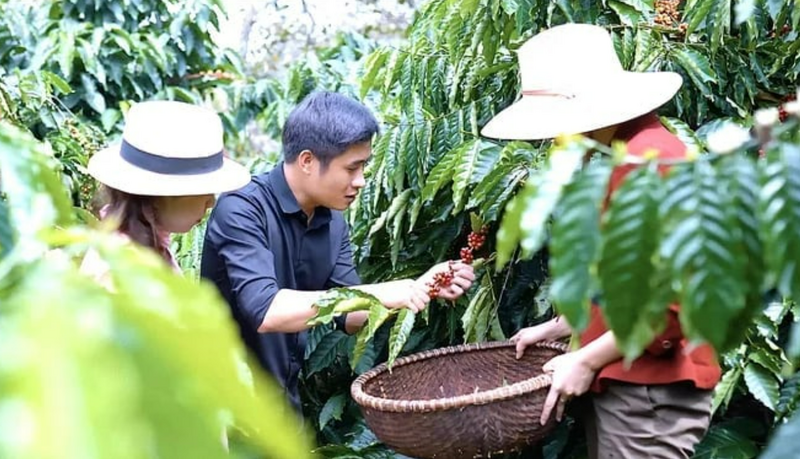
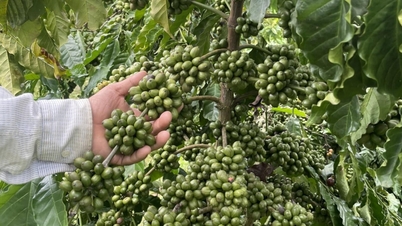
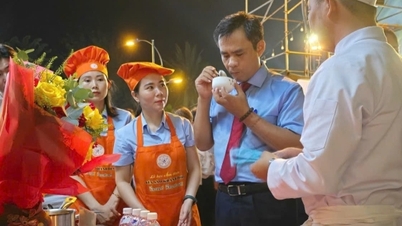
Mr. Le Van Hoang introduces the process of harvesting ripe coffee beans to visitors at the Enjoy Coffee farm. Photo: Hong Thuy.
My connection with coffee came about quite naturally, as I was born into an environment where many relatives worked in the coffee industry. In 2014, I opened a small shop with the simple goal of bringing pure, authentic coffee to Vietnamese people.
However, during the course of operation, I realized that the quality of coffee doesn't just depend on the brewing process. There were days when the same brewing method and the same type of beans resulted in different flavors. That's when I understood that the problem lay in the preceding stages, from the growing region and harvesting to the initial processing.
In 2015, I decided to shift from retail to manufacturing, establishing MTM Bazan Dak Nong Coffee Co., Ltd. Initially, we sourced raw materials from various places, but later returned to the local area to work directly with farmers.
The biggest challenge wasn't capital or technology, but convincing farmers to change their production practices. Without credibility, any proposal is difficult to accept. Therefore, we chose to take action first.
The company leased a farm of about 10 hectares to implement the entire process from cultivation and harvesting to preliminary processing. After more than a year, the results showed a significant improvement in product quality and value. When people saw the effectiveness, they began to believe and follow suit.
We consider "credibility" to be the core element. Our business not only purchases but also participates from the beginning of the supply chain, guiding processes, providing technical support, and committing to purchasing at prices higher than the market rate if the products meet standards.
There were times when the market price was just over 30,000 VND/kg, but we still bought it at 50,000 - 70,000 VND/kg. This motivated farmers to change their farming methods.
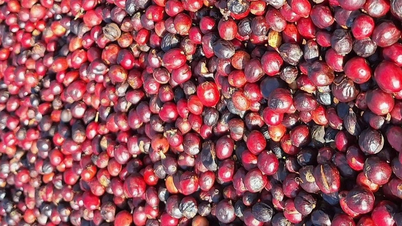
In addition, businesses support the construction of greenhouses for preliminary processing, lend equipment, organize training, and conduct quality assessment competitions. When farmers taste the products themselves and realize the difference, they proactively improve their processes.
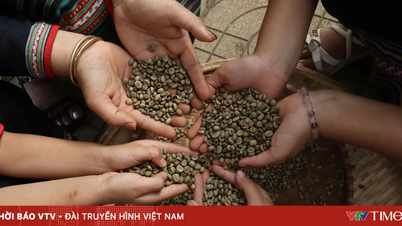
Currently, we are linked with 5 cooperatives and over 100 farming households. While not large in scale, we can meticulously control each shipment. Each product has its own "file," clearly detailing the growing region, process, harvesting time, and initial processing. This makes traceability a natural part of our operations, giving us an advantage when entering international markets.
During the coffee production process, we also realized that cocoa is a crop with potential. Despite facing similar initial difficulties, the business continued to choose a practical approach: conducting its own research, processing, and finding markets.
The advantage is that cocoa does not compete with but complements coffee seasonally. When coffee harvesting ends, cocoa begins, helping farmers increase their income. Currently, there are about 6 cooperatives involved in supplying cocoa with an area of over 100 hectares, and businesses are developing chocolate products to expand their market.
Building a brand from the local area to the international market.
- In your opinion, what are the competitive advantages of small businesses in the agricultural value chain?
Mr. Le Van Hoang: The advantage of small businesses lies not in production volume, but in their ability to closely monitor the growing areas. We can track each process, understand each garden, and the farming methods of each household—something that large businesses find difficult to do due to high costs.
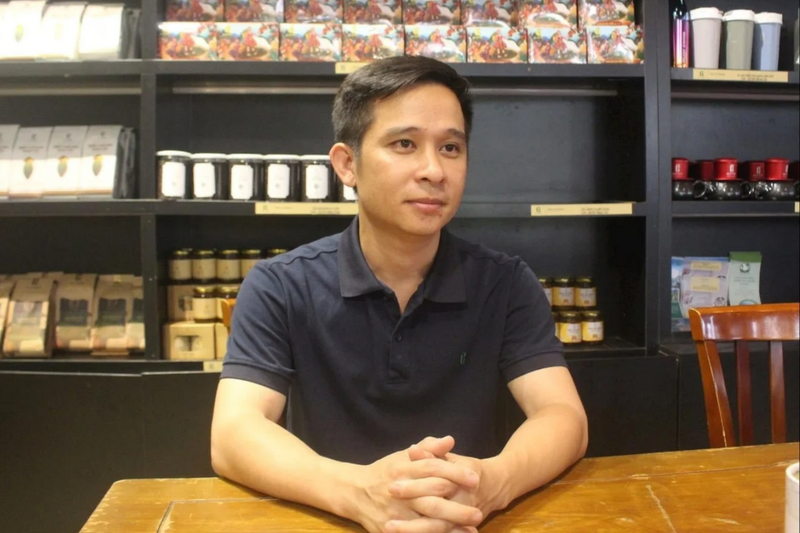
Mr. Le Van Hoang, Director of Bazan Dak Nong Coffee Company Limited. Photo: Thanh Nga.
Therefore, the product doesn't need to be in large quantities, but its origin and quality must be clearly stated. In many export orders, customers are very interested in information such as the growing region, processing methods, fermentation time, etc. These factors are increasingly becoming core values of the product.
The relationship with farmers is also built on a foundation of trust. Some households have been working together for nearly a decade without any binding contracts. The company does not aim for a monopoly, but rather focuses on improving the overall quality of the entire raw material supply area.
As quality improves, benefits will spread throughout the entire chain. This is also a prerequisite for meeting the increasingly high demands of the market, as partners will not only look at certifications but also directly inspect the production process.
- How has the company developed its market and built its brand, sir?
Mr. Le Van Hoang: Starting our business in a small locality like Dak Nong (now part of Lam Dong province), we took advantage of word-of-mouth marketing. When a product is good, the story will naturally spread throughout the community and follow customers to many different markets.
This allows the business to gain local recognition before expanding internationally. As consumer trends shift towards high-quality products, we leverage our local raw material resources to drive growth.
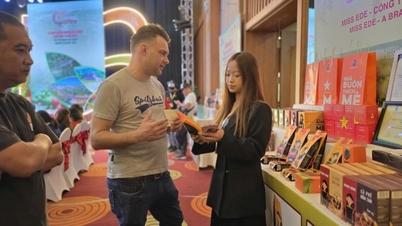
Currently, in addition to the domestic market, the product has reached international markets such as Japan and the United States. The company previously operated a sales outlet in Osaka and still maintains distribution operations there.
The two main product lines, coffee and cocoa (processed into chocolate), have formed a relatively stable customer base, creating a foundation for long-term development.
There are no shortcuts to success.
- Looking back on your journey of over 10 years, what lessons have you learned and what advice do you have for young people?
Mr. Le Van Hoang: There are no shortcuts to starting a business in agriculture . Growth is a process of accumulation through each season, each experiment, and even each failure.
After more than 10 years, the relationship between businesses and farmers has become increasingly close. During difficult times, farmers have been a tremendous source of support. This cooperation is based on the principles of harmonizing interests and long-term trust.
Reputation must be built over time and through tangible results. We constantly ask ourselves if our product is truly getting better every day. When we achieve that, market expansion will follow naturally.
For young people, perseverance is the most important thing. Starting a business in agriculture is not a quick way to get rich, but requires long-term accumulation. After more than 10 years, this journey is still ongoing for us.
Thank you, sir!
Vietnam primarily exports Robusta coffee, while these markets prefer Arabica. Furthermore, for a long time, the domestic coffee industry has not focused much on post-harvest processing and quality improvement. However, the trend is changing. Young businesses are beginning to invest in deep processing and improving the quality of Robusta to meet the blending demands of the international market. This is seen as a promising direction, helping Vietnamese coffee gradually establish its position in the high-quality segment.
Source: https://congthuong.vn/lam-tu-goc-de-hat-ca-phe-ca-cao-di-xa-hon-451638.html
























![[Photo] Reception to welcome General Secretary and President To Lam and his wife on their State visit to the Philippines](https://vphoto.vietnam.vn/thumb/1200x675/vietnam/resource/IMAGE/2026/06/01/1780295488620_vna-potal-chieu-dai-chao-mung-tong-bi-thu-chu-tich-nuoc-to-lam-va-phu-nhan-tham-cap-nha-nuoc-toi-philippines-8798060-7855-jpg.webp)





















































Comment (0)