


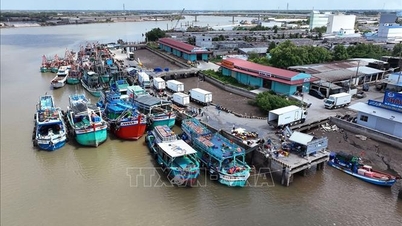
The sea area of Ca Mau - Photo: THANH HUYEN
Large-scale land reclamation proposals are opening up new prospects for the Mekong Delta. However, for a delta already suffering from erosion, subsidence, saltwater intrusion, and water resource depletion, a solution is needed to address the challenge of expanding its land while ensuring a balance between development and environmental sustainability.
Is there a limit to the development space?
The Mekong Delta is facing a structural turning point in its development. Its historical development is based on its advantageous land and water resources, utilizing the natural conditions of alluvial deposits, fertile soil, and a people adapted to a river-sea economy . However, these advantages are gradually diminishing due to the impacts of climate change, rising sea levels, and the depletion of water resources.
The amount of sediment from the upper Mekong River, once reaching approximately 160 million tons per year, has now declined sharply. There are reliable forecasts that the region could lose up to 90% of its sediment by 2040 compared to previous years. Gone are the days of "Cape Ca Mau, a land of fresh, tender sprouts / For hundreds of generations, it has expanded into the sea / Silt from thousands of miles flows here" (Cape Ca Mau, a poem by Xuan Dieu).
The delta today is no longer "expanding" but is shrinking. Some studies indicate that, between 2011 and 2021, Ca Mau province alone lost approximately 5,250 hectares, a figure equivalent to the average area of a commune in that locality.
For the first time, the Politburo issued Conclusion No. 26 dated April 24, 2026, on preventing and combating subsidence, landslides, flooding, drought, and saltwater intrusion in the Mekong Delta region for the period 2026-2035.
Meanwhile, land demand is increasing rapidly. The pressure to expand urban areas, industries, infrastructure, and services is growing, while domestic land resources are becoming increasingly limited. Horizontal development space seems to have reached its limit, forcing localities to seek new directions.
In this context, the sea has become a new "development frontier." The idea of reclaiming land from the sea to create land for urban development, coastal economic zones, and large-scale tourist areas quickly attracted attention. Several corporations have proposed land reclamation projects spanning tens of thousands of hectares, expanding the area to many nautical miles, and integrating multiple functions from urban development and logistics to energy.
From an economic perspective, these are groundbreaking ideas that could open up new development opportunities for the region. However, the question is not just "is it possible?", but "how?".
Will the natural foundation of the Mekong Delta – a delta already struggling to withstand numerous negative impacts – be strong enough to support such large-scale interventions?
Materials and Environment Problem
One of the core issues that needs to be adequately addressed in land reclamation proposals is the supply of fill materials. To illustrate the scale, a land reclamation project of approximately 10,000 hectares, with an average elevation of 2-3 meters, could require 200-300 million cubic meters of material. For proposals covering tens of thousands of hectares, the total demand could reach billions of cubic meters. This figure far exceeds the existing supply capacity of the region.
Meanwhile, river sand resources – the main material for land reclamation and construction in the Mekong Delta – are severely depleted. The shift to exploiting sea sand also poses many risks, as reserves have not been fully surveyed and environmental impacts have not been comprehensively assessed.
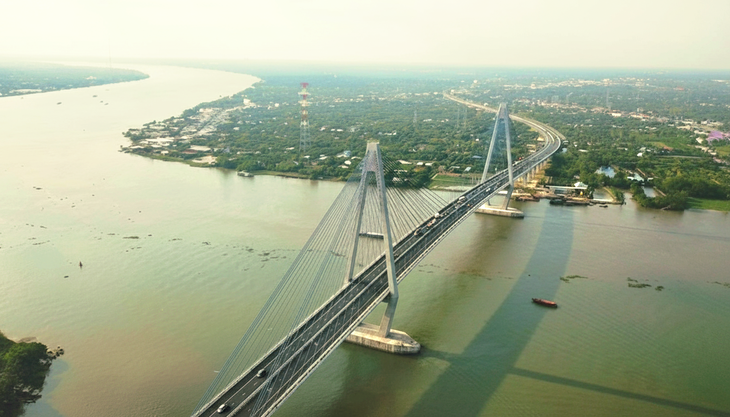
The Tien River section flowing through Vinh Long province - Photo: CHI QUOC
If we use sea sand for land reclamation in a way that's like "using peanuts to cook peanuts," the problem isn't just about technology, but also about the trade-off between resources and ecosystems.
Given the Mekong Delta's current sediment shortage, the simultaneous implementation of multiple large-scale land reclamation projects could create uncontrollable disruptions. As water flow and materials are redistributed, the natural river-sea relationship changes, and erosion may increase.
The reality is that the number of landslide-prone areas in the Mekong Delta has increased rapidly in recent years, reflecting an ecosystem that is becoming unbalanced.
Undeniably, land reclamation, if done correctly, can create value. The Rach Gia urban land reclamation project is an example, where a moderately sized project, implemented in phases, contributed to expanding urban space and increasing land value. However, this is a conditional success and cannot be applied mechanically to projects many times larger.
International experience also shows that successful land reclamation models are based on a very high level of science, technology, and management.
The Netherlands, Singapore, and South Korea not only possess strong financial capabilities but also have long-established water and sediment control systems. They not only reclaim land from the sea but also manage the consequences of this land reclamation.
The Mekong Delta is a subsiding delta, with a rate of 1-3 cm per year in many areas. This means that the long-term cost of maintaining and reinforcing infrastructure will be enormous. Some proposals even show significantly lower investment costs per hectare compared to international practices, raising questions about financial feasibility.
The boundary between opportunity and risk therefore lies not in the scale of the project, but in the degree of compatibility between scale, natural conditions, and management capacity. When scale exceeds controllable capacity, risk is no longer localized but can become systemic risk.
Controlled development
In light of the recent wave of proposed mega-projects for land reclamation in Can Tho, Vinh Long, and Ca Mau, the necessary approach is not a choice between "giving the green light" or "closing the doors," but rather a cautious, controlled approach based on science and practice, ensuring the "no regrets principle."
First and foremost, a clear principle must be established: ecological stability must not be sacrificed for short-term growth.
The Mekong Delta is not only a space for economic development, but also the livelihood of tens of millions of people. It ensures national food security with over 100 million people consuming rice and supplying approximately 18-20% of the global rice market.
Therefore, a strategic environmental assessment at the regional level needs to be implemented for the entire coastal strip of the Mekong Delta, linked to the national marine spatial planning. This will serve as the basis for determining intervention limits, instead of relying solely on assessments submitted by individual investors for each project.
Simultaneously, it is necessary to establish a regional-level management mechanism for landfill materials, including surveying reserves, planning exploitation, and controlling licensing. This aims to prevent scattered and uncontrolled exploitation that could lead to widespread negative impacts.
Pilot land reclamation projects of medium scale could be considered in the most favorable areas, with strict monitoring mechanisms and transparent information. The aim of these pilot projects is not to "do it quickly," but to accumulate experience and minimize risks.
All decisions must be made within the framework of "harmonious with nature" development, in line with Conclusion No. 26 dated April 24, 2026, of the Politburo on preventing and combating land subsidence, landslides, flooding, drought, and saltwater intrusion.
"Following nature's natural order" does not mean not intervening at all, but rather intervening within the limits that nature allows, respecting the laws governing the delta's movement, and making the most of scientific and technological achievements.
Land reclamation from the sea can be a way for the delta to develop towards the sea. However, if left unchecked, it can also become a risky test for the very foundation of the Mekong Delta's existence.
In a changing landscape, every decision to expand space needs to be considered a long-term decision, not just for today but for the future of the delta.
Source: https://tuoitre.vn/lan-bien-phep-thu-voi-thuan-thien-20260522113854976.htm




























































































Comment (0)