

Recognition is not simply about certifying, honoring, or being proud of a craft, but also about establishing its legal identity, providing a basis for preserving and developing the craft, and supporting production in craft villages.

Honored and proud to be a professional.
The village of Ngũ Xã, located in Trúc Bạch ward, Ba Đình district, is renowned as a gathering place for the finest bronze casting artisans of Thăng Long (Hanoi). The Ngũ Xã bronze casting craft has contributed magnificent masterpieces to Vietnam's heritage, many of which honor the nation's traditional culture. Some notable works include: the statue of Trấn Vũ located at Quán Thánh Temple, one of the Four Guardian Temples of Thăng Long - Hanoi ; and the 14-ton statue of Amitabha Buddha at Ngũ Xã Pagoda, recognized by the State as a Vietnamese Cultural and Artistic Work...
Continuing the tradition, artisan Bui Thi Minh and her children and grandchildren still preserve and develop the bronze casting craft. Currently, four members of her family have been awarded the title of "Hanoi Artisan" by the Hanoi People's Committee. In 2024, the city also recognized the Ngu Xa village as a "traditional craft".
"This is both a great honor and a huge responsibility, motivating us to continue our efforts to preserve, conserve, promote, and develop the traditional craft of the village in the face of countless difficulties and the risk of its disappearance," said Ms. Bui Thi Minh.
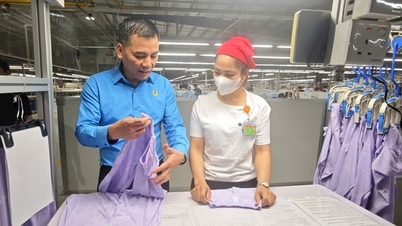
As a locality recently recognized as a "traditional craft village," Nguyen Thi Phuong, head of Gie Thuong village ( Phu Yen commune, Phu Xuyen district), proudly stated that the village has a leather shoe manufacturing industry attracting 350 households with approximately 1,000 workers. In recent years, the craft village has developed strongly, bringing significant income to many families and contributing to Phu Yen commune's completion of the model new rural development program.
Rural industries and traditional craft villages have a long history of formation and play an important role, contributing to socio -economic development and the preservation of cultural values in the region.
According to Nguyen Dinh Hoa, Deputy Director of the Hanoi Department of Agriculture and Environment, in 2024, the city had three rounds of recognition for 14 craft villages. Among them, the Van An carpentry village (Son Dong commune, Son Tay town), the Hat Mon carpentry village (Hat Mon commune, Phuc Tho district), and the Chung Chan tailoring village (Van Tu commune, Phuc Xuyen district) were recognized as "Hanoi craft villages". The embroidery village of Co Chat hamlet (Dung Tien commune, Thuong Tin district); the leather shoe making villages of Gie Ha and Gie Thuong hamlets (Phu Yen commune, Phu Xuyen district); and the lotus tea making village of Quang Ba (Quang An ward, Tay Ho district) were recognized as "traditional craft villages". Other crafts recognized included: Hang Than street rice flake making and Ngu Xa bronze casting (both in Truc Bach ward, Ba Dinh district); Ba Duong Noi village kite making (Hong Ha commune, Dan Phuong district); jewelry making and silver inlaying in Dinh Cong village (Dinh Cong ward, Hoang Mai district); and Vong village rice flake making (Dich Vong Hau ward, Cau Giay district). The practice of infusing tea with lotus flowers in Quang An (Quang An ward, Tay Ho district) has been recognized as a "Traditional Craft" of Hanoi.
Thus, by the beginning of 2025, the city will have more than 1,350 craft villages, of which 337 have been officially recognized by the Hanoi People's Committee. This is a great recognition and encouragement for craft villages in Hanoi. It is also the first step towards establishing legal status, providing a basis for preserving, developing, and supporting production in these craft villages.
Supporting traditional craft villages
To encourage the development of traditional crafts and rural industries, over the years, Hanoi city has issued programs, plans, and policies such as: encouraging and promoting the export of craft products; supporting the preservation and development of crafts and craft villages; developing craft villages in combination with tourism; preserving and promoting the value of cultural heritage in traditional craft villages; encouraging the development of concentrated specialized agricultural production areas; encouraging the development of craft villages in Hanoi city…
For the period 2025-2030, Hanoi aims to restore and preserve at least 5 traditional crafts and craft villages at risk of disappearing; strive to recognize at least 10 new crafts and 25 craft villages and traditional craft villages, and develop 10 villages from "craft villages" to "traditional craft villages"... To turn this goal into reality, the city will continue to implement comprehensive policies to support craft villages, especially effectively implementing the "Overall Plan for the Development of Craft Villages in Hanoi City for the period 2025-2030, with a vision to 2050".
Besides support from the city, according to Nguyen Dinh Hoa, Deputy Director of the Hanoi Department of Agriculture and Environment, for recognized craft villages, localities need to continue maintaining, honoring, and linking them with the development of products under the One Commune One Product (OCOP) program to form craft village tourism destinations and experiential tourism destinations. For craft villages, it is necessary to continue developing production and business effectively in the direction of sustainable product development along the value chain, investing in upgrading and expanding scale, improving designs and quality; applying technology, and promoting more effective development.
Source: https://hanoimoi.vn/lang-nghe-ha-noi-cong-nhan-de-bao-ton-va-phat-trien-ben-vung-699380.html



















































































Comment (0)