

In the Mnong language of Dam Rong district, Lam Dong province, the wedding ceremony is called "Leh tam bau". Along with that, a basic system of rituals has also formed, such as the Kep moi ceremony (engagement ceremony), the Vang ur ceremony (proposal ceremony); the Nja gre, pap plo ceremony (returning to the bride's family)... Today, although somewhat influenced by modern life, the Mnong people in the southern Central Highlands still retain the distinctive traditional culture of their ethnic group.
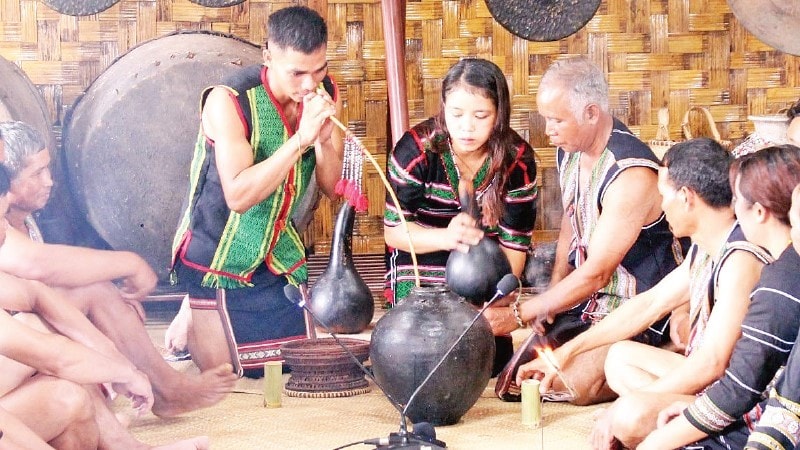 Recreating the wedding ceremony of the Mnong people in Dam Rong district, Lam Dong province.
According to Elder K'Tư of Dam Rong District, Lam Dong Province, the Mnong people have a custom of holding the engagement ceremony immediately followed by the wedding ceremony. After the engagement ceremony, with the gifts and wedding date set, the wedding is also held early. Depending on the Mnong ethnic group, the wedding ceremony has different names, but basically, the rituals are similar. Lèh tàm bau is usually held at the bride's house. On the wedding day, the groom's family brings the predetermined gifts to the bride's house, including a pig, three jars of wine, a rooster, a set of gongs, a spear, candles, etc. Leading the procession is the matchmaker, followed by the parents, then the groom, relatives, and the gong ensemble. The groom's family is welcomed by the bride's family with the resounding sound of gongs and traditional dances. The bride's family receives the gifts from the groom's family and appoints a representative to inspect them. If all the gifts are present as agreed upon, they tap the pig's head with a machete to confirm.
Afterward, the bride's family slaughters the pig, keeping half (the part with the head of the sacrificial animal) and returning the other half to the groom's family. The bride's family sends someone to pour wine and prepare meat and rice to entertain the groom's family. Each member of the groom's family receives a beaded necklace as a gift from the bride's family.
The jar of rice wine brought by the groom's family is placed in the center of the house. The master of ceremonies holds the young couple's hands, praying to the spirits to witness and bless the couple's lifelong love. The master of ceremonies will taste the rice wine, then pass the wine cup to a representative of the groom's family to drink, followed by the young couple, and then the bride's father. The cup is then passed to a member of the groom's family, then another member of the bride's family, and so on until all members of both families have drunk. After everyone has drunk the wine, the master of ceremonies and the matchmaker lead the groom into the parents' bedroom and the granary, signifying that from now on, the groom is officially a member of the bride's family. Next, the matchmaker invites the bride and groom to exchange beads in front of everyone. Afterwards, the matchmaker and the village elder cover the couple's heads with a large blanket and bless the couple. The young couple feed each other rice, symbolizing their close bond. After this ceremony, the bride and groom offer meat and wine to their parents and relatives from both sides to express their respect and gratitude.
In the main house, the groom's mother gives the bride a ring, the bride's father gives the groom a ring, then they chat and introduce the bride and groom to members of their respective families; both sides exchange gifts, including skirts, loincloths, copper bracelets, beaded bracelets, etc. Next, both families and relatives eat, drink, play gongs, sing, and dance to celebrate the young couple.
After the wedding, the groom stays at his wife's house for four or eight days, then returns to his parents' house with the bride's family to "pay respects" to the groom's family and introduce the bride to his parents and relatives before returning to live permanently with his wife's family (as the Mnong people follow a matriarchal system). This ceremony, called Njă gre, păp plơ, has a similar meaning to the "pay respects" ceremony of the Kinh people. On the way to the groom's house, young men from the bride's village ambush and throw mud at the groom's procession, signifying their desire to keep the girl in their village.
Wedding ceremonies not only reflect the family's moral values, but also represent customs, traditions, and culture that need to be preserved and maintained by the Mnong community in the southern Central Highlands.
Source: https://baodaknong.vn/le-cuoi-cua-nguoi-mnong-248087.html

![[Photo] General Secretary and President To Lam receives Amazon's Senior Vice President David Zapolsky](https://vphoto.vietnam.vn/thumb/1200x675/vietnam/resource/IMAGE/2026/05/22/1779466547770_a1-bnd-3513-6601-jpg.webp)






















































Comment (0)