

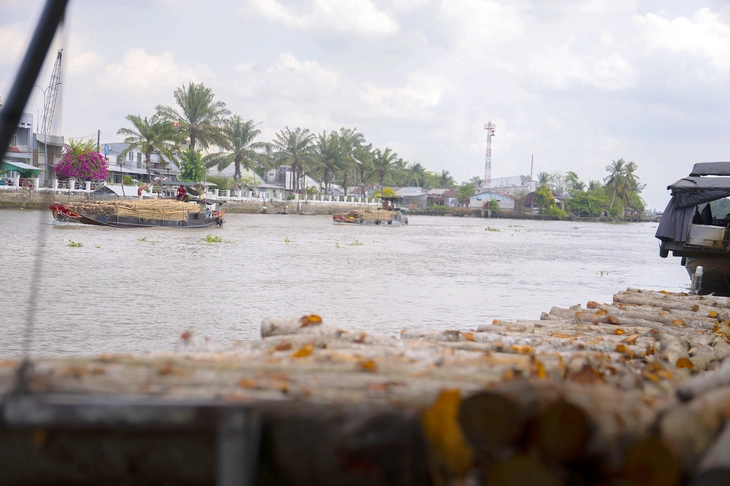
Firewood barges arrive at Nga Bay floating market - Photo: AN VI
Looking down from the Phung Hiep bridge onto the Cai Con river, you can see a long line of boats carrying all kinds of wood such as mangrove, nipa palm, and longan... Some boats have just docked, waiting for buyers, while others with 3-4 workers have been moored ashore for a week because they haven't been able to sell their wood at a good price.
Floating firewood market on the river
Unlike the bustling scene of buyers and sellers seen in typical floating markets, the floating firewood market is unique because the boats, being heavy, are anchored close to the shore, lying still and waiting for the charcoal wholesalers to come and inquire about purchasing their goods, rather than going out to hawk their wares. It's also different from those who work in the fishing industry, often loading up with fishing gear or bringing their entire families onto their boats. The firewood boats here, however, only have one or two people perched on them, mostly men.
We approached the boat with the most firewood, piled high on both sides, with more than half of the boat submerged in the water. Inside were two men sitting silently. Seeing strangers, they chattered excitedly: "Looking for firewood, sir? We've been moored here for too long and no one's taken it. If the price is right, we'll bring it back and load it up." We learned they had left their boat at Nga Bay for several days, and a few people had inquired about selling, but the offers were too low, so they hadn't sold yet.
Mr. Nguyen Cong Duong (37 years old) lamented: "It took almost a whole day to get here. We left at 4 or 5 in the morning and arrived here early in the evening to find a place to dock. But surprisingly, 40 tons of firewood are still untouched. Wholesale sales are so slow!" He explained that the reason for the lack of boats this season is that firewood prices in the lowlands have decreased, and people are planting fewer trees for timber than before. The firewood they sell is mainly bought from fruit orchards.
Pointing to the distance where a boat carrying mangrove trees was approaching, Duong said that buying mangrove trees like those people did was the most profitable. The price down there was cheap, so he could sell them to charcoal kilns or let people buy them for cooking.
As for the pile of firewood he's been contracting from several orchards, only two kiln owners have inquired about the price so far. He calculates he'll lose money, so he hasn't sold it yet. "That's what I say, but I can't stay here forever. The longer I stay, the more I lose. Not to mention I have lumberjacks back home; if I don't go back, they won't do the cutting. I'm telling myself, if I can get a little more profit, I'll quit," said Duong.
calculate.

The charcoal kiln owner buys firewood and brings it ashore from Mr. Duong's boat - Photo: AN VI
I only see my wife for about 3 days a month.
Currently, traders are offering to buy firewood at around 2.3 - 2.4 million VND per cubic meter. At this price, plus the fact that the boat has been sitting idle for so long, Mr. Duong is certain to lose money. "Because we've been moored here for so long, the weather has affected the quality of the firewood. When traders come and tap it to see if it's waterlogged, they'll offer very little. So even though I regret it, I'm trying to sell it to get back," Mr. Duong shared.
Sharing the same sentiment as Mr. Duong, Mr. Truong Van Sang (45 years old), who was unloading firewood into the charcoal kiln, also sighed in frustration because the kiln owner was buying it at a low price. He calculated roughly that after paying his younger brother for his work and the landowner, he would lose nearly ten million dong this trip. "I can't stay here forever. I just finalized the purchase of a mangrove garden in Nam Can. Now I have to go back and hire workers to cut it down quickly and transport it back here to make up for this loss," he confided.
Mr. Sang said that his entire family of four depends on this boat for their livelihood: "Ten years ago, I sold my rice fields and invested 400 million VND into the firewood business. At first, there were plenty of trees, especially in Ca Mau and Dong Thap. Now they are very rare; if you buy fruit trees from people's orchards and have them cut down, you don't make much profit."
Most boat owners who transport firewood make their living through their labor; they rarely hire outside help, managing everything themselves on the unpredictable waterways. If they manage to buy wood consistently, people like Mr. Sang and Mr. Duong might only see their families once or twice a month.
"After unloading and selling the firewood, I immediately run down to that garden, saw for several days, then load it onto the boat and speed off again. I'm constantly on the go, I don't get to go home. If I stop for a few days, another boat will come by and ask to buy," Mr. Sang recounted. He said that sometimes his wife would call to say their child was sick and needed to go to the hospital, and he was helpless because he was anchored at the time waiting for buyers for firewood. He could only grit his teeth and send the capital back to his wife to take care of their child.
This job isn't easy.
Mr. Sang himself was constantly worried during the days of heavy rain and wind, because the heavily loaded boat could easily sink. At this point, he shared a trick to prevent the firewood from falling into the river while still ensuring it was evenly loaded: "Before loading the firewood, the bottom of the boat must be cleaned and lined with wooden beams to prevent moisture. The largest logs are prioritized as the base; the higher up the boat, the more logs are arranged vertically and horizontally, alternating or overlapping to create a secure bond."
On his boat, Duong uses large pieces of wood to tightly bind the edges, then skillfully inserts smaller pieces of wood into each gap to ensure proper compression and avoid wasting any space.
Despite the skill, in this profession, everyone has at some point dropped firewood or failed to load the boat properly. For Duong, the scariest time is during the flood season, when the current is so strong that he has to stay up all night steering.
Then there's the matter of laundry and hygiene; they're used to bathing in the river, washing their clothes every few days, and fishing on days when they run out of money for food. Some people look at the long rows of firewood boats anchored on the river and think it's a lucrative profession. Only those involved understand that profit and loss sometimes depend on a single rain shower or a few days the boats sit waiting at the dock.
For example, this trip of Mr. Duong's boat being docked for four extra days means that each day costs money for food, fuel, and labor. Not to mention the firewood soaked in dew, which is clearly being sold at a lower price. One trader, after stepping onto the boat and poking a metal rod into the pile of firewood, heard a "thump, thump" sound because it was damp and shook his head and left.
"In this profession, you can't afford to get sick. If you get sick, the boat is out of service. The owner of the orchard calls you down to cut the trees, but you can't go, and the buyers here have to wait for another boat. Sometimes, missing a deal means losing tens of millions of dong," Duong shook his head.
People on the boats sometimes can't even remember what day it is, only which tides are easiest to navigate, which sections have lots of water hyacinths, and which traders are honest buyers.
The charcoal kiln awaits the firewood barge.

Mr. Chau said that charcoal sales were slow, so the firewood boats were also left unsold - Photo: AN VI
Not far from the floating firewood dock is the charcoal kiln of Mr. Nguyen Nam Chau (34 years old), one of the regular buyers of many firewood boats in Nga Bay. He is also the one who buys all the firewood from Mr. Duong.
Amidst the sweltering heat from the glowing charcoal kiln, Mr. Chau and his workers continuously carried firewood, piling it into the kiln and covering it tightly with earth to let it smolder for days. He recounted that the charcoal-making business is now struggling just as much as the firewood boat trade. The price of charcoal fluctuates erratically, while the price of raw firewood is constantly rising. At times, boats full of firewood sit at the docks, but the charcoal kilns don't dare buy it because burning it and selling it wouldn't be profitable.
"Making charcoal is incredibly hard work these days. Good quality firewood is expensive, and sometimes the cheap wood doesn't produce the right amount of charcoal. It's tough dealing with the boats from Ca Mau coming all the way here; sometimes I ask about the price and realize I'm buying at a loss, so I don't dare take it," Mr. Chau said honestly.
According to him, the most preferred types of firewood for charcoal kilns are still mangrove and melaleuca because they burn for a long time and produce beautiful charcoal. However, these trees are becoming increasingly scarce, so fishermen have to travel further, costing more in fuel and transportation.
Source: https://tuoitre.vn/lenh-denh-cho-cui-nga-bay-20260528233506482.htm



![[Image] Hanoi Police officially crowned champions of V-League 2025/2026](https://vphoto.vietnam.vn/thumb/1200x675/vietnam/resource/IMAGE/2026/05/31/1780244769054_ndo_br_039d561b692be875b13a-jpg.webp)




![Water security in the Mekong Delta: [Part 3] Turning rivers into 'super reservoirs'](https://vphoto.vietnam.vn/thumb/402x226/vietnam/resource/IMAGE/2026/06/01/1780271198729_0712-t10nr-150406_121.jpeg)

















![[Photo] The General Secretary, President and his wife begin their state visit to the Philippines.](https://vphoto.vietnam.vn/thumb/1200x675/vietnam/resource/IMAGE/2026/05/31/1780230559452_anh-man-hinh-2026-05-31-luc-19-28-11.png)






































































Comment (0)